How to Write a Spice Quality Specification
The parameters a buyer must fix — species, grade, moisture, cleanliness, contaminants — so a container can be judged objectively.
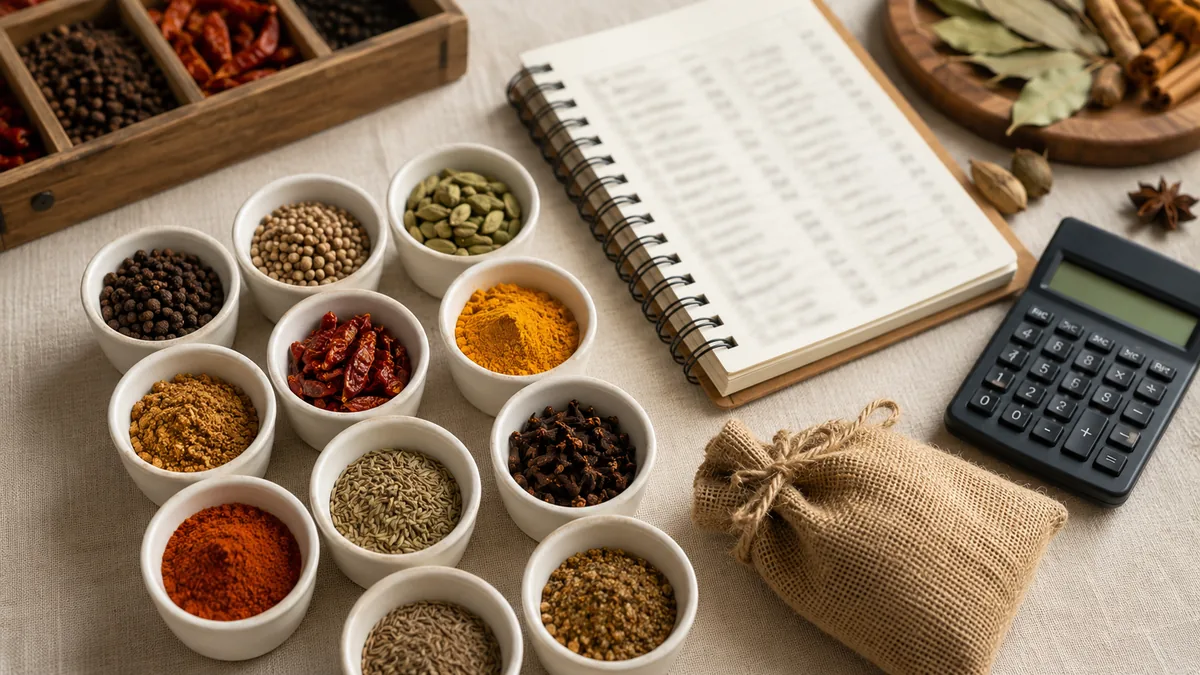
Start with species and form
A specification begins with unambiguous identity. Name the botanical species, not just the common name — this matters most for cinnamon, where cassia (Cinnamomum cassia) is high-coumarin and true Ceylon cinnamon (C. zeylanicum) is very low, and India schedules them as separate spices. Then fix the form: whole, cracked, cut or ground, and for ground add mesh size.
Fix the grade parameters
Grade is spice-specific and must be numeric. Turmeric: curcumin band by origin (Alleppey-type 4–6%, Erode 2.5–3%, Nizamabad 1.5–2.25%). Chilli: SHU and ASTA colour (Sannam S4 35,000–45,000 SHU / ASTA 100–120; Byadgi ASTA 130–150). Cumin: purity (Singapore 99%, Europe 99.5%). Pepper: bulk density (MG1 ~500–550 g/l, TGEB 550+ g/l). Cardamom: capsule size (6–8mm, AGEB).
| Spice | Primary grade parameter | Example |
|---|---|---|
| Turmeric | Curcumin % | Alleppey-type 4–6% |
| Chilli | SHU + ASTA colour | Sannam S4 35–45k SHU / ASTA 100–120 |
| Cumin | Purity % | Europe quality 99.5% |
| Black pepper | Bulk density g/l | TGEB 550+ |
| Green cardamom | Capsule size | 8mm / AGEB |
Set physical and cleanliness limits
Add a moisture ceiling (export turmeric finger typically ≤12%), extraneous-matter and foreign-matter limits, and any colour or appearance criteria. Moisture protects against mould and aflatoxin; cleanliness limits protect against padding a lot with stalk, dust or stones.
Write in the contaminant and micro limits
Close the spec with the destination’s safety limits so they are contractual, not assumed: aflatoxin B1 5 µg/kg and total aflatoxins 10 µg/kg, ochratoxin A 15 µg/kg (20 for dried chillies), Salmonella absent in 25 g, ethylene oxide 0.1 mg/kg default (banned in the EU — require steam sterilisation), and any spice-specific adulterant screen.
How YouPals helps
YouPals helps you draft a specification suppliers can actually be held to, then enforces it. We turn your market’s legal limits and your product needs into a numeric spec, approve it on a sample, and run pre-shipment QC against it. We do not process spice, so the spec is written for your protection, not to suit an owned line.
Frequently asked
Why name the botanical species in a spice spec?
Because common names hide legal differences — cassia is high in coumarin while true Ceylon cinnamon is very low, and India treats them as separate spices, so “cinnamon” alone is not enough.
Should contaminant limits go in the specification?
Yes. Writing aflatoxin, Salmonella and ETO limits into the spec makes them contractual rather than assumed, so a failing lot is a breach you can act on.
Sourcing this? Tell us the spice, grade and destination and we return a documented offer — vetted supply, QC oversight, and the test dossier your market needs.
Start a sourcing enquiry →What this page does not tell you
- Full ISO/ASTA method references
- Specific test-method standards sit outside our cited source list; we align to the accredited lab’s validated methods.
Reviewed 16 July 2026.
Sources
- Spices Board of India — Export statistics· Tier 1, retrieved 2026-07-16
- Reg. (EU) 2023/915 — maximum levels for certain contaminants· Tier 1, retrieved 2026-07-16
- Spices Board Act, 1986 — Schedule of spices· Tier 1, retrieved 2026-07-16