Coriander export from India
Coriandrum sativum · Apiaceae · Fruit, leaf
Traded on colour and splitting behaviour — bright green "eagle" seed for whole sale, single/double parrot grades for milling.
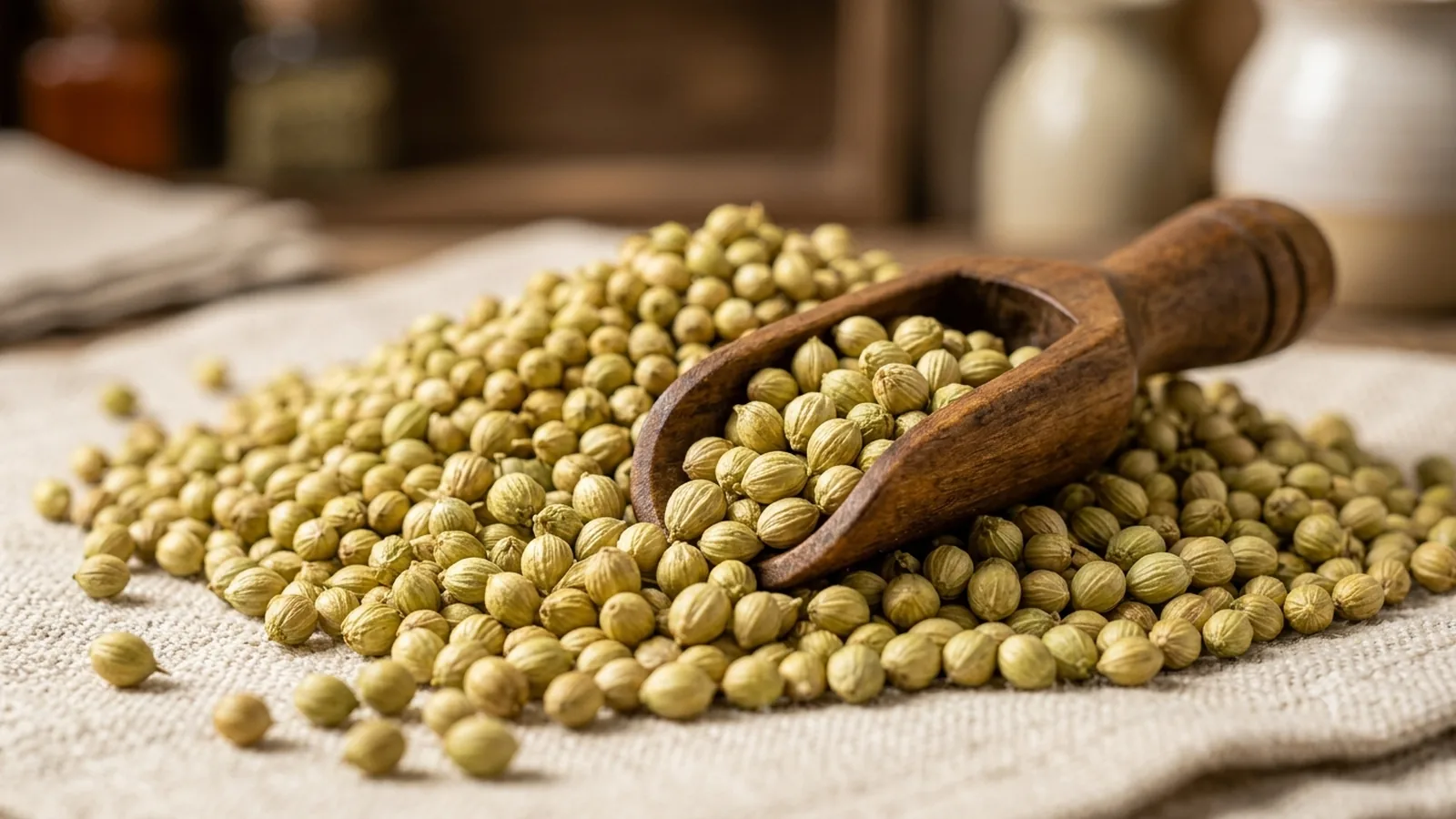
Coriander at a glance
- Botanical name
- Coriandrum sativum
- Family
- Apiaceae
- Part used
- Fruit, leaf
- Also known as
- Dhania, Coriander seed, Kothamalli
- Forms exported
- Whole, Ground, Seed
- ITC-HS
- 0909 21 00, 0909 22 00
- Spices Board schedule
- #6
- Export basket share
- 2% (FY2025-26)
What is Coriander and how is it exported from India?
Coriander is the dried fruit (seed) of Coriandrum sativum, graded by colour and size (Eagle, Scooter, Parrot / single- and double-parrot). India is a major producer centred on the Unjha and Kota markets.
Overview
Coriander is the dried ripe fruit (seed) of Coriandrum sativum, a member of the Apiaceae grown across the drier belts of central and western India. Unlike the pungent seed spices, coriander is prized for a mild, sweet, citrusy aroma and for its behaviour in milling, and the trade grades it heavily on colour and on how cleanly it splits. Bright green, well-filled seed is the premium for whole sale, while the splitting-friendly grades feed the powder and curry-blend industry.
The market vocabulary is distinctive: “Eagle” denotes bright green, bold whole seed sold for its appearance; “Scooter” and “Parrot” (including single-parrot and double-parrot) describe green grades of varying colour intensity; and split-friendly badami and mill grades are bought for grinding. India runs two broad seed types, a bolder round seed and a longer, thinner badami type, and buyers choose between them on colour, volatile-oil aroma and grinding yield. Beyond seed, coriander leaf (cilantro) and coriander essential oil and oleoresin are separate value streams.
Coriander is a couple of per cent of India’s spice export basket by value, but it is a genuine bulk staple of the curry-powder and seasoning trades, centred on the great seed-spice markets of Unjha (Gujarat) and Kota and Ramganj (Rajasthan). Its compliance profile is led by pesticide residues, given intensive field cultivation, so buyers for regulated markets, including the EU, expect a clean residue panel on export lots.
Forms & export grades
Colour-graded whole seed (Eagle/Parrot/Scooter) for retail and pickling.
Bulk seed for milling and the curry-powder trade.
Coriander powder milled to a specified mesh for blend manufacturing.
Extracted oleoresin and essential oil for flavour applications.
Varieties & types
- Eagle
- Bright green, bold whole seed sold at a premium for colour and appearance.
- Single / Double Parrot
- Green grades of increasing colour intensity, valued for whole-seed sale.
- Scooter
- A green, splitting-friendly grade used across whole and milling channels.
- Badami (long/thin type)
- The longer, thinner Indian seed type favoured for grinding yield and aroma.
- Eagle Green / mill grades
- Colour-sorted and mill-oriented lots supplied to the powder and curry-blend trade.
Growing regions
Rajasthan (Kota, Ramganj, Baran), Madhya Pradesh (Guna, Neemuch) and Gujarat are the principal producing states, with Unjha in Gujarat the dominant trading market. It is a rabi (winter) crop, sown after the monsoon and harvested in spring, with colour retention through drying being the key to premium green grades. Green, bold seed from cooler-finishing regions commands the best prices.
Uses & applications
- Whole seed for retail spice packs, tempering and pickling
- Ground coriander as a base volume ingredient in curry powders and masala blends
- Roasted-and-ground coriander for seasoning and snack manufacturing
- Coriander as a bulking and aromatic base in commercial spice-blend formulation
- Coriander essential oil and oleoresin for flavour houses, beverages and liqueurs
- Bakery, sausage and processed-meat seasoning
- Coriander (cilantro) leaf, fresh and dried, for the herb and diaspora trade
- Nutraceutical and traditional-medicine digestive preparations
- Beverage and gin-botanical flavouring
Sourcing & export considerations
- Available as whole seed (colour grades Eagle/Parrot/Scooter), split, ground powder, and as oil/oleoresin
- Specify colour grade, seed type (bold round vs long badami), splitting behaviour, moisture and volatile-oil aroma
- Machine-cleaned and sortex colour-sorted; green colour is a fugitive premium that fades with age and heat
- Compliance flags: pesticide residues are the lead issue for this intensively grown field crop; EU-bound lots need a clean residue panel
- Buyers favour current-crop material for green colour and aroma; older seed dulls and loses volatile oil
- Specify whether whole, split or ground, plus mesh for powder, on the contract
- Dense seed spice ships efficiently; a 20ft container carries a substantial payload
- Sample 50–100 kg and blend-scale MOQs follow standard trade practice
ITC-HS classification
- 0909 21 00 — Coriander seeds, neither crushed nor ground
- 0909 22 00 — Coriander seeds, crushed or ground
Compliance that applies
Frequently asked
What do the coriander grade names like Eagle and Parrot mean?
They are colour-and-appearance grades. Eagle is bright green, bold whole seed at a premium; single and double Parrot denote green grades of rising colour intensity; Scooter is a splitting-friendly green grade. Greener, bolder seed sells higher.
Which coriander is better for grinding into curry powder?
The longer, thinner badami-type and dedicated mill grades split and grind more efficiently and are chosen for powder and curry-blend volume, while bold green Eagle-type seed is reserved for whole-seed retail where colour matters.
Why does coriander colour matter so much?
Bright green seed signals fresh, well-dried, current-crop material and commands a premium in whole-seed markets. Colour fades with age, heat and poor storage, so green grades must be current crop and protected from light and moisture.
Related spices
Sources
- Spices Board of India — Export statistics· Tier 1, retrieved 2026-07-16
- Spices Board Act, 1986 — Schedule of spices· Tier 1, retrieved 2026-07-16
- Reg. (EU) 2019/1793 — temporary increase of official controls· Tier 1, retrieved 2026-07-16
- Reg. (EU) 2023/915 — maximum levels for certain contaminants· Tier 1, retrieved 2026-07-16