Cumin export from India
Cuminum cyminum · Apiaceae · Fruit
India produces the bulk of the world’s cumin and prices it every morning at Unjha — but the EU now checks Indian cumin at 30% for pesticides.
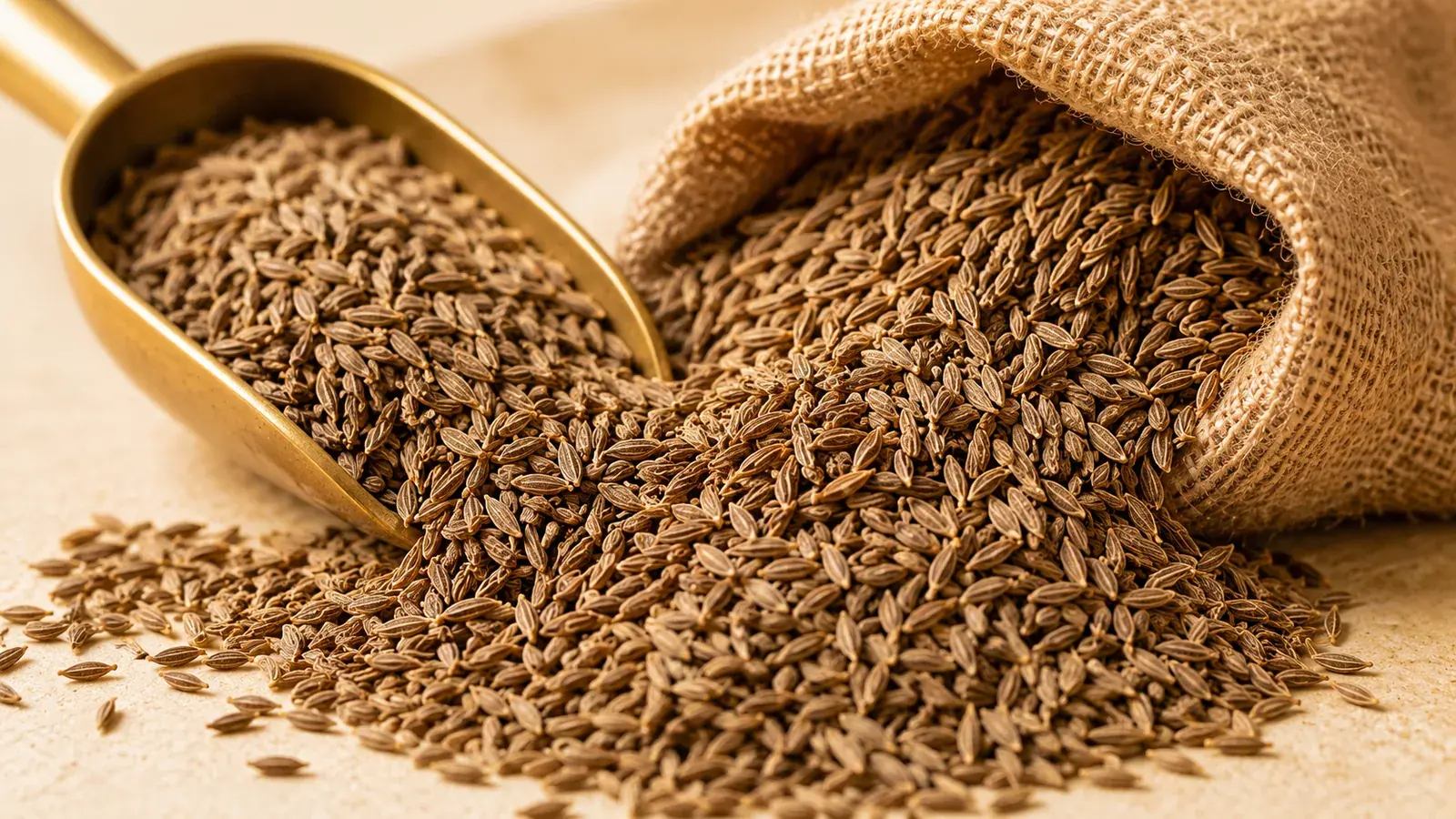
| Property | Value | Unit | Method | Source |
|---|---|---|---|---|
| Cumin Europe Quality 99.5% — purity | 99.5 | % | — | Spices Board of India — Export statistics |
| Cumin Singapore Quality 99% — purity | 99 | % | — | Spices Board of India — Export statistics |
Cumin at a glance
- Botanical name
- Cuminum cyminum
- Family
- Apiaceae
- Part used
- Fruit
- Also known as
- Jeera, Zeera, Cumin seed
- Forms exported
- Whole, Ground, Seed
- ITC-HS
- 0909 31 00, 0909 32 00
- Spices Board schedule
- #7
- Export basket share
- 12% (FY2025-26)
What is Cumin and how is it exported from India?
Cumin is the dried fruit of Cuminum cyminum, graded by purity (Singapore 99%, Europe 99.5%, machine-cleaned/sortex). Gujarat and Rajasthan dominate world supply; the Unjha market sets the reference price.
Overview
Cumin is the dried fruit of Cuminum cyminum, a small Apiaceae seed that India dominates in world supply more completely than almost any other spice. The commercial character is its warm, earthy, slightly bitter aroma from a high volatile-oil content, and the trade grades it not on colour but on purity: how free the lot is of foreign matter, stalk, dust and other seeds. The reference grades are “Singapore quality” at 99 per cent purity and “Europe quality” at 99.5 per cent, both machine-cleaned and sortex-sorted.
The pricing centre of gravity is Unjha in Gujarat, Asia’s largest seed-spice market, which handles the bulk of India’s cumin and effectively sets the global morning reference price. Gujarat and Rajasthan together grow the overwhelming majority of the crop. Buyers specify purity percentage, cleaning method (single or double sortex), moisture and volatile-oil level, and can source whole seed, ground cumin, and roasted cumin for value-added streams; cumin oil and oleoresin serve flavour houses.
Cumin is about 12 per cent of India’s spice export basket by value, the seed spice India most dominates, which makes its compliance exposure commercially significant. Under Reg. (EU) 2019/1793 Indian cumin is listed for increased official controls at a 30 per cent check rate for pesticide residues, raised in January 2025, and pyrrolizidine alkaloids (an EU limit of 400 µg/kg, arising from co-harvested weeds) are a rising focus. For the EU, a recent accredited residue and PA panel is effectively required on every consignment.
The read
Cumin is ~12% of the basket and the seed-spice India most dominates — the Unjha mandi in Gujarat sets the global morning price. The commercial grades are purity-defined: "Singapore quality" 99%, "Europe quality" 99.5%, machine-cleaned and sortex-sorted. The live compliance issue: under Reg. (EU) 2019/1793 Indian cumin is at a 30% pesticide check rate (raised January 2025), and pyrrolizidine alkaloids (a 400 µg/kg EU limit from co-harvested weeds) are an increasing focus. Lots for the EU need a clean, recent residue panel.
Forms & export grades
Cleaned, purity-graded seed for tempering, retail and processing.
Bulk sortex-sorted seed at a specified purity for the blend trade.
Cumin powder, including roasted cumin, milled to a specified mesh.
Extracted oleoresin and essential oil for flavour applications.
- Cumin Europe Quality 99.5%
Machine-cleaned, sortex-sorted cumin at 99.5% purity — the grade EU buyers specify.
- Cumin Singapore Quality 99%
The 99%-purity "Singapore quality" cumin — the widely-traded standard grade.
Varieties & types
- Singapore quality (99%)
- The standard export purity grade at 99% purity, machine-cleaned and sortex-sorted.
- Europe quality (99.5%)
- A higher-purity grade at 99.5%, typically double-sortex, for demanding EU buyers.
- Machine-cleaned / sortex
- Cleaned, colour-sorted lots specified by cleaning method and foreign-matter limit.
- Bold vs regular seed
- Seed-size distinctions within the crop that affect appearance and price at the same purity.
Growing regions
Gujarat and Rajasthan grow the overwhelming majority of India’s cumin, with the crop concentrated in the arid north-western belt. It is a rabi (winter) crop, sown after the monsoon and harvested in spring, sensitive to unseasonal rain at maturity. Unjha in Gujarat is Asia’s largest seed-spice market and the reference price for cumin is set there each morning.
Uses & applications
- Whole cumin seed for tempering, retail spice packs and the ethnic-foods trade
- Ground and roasted cumin for seasoning and snack manufacturing
- A core component of curry powders, garam masala, taco/Tex-Mex and Middle-Eastern blends
- Cumin as a base aromatic in commercial spice-blend and seasoning formulation
- Cumin essential oil and oleoresin for flavour houses and beverages
- Bakery, sausage and processed-meat seasoning
- Ready-meal, sauce and instant-food manufacturing
- Pickle and chutney manufacturing
- Nutraceutical and traditional-medicine digestive preparations
Sourcing & export considerations
- Available as whole seed, ground and roasted cumin, and as cumin oil and oleoresin
- Graded by purity: Singapore quality 99%, Europe quality 99.5%, both machine-cleaned and sortex-sorted
- Specify purity percentage, cleaning method (single/double sortex), moisture, volatile-oil level and foreign-matter limit
- Steam-sterilised, ETO-free lots available for markets that require them
- Compliance flags: pesticide residues (EU 30% check rate under Reg. 2019/1793, raised Jan 2025) and pyrrolizidine alkaloids (EU 400 µg/kg from co-harvested weeds)
- A recent accredited residue and PA test dossier is effectively required for EU shipments
- Buyers favour current-crop material for aroma; dense seed spice ships efficiently by container
- Sample 50–100 kg and blend-scale MOQs follow standard trade practice; the Unjha morning price is the pricing reference
ITC-HS classification
- 0909 31 00 — Cumin seeds, neither crushed nor ground
- 0909 32 00 — Cumin seeds, crushed or ground
Compliance that applies
Frequently asked
What are the export purity grades of Indian cumin?
"Singapore quality" is 99% pure; "Europe quality" is 99.5%; both are typically machine-cleaned and sortex-sorted to remove foreign matter. Purity percentage and cleaning method are specified on the contract.
Is Indian cumin subject to extra EU border checks?
Yes. Under Reg. (EU) 2019/1793 cumin from India is listed for increased official controls at a 30% check rate for pesticide residues (raised in January 2025). A recent accredited residue panel is effectively required for EU shipments.
What is the difference between Singapore-quality and Europe-quality cumin?
They are purity grades. Singapore quality is 99% pure; Europe quality is 99.5%, typically achieved with double-sortex cleaning to remove more foreign matter and other seeds. Both are machine-cleaned; the higher grade suits demanding EU specifications.
What extra EU checks apply to Indian cumin?
Under Reg. (EU) 2019/1793, Indian cumin is at a 30% pesticide check rate (raised January 2025), and pyrrolizidine alkaloids (EU limit 400 µg/kg) are increasingly scrutinised. A recent accredited residue and PA panel is effectively required per consignment.
Where does the price of Indian cumin come from?
From the Unjha mandi in Gujarat, Asia’s largest seed-spice market, which handles the bulk of the crop and sets the global reference price each morning. Serious cumin quotations track the prevailing Unjha level rather than a fixed list price.
Related spices
Sources
- Spices Board of India — Export statistics· Tier 1, retrieved 2026-07-16
- Spices Board Act, 1986 — Schedule of spices· Tier 1, retrieved 2026-07-16
- Reg. (EU) 2019/1793 — temporary increase of official controls· Tier 1, retrieved 2026-07-16
- Reg. (EU) 2023/915 — maximum levels for certain contaminants· Tier 1, retrieved 2026-07-16