Fennel export from India
Foeniculum vulgare · Apiaceae · Fruit
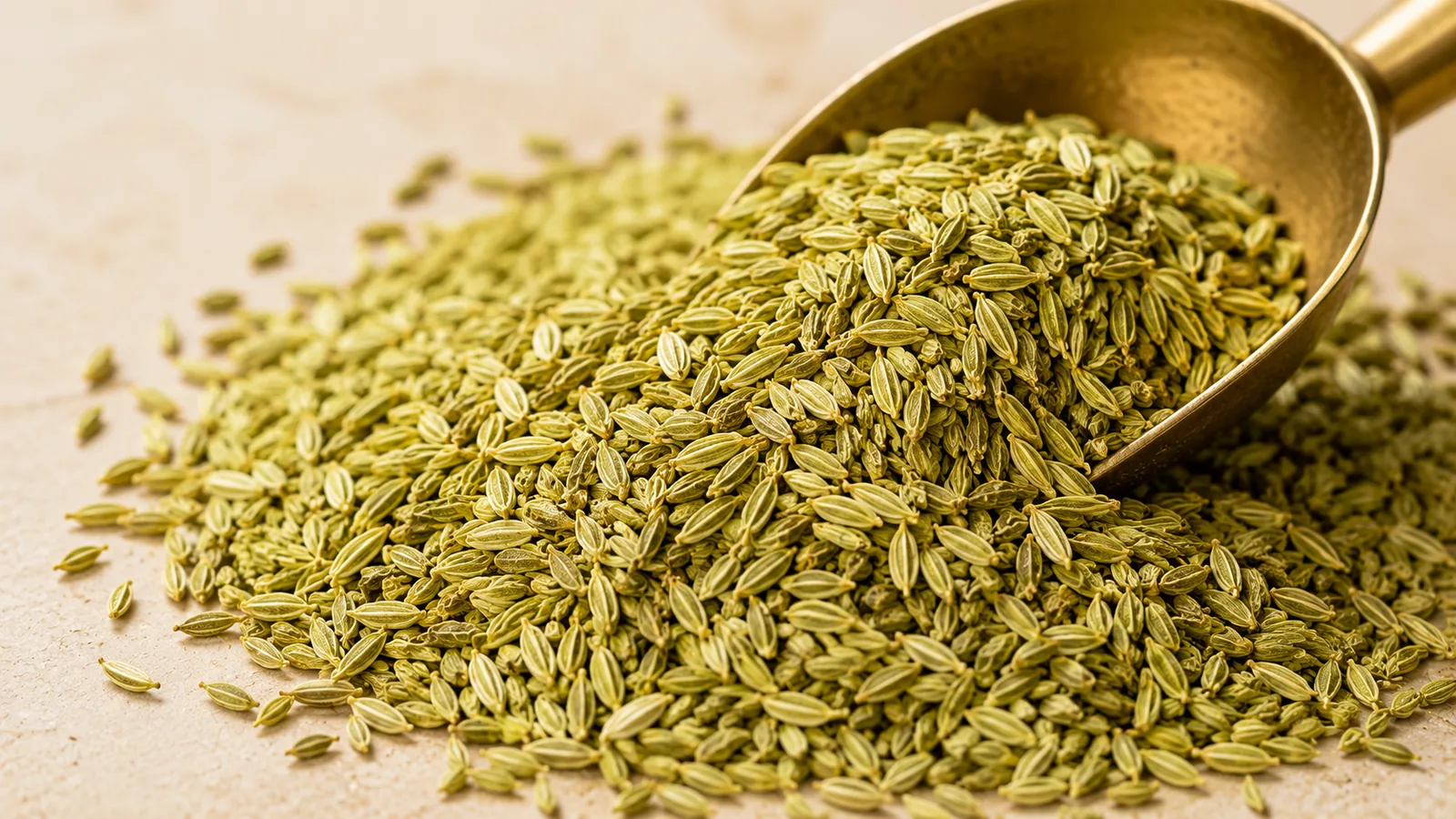
Sold on greenness and sweetness — bold bright-green Lucknowi and Rajasthani fennel are the premium export grades.
Fennel at a glance
- Botanical name
- Foeniculum vulgare
- Family
- Apiaceae
- Part used
- Fruit
- Also known as
- Saunf, Fennel seed
- Forms exported
- Whole, Seed, Ground
- ITC-HS
- 0909 61 00, 0909 62 00
- Spices Board schedule
- #8
What is Fennel and how is it exported from India?
Fennel is the dried fruit of Foeniculum vulgare, graded by colour and size. Bold, bright-green seed is the premium; India exports whole seed and, increasingly, sortex-cleaned lots for confectionery and mouth-freshener use.
Overview
Fennel is the dried fruit of Foeniculum vulgare, an Apiaceae seed sold above all on greenness and sweetness. The prized character is a bold, bright-green, well-filled seed with a sweet, anethole-driven aroma, and the trade grades heavily on colour: the greener and bolder the seed, the higher the price. This makes fennel, like coriander, a colour-and-appearance spice as much as an aroma spice, and current-crop material is preferred because green colour fades with age and heat.
India runs several commercial types. Lucknowi fennel is a small, sweet, bright-green premium seed associated with the mouth-freshener and confectionery trade; Rajasthani and Gujarati bold fennel supplies larger seed for culinary and grinding use. Beyond whole seed, the value-added streams are sortex-cleaned and polished lots, ground fennel, sugar-coated and roasted mukhwas-style preparations, and fennel essential oil and oleoresin for flavour and beverage use.
Fennel shares its HS sub-heading with anise, badian and caraway, so a clean fennel-only partner split is not consistently published, and its trade is best described qualitatively rather than pinned to an invented figure. It is grown chiefly in Rajasthan and Gujarat as a winter crop, and its compliance profile is led by pesticide residues, so buyers for regulated markets expect a residue-tested lot.
Forms & export grades
Colour-graded whole seed for mouth-freshener, culinary and pickling use.
Bulk sortex-cleaned green seed for the confectionery and blend trade.
Fennel powder milled to a specified mesh for seasoning use.
Extracted oleoresin and essential oil for flavour applications.
Varieties & types
- Lucknowi (small, sweet)
- A small, bright-green, sweet premium fennel favoured for mouth-freshener and confectionery use.
- Rajasthani bold
- Larger, bold green seed grown for culinary and grinding use.
- Gujarati / Methwan types
- Regional bold-seed types feeding the whole-seed and processing trade.
- Sortex / polished green grades
- Cleaned, colour-sorted lots specified on greenness and foreign-matter limit.
Growing regions
Rajasthan and Gujarat are the principal producing states, with the arid north-west giving the bold, aromatic seed the trade favours. Fennel is a rabi (winter) crop, sown after the monsoon and harvested in spring; retaining green colour through drying is the key to premium grades. Cooler-finishing conditions help preserve the bright green that commands the best prices.
Uses & applications
- Whole seed for mouth-freshener (mukhwas) and after-meal digestive use
- Sugar-coated, roasted and flavoured fennel for the confectionery and paan trade
- A whole-spice component of tempering, pickling and masala blends
- Ground fennel for seasoning, sausage and processed-meat manufacturing
- Bakery and confectionery flavouring (breads, biscuits, sweets)
- Fennel tea, herbal-infusion and functional-beverage manufacturing
- Fennel essential oil and oleoresin for flavour houses and liqueurs
- Nutraceutical and traditional-medicine digestive and lactation preparations
Sourcing & export considerations
- Available as whole seed, sortex-cleaned/polished green grades, ground powder, and as oil/oleoresin
- Specify colour (greenness), seed size (bold vs small sweet type), moisture and volatile-oil aroma
- Machine-cleaned and sortex colour-sorted; green colour is a fugitive premium that fades with age and heat
- Compliance flags: pesticide residues are the lead issue for this field crop; EU-bound lots need a clean residue panel
- Lacks a separable trade figure because fennel shares HS 0909 61/62 with anise, badian and caraway; describe volume qualitatively
- Buyers favour current-crop material for green colour and sweet aroma; older seed dulls and loses volatile oil
- Specify whole vs ground, and confectionery-grade cleanliness where relevant, on the contract
- Dense seed spice ships efficiently; sample and blend-scale MOQs follow standard trade practice
ITC-HS classification
- 0909 61 00 — Seeds of anise, badian, caraway or fennel — neither crushed nor ground
- 0909 62 00 — Seeds of anise, badian, caraway or fennel — crushed or ground
Compliance that applies
Frequently asked
What makes premium fennel command a higher price?
Bold, bright-green, well-filled seed with a sweet aroma. Greenness signals fresh, well-dried, current-crop material; the small sweet Lucknowi type is prized for mouth-freshener use. Colour and sweetness, not size alone, drive the premium.
Why is there no separate fennel export figure?
Fennel reports under HS 0909 61/62 together with anise, badian and caraway, so a fennel-only partner split is not consistently published. A serious supplier describes availability qualitatively rather than quoting an invented volume.
What this page does not tell you
- Separate fennel export volume
- Fennel shares HS 0909 61/62 with anise, badian and caraway; a fennel-only partner split is not consistently published.
Related spices
Sources
- Spices Board of India — Export statistics· Tier 1, retrieved 2026-07-16
- Spices Board Act, 1986 — Schedule of spices· Tier 1, retrieved 2026-07-16
- Reg. (EU) 2019/1793 — temporary increase of official controls· Tier 1, retrieved 2026-07-16
- Reg. (EU) 2023/915 — maximum levels for certain contaminants· Tier 1, retrieved 2026-07-16