Black Pepper export from India
Piper nigrum · Piperaceae · Fruit
The origin of the trade’s benchmark grades — Malabar Garbled and Tellicherry Extra Bold — and the spice the EU checks hardest for Salmonella.
| Property | Value | Unit | Method | Source |
|---|---|---|---|---|
| Malabar Garbled MG1 — bulk density | 525 | g/l | — | Spices Board of India — Export statistics |
| Tellicherry Garbled Extra Bold (TGEB) — bulk density | 560 | g/l | — | Spices Board of India — Export statistics |
Black Pepper at a glance
- Botanical name
- Piper nigrum
- Family
- Piperaceae
- Part used
- Fruit
- Also known as
- Kali mirch, Malabar pepper, Peppercorn
- Forms exported
- Whole, Ground, Crushed
- ITC-HS
- 0904 11 10, 0904 11 90, 0904 12 00
- Spices Board schedule
- #2
- Export basket share
- 3% (FY2025-26)
What is Black Pepper and how is it exported from India?
Black pepper is the dried unripe drupe of Piper nigrum, graded by bulk density (g/l) and berry size into MG1 (Malabar Garbled) and TGEB (Tellicherry Garbled Extra Bold). India both grows and re-processes pepper for export.
Overview
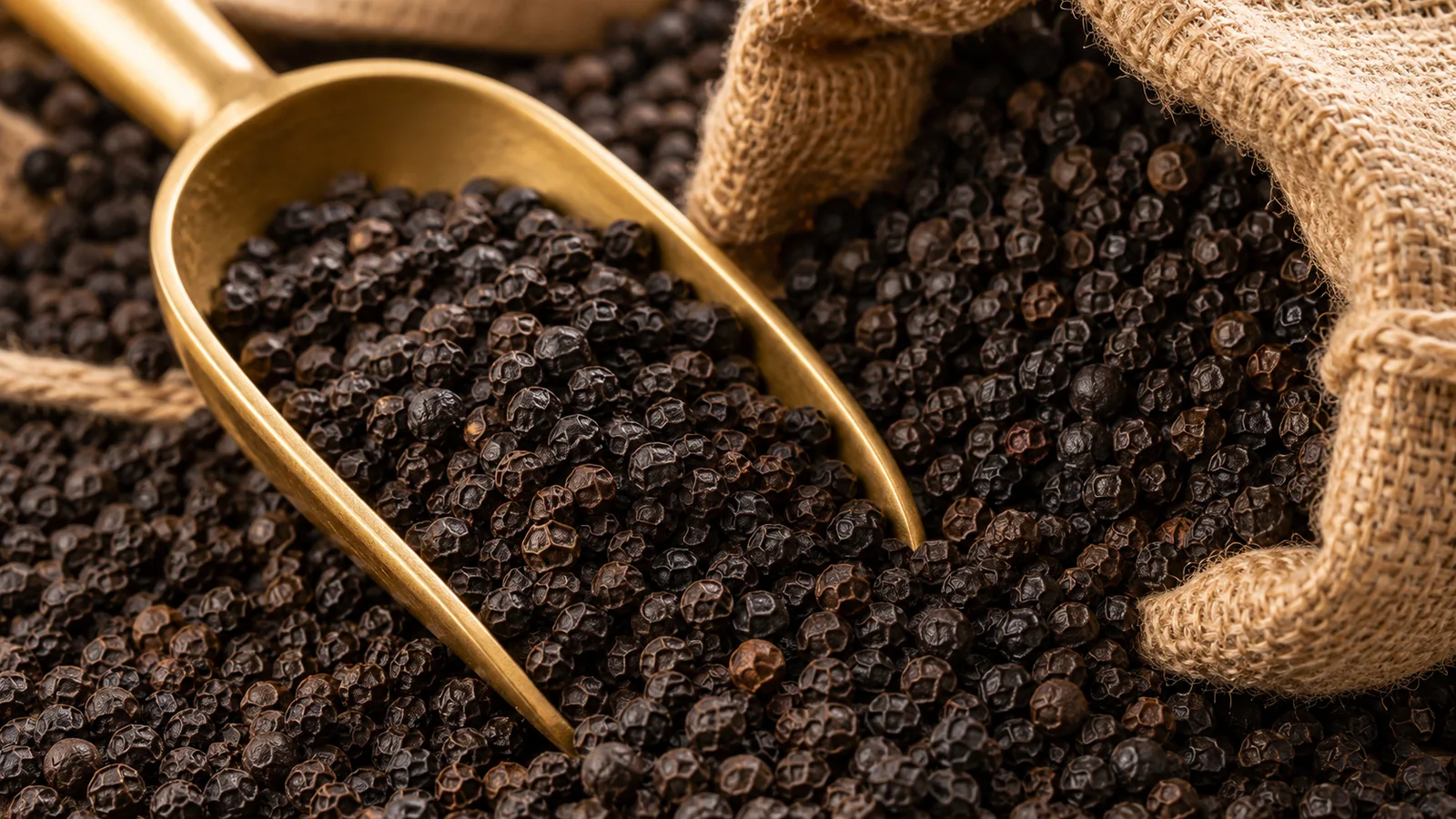
Black pepper is the dried unripe drupe of the perennial vine Piper nigrum, native to the Malabar coast and often called the king of spices for its historic weight in the trade. The berries are picked green, briefly blanched and sun-dried, during which enzymatic browning wrinkles and blackens the skin. Pungency comes from the alkaloid piperine and the aroma from the volatile oil, so a good peppercorn is judged on both bite and fragrance, not heat alone.
The commercial language of pepper is grade, and grade is largely a function of bulk density measured in grams per litre, which tracks berry size, maturity and cleanliness. The two names buyers reach for are MG1 (Malabar Garbled Grade 1), cleaned pepper at roughly 500–550 g/l, and the premium TGEB (Tellicherry Garbled Extra Bold), the largest, heaviest, hand-selected berries above roughly 550 g/l. Heavier, denser lots contain more piperine and oil per kilo, which is why bulk density is the number that sits on the contract.
Indian pepper competes on grade, cleanliness and origin story rather than on price, since Vietnam and Indonesia undercut it on sheer volume. India also both grows pepper and re-processes imported pepper for value-added export, so buyers should be clear on origin when Indian-grown provenance matters. Pepper is a modest single-digit share of the export basket by value, but it remains a benchmark product because the trade’s reference grades were born on this coast.
The compliance fact that governs EU-bound pepper is microbiological. Under Reg. (EU) 2019/1793 Indian black pepper sits in the increased-controls annex at a 50 per cent physical-check rate for Salmonella, so steam-sterilised, accredited-lab-tested lots are effectively mandatory for Europe. Aflatoxin and ethylene-oxide residues are the other standing checks, which is why steam treatment plus a recent test dossier has become the working norm.
The read
Indian black pepper sells on grade and cleanliness, not price — Vietnam undercuts it on volume. The two grades buyers name are MG1 (Malabar Garbled, ~500–550 g/l) and the premium TGEB (Tellicherry, bold berries, 550+ g/l). The compliance fact that matters: under EU Reg. 2019/1793, Indian black pepper sits in the increased-controls annex at a 50% physical-check rate for Salmonella, so steam-sterilised, tested lots are effectively mandatory for the EU.
Forms & export grades
Graded peppercorns (MG1, TGEB and lighter grades) for grinders and processors.
Milled pepper to a specified mesh for table and manufacturing use.
Cracked/coarse pepper for visible seasoning and rubs.
Concentrated extract delivering standardised piperine and aroma.
Steam-distilled essential oil for flavour and fragrance.
- Malabar Garbled MG1MG1
Cleaned Malabar pepper at roughly 500–550 g/l bulk density — the workhorse export grade.
- Tellicherry Garbled Extra Bold (TGEB)TGEB
The premium tier: bold, heavy Tellicherry berries above ~550 g/l, hand-selected from the largest fruit.
Varieties & types
- Malabar Garbled (MG1)
- Cleaned, garbled Malabar pepper around 500–550 g/l bulk density; the workhorse export grade.
- Tellicherry Garbled Extra Bold (TGEB)
- The premium tier: the largest, heaviest berries above ~550 g/l, hand-selected from the Tellicherry region.
- Ungarbled (MG2 / lighter)
- Lower-density, less-cleaned pepper with more light berries and foreign matter, for price-driven buyers.
- Cultivar types (Panniyur, Karimunda)
- Named vine cultivars grown on the Malabar coast that feed the graded export streams.
Growing regions
Kerala is the traditional home of Indian pepper, with Idukki and Wayanad the core districts, and Karnataka and Tamil Nadu adding significant volume. The vines are grown up support trees in mixed plantations, often alongside cardamom and coffee. Harvest runs across the drier months from late in the year into spring; Kochi is the historic auction and pricing benchmark for the trade.
Uses & applications
- Whole peppercorns for retail grinders, foodservice and pepper-mill packing
- Ground and cracked pepper for table use, seasoning and food manufacturing
- A core component of countless masalas, rubs, marinades and seasoning blends
- Meat, poultry and snack seasoning for processed-food manufacturers
- Pepper oleoresin and essential oil for flavour houses, giving standardised heat and aroma without particulate
- Piperine extraction for nutraceuticals, notably bioavailability-enhancer supplements
- Instant foods, sauces, soups and marinade bases
- Table-blend and pepper-salt formulations
- Ayurvedic and traditional-medicine formulations
Sourcing & export considerations
- Available whole, cracked and ground, and as pepper oleoresin/essential oil and piperine extract
- Graded principally by bulk density (g/l): MG1 ~500–550 g/l, TGEB 550+ g/l, with lighter ungarbled grades below
- Machine-cleaned, garbled and gravity/sortex sorted to remove light berries, stalk and foreign matter
- Steam sterilisation plus accredited testing is effectively required for the EU because of Salmonella controls
- Specify grade, bulk density, moisture (typically kept low to prevent mould), steam-treated/ETO-free status and origin (India-grown vs re-processed) on the contract
- Compliance flags: Salmonella (EU 50% check rate under Reg. 2019/1793), aflatoxin and ethylene-oxide residues
- Dense seed spice ships efficiently, with a 20ft container carrying a large payload before it cubes out
- Sample 50–100 kg and blend-scale MOQs follow standard trade practice; new-crop material carries fresher aroma
ITC-HS classification
- 0904 11 10 — Pepper, of the genus Piper — black, whole
- 0904 11 90 — Pepper, of the genus Piper — other (not crushed/ground)
- 0904 12 00 — Pepper, crushed or ground
Compliance that applies
Frequently asked
What is the difference between MG1 and TGEB black pepper?
MG1 (Malabar Garbled Grade 1) is cleaned pepper at roughly 500–550 g/l bulk density. TGEB (Tellicherry Garbled Extra Bold) is the premium tier: larger, heavier berries above ~550 g/l, hand-selected from the Tellicherry region.
Why does EU-bound Indian black pepper need Salmonella testing?
Under Reg. (EU) 2019/1793 black pepper from India is listed for increased official controls at a 50% check rate for Salmonella. Steam sterilisation and accredited pre-shipment testing are needed to clear EU border control reliably.
Does higher bulk density really mean better pepper?
Largely yes. Denser berries are more mature and cleaner, carrying more piperine and volatile oil per kilo, which is why TGEB (550+ g/l) outranks MG1 (~500–550 g/l). Always confirm the g/l figure and test method on the contract.
Can Indian pepper be supplied Salmonella-compliant for the EU?
Yes. Steam sterilisation followed by accredited microbiological testing is standard for EU-bound lots, since Reg. (EU) 2019/1793 imposes a 50% Salmonella check rate on Indian black pepper. A recent test dossier should accompany each consignment.
Is Indian-grown pepper distinguishable from re-processed imported pepper?
Only if you specify it. India both grows pepper and cleans/re-exports imported pepper. If India-origin provenance matters (for marketing or preferential origin), state it on the contract and require origin documentation.
Related spices
Sources
- Spices Board of India — Export statistics· Tier 1, retrieved 2026-07-16
- Spices Board Act, 1986 — Schedule of spices· Tier 1, retrieved 2026-07-16
- Reg. (EU) 2019/1793 — temporary increase of official controls· Tier 1, retrieved 2026-07-16
- Reg. (EU) 2023/915 — maximum levels for certain contaminants· Tier 1, retrieved 2026-07-16