Ginger export from India
Zingiber officinale · Zingiberaceae · Rhizome
Exported both fresh and as dry ginger (sonth), with the Northeast’s low-fibre GI gingers commanding a premium.
Ginger at a glance
- Botanical name
- Zingiber officinale
- Family
- Zingiberaceae
- Part used
- Rhizome
- Also known as
- Adrak, Dry ginger, Sonth
- Forms exported
- Dried, Ground, Oleoresin
- ITC-HS
- 0910 11 10, 0910 12 00
- Spices Board schedule
- #4
- Export basket share
- 3% (FY2025-26)
What is Ginger and how is it exported from India?
Ginger is the rhizome of Zingiber officinale, exported fresh, as dried whole/split "sonth", as powder, and as oleoresin. Indian dry ginger is valued for its aroma; Northeast GI gingers (Mizo, Karbi Anglong) are low-fibre.
Overview
Ginger is the underground rhizome of Zingiber officinale, exported in two quite different commercial streams: fresh green ginger and dried ginger, known in the trade as sonth. The character that matters is the balance of pungency, from the gingerol and shogaol compounds, and aroma, from the essential oil, together with fibre content. Low-fibre, high-oil rhizomes are the premium, and India’s Northeastern gingers, including the GI-tagged Mizo and Karbi Anglong types, are valued precisely for their low fibre and clean aroma.
Dry ginger is produced by peeling or partially peeling and sun-drying the rhizome, and it grades on whether it is whole or split, bleached (limed) or unbleached, and on its oil and fibre profile. Fresh ginger grades on rhizome size, plumpness, freedom from sprouting and rot, and cleanliness of the skin. From these come the value-added forms the food industry buys: ginger powder, ginger oil and ginger oleoresin, the last two giving standardised pungency and aroma without the handling burden of the raw rhizome.
Ginger is a modest single-digit share of India’s spice export basket by value, but it is a versatile, high-demand product spanning culinary, beverage and nutraceutical use. Its compliance profile centres on aflatoxin (relevant to dried ginger under EU limits) and, importantly, pesticide residues, since ginger is a soil crop prone to residue and heavy-metal pickup; buyers for regulated markets expect a clean residue panel and, for dried material, aflatoxin testing.
Forms & export grades
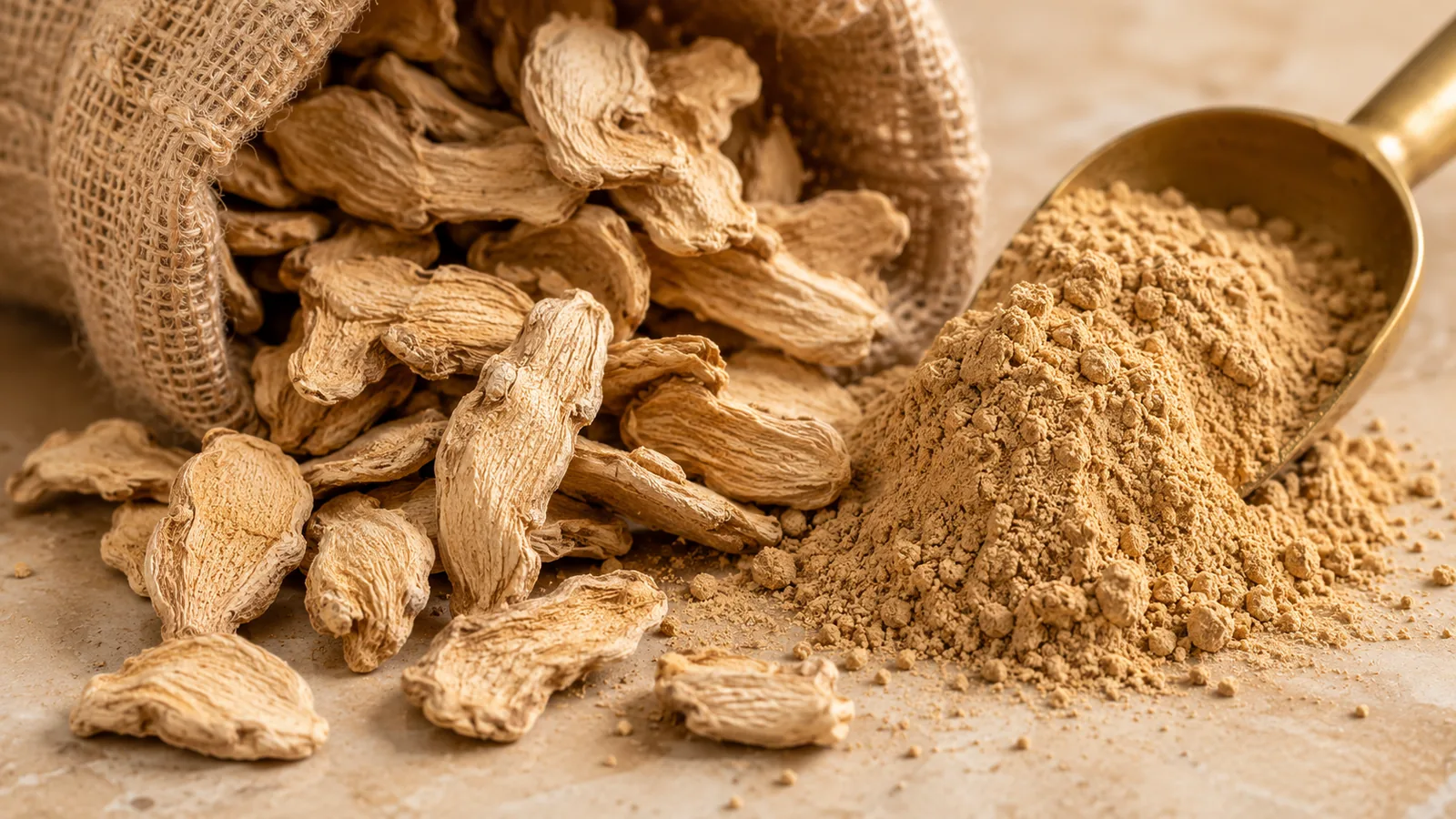
Whole or split sun-dried sonth, bleached or unbleached, for grinding and traditional use.
Ginger powder milled to a specified mesh for food and beverage manufacturing.
Concentrated extract delivering standardised pungency and aroma.
Steam-distilled ginger essential oil for flavour and fragrance.
Varieties & types
- Mizo ginger
- A GI-tagged Northeastern ginger prized for low fibre and clean, strong aroma.
- Assam / Karbi Anglong ginger
- A GI-linked Northeastern type, low-fibre and aromatic, valued for both fresh and dry use.
- Cochin / Calicut (Kerala) dry ginger
- The classic South Indian sonth types feeding the dried-ginger and oleoresin trade.
- Nadia / Rio-de-Janeiro cultivars
- High-yield cultivar types widely grown for fresh and processing markets.
Growing regions
Ginger is grown across a wide belt, with Kerala the traditional dry-ginger and oleoresin base, the Northeastern states (Meghalaya, Mizoram, Assam, Nagaland) supplying prized low-fibre gingers, and Karnataka a major fresh-ginger producer. It is planted before the monsoon and harvested from late in the year; rhizomes destined for dry ginger are cured and sun-dried after lifting. Mizo and Assam/Karbi Anglong gingers are GI origins.
Uses & applications
- Fresh ginger for retail, foodservice and the diaspora vegetable trade
- Dry ginger (sonth), whole or split, for grinding and traditional use
- Ginger powder for bakery, beverages, seasoning and instant-food manufacturing
- Ginger oleoresin and essential oil for standardised pungency and aroma in flavour houses
- Ginger ale, ginger beer, herbal teas and functional-beverage manufacturing
- Confectionery, candied/crystallised ginger and preserves
- Sauces, marinades, curry pastes and Asian-cuisine blends
- Nutraceutical and traditional-medicine (Ayurvedic) preparations for digestion and anti-inflammatory use
- Personal-care and warming-formulation applications
Sourcing & export considerations
- Available fresh, as dried whole/split sonth, as powder, and as ginger oil and oleoresin
- Dry ginger grades on whole vs split, bleached (limed) vs unbleached, and oil/fibre content; specify which you want
- Fresh ginger grades on rhizome size, freedom from sprouting/rot, and skin cleanliness; it is a perishable, temperature-sensitive cargo
- Cleaned and sorted; oleoresin and oil are bought on standardised pungency (gingerol) and volatile-oil content
- Compliance flags: aflatoxin for dried ginger under EU limits, and pesticide-residue and heavy-metal screening for this soil crop
- Specify form, grade, moisture (for dry ginger), fibre level and residue-tested status on the contract
- Buyers favour current-crop, well-cured dry ginger; fresh ginger moves on cold-chain and shelf-life terms
- Sample and blend-scale MOQs follow standard trade practice; dense dry ginger ships efficiently while fresh ginger is planned around perishability
ITC-HS classification
- 0910 11 10 — Ginger, fresh — neither crushed nor ground
- 0910 12 00 — Ginger, crushed or ground
- 3301 90 16 — Spice oleoresins
Compliance that applies
Frequently asked
What is sonth, and how does it differ from fresh ginger?
Sonth is dried ginger, made by peeling and sun-drying the rhizome. It is more pungent and concentrated than fresh ginger, ships and stores far better, and is the form used for grinding into powder and for oleoresin extraction.
Why do buyers prefer low-fibre ginger?
Low-fibre rhizomes, such as the Northeastern GI gingers, give cleaner powder, higher oil and oleoresin yield, and better eating quality. High fibre lowers extraction efficiency and downgrades culinary and processing use.
What residue testing does export ginger need?
Because ginger is a soil crop, buyers for regulated markets expect a recent pesticide-residue panel and, for dried ginger, aflatoxin testing against EU limits, plus heavy-metal screening where required. State the test dossier requirement on the contract.
Related spices
Sources
- Spices Board of India — Export statistics· Tier 1, retrieved 2026-07-16
- Spices Board Act, 1986 — Schedule of spices· Tier 1, retrieved 2026-07-16
- Geographical Indications Registry, India — Registered GIs· Tier 1, retrieved 2026-07-16
- Reg. (EU) 2019/1793 — temporary increase of official controls· Tier 1, retrieved 2026-07-16
- Reg. (EU) 2023/915 — maximum levels for certain contaminants· Tier 1, retrieved 2026-07-16