Thyme export from India
Thymus vulgaris · Lamiaceae · Leaf
Grown for dried leaf and thymol-rich thyme oil for the seasoning and flavour trade.
Thyme at a glance
- Botanical name
- Thymus vulgaris
- Family
- Lamiaceae
- Part used
- Leaf
- Forms exported
- Dried, Essential oil
- ITC-HS
- 1211 90 99
- Spices Board schedule
- #49
What is Thyme and how is it exported from India?
Thyme is Thymus vulgaris, exported dried and as thymol-bearing oil. Indian production is hill-grown for the seasoning and essential-oil trade.
Overview
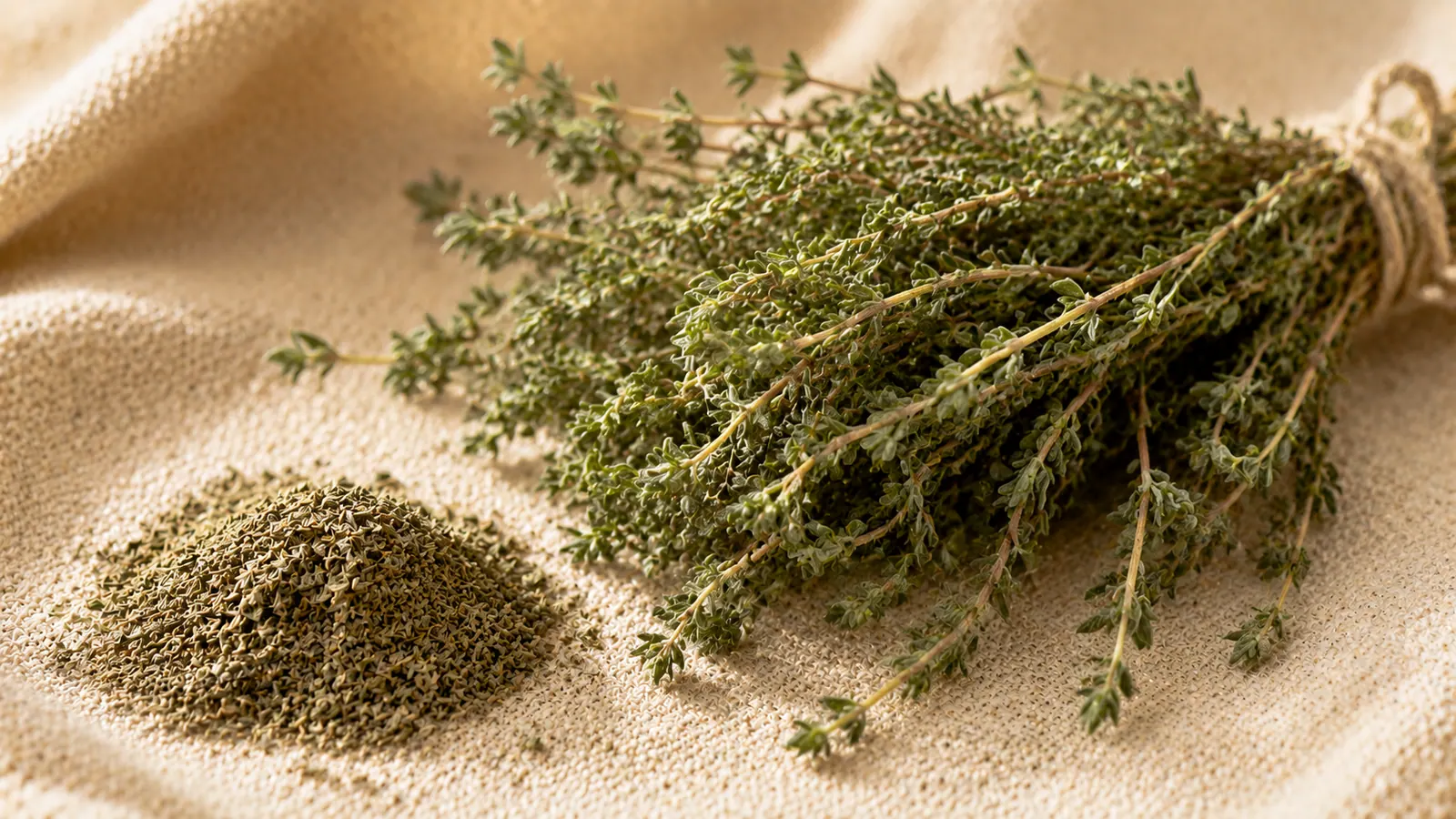
Thyme is Thymus vulgaris, a low woody perennial of the mint family with tiny grey-green leaves and one of the most recognisable savoury-herb aromas in the seasoning trade. It is grown in India's hill zones for dried leaf and for thyme oil. The defining chemistry is thymol, a phenolic that gives thyme its sharp, warm, antiseptic-clean aroma; carvacrol and other volatiles round out the profile. Because thymol is both a flavour and a functional molecule, thyme spans the seasoning market and the essential-oil and extract markets at once.
Thymol-rich thyme oil is the reason thyme matters beyond the herb rack. The oil, distilled from the leaf, is valued for its thymol content in flavour, fragrance, oral-care and antimicrobial-ingredient applications, and demand for thyme as an extract and oil feedstock runs alongside demand for the dried culinary leaf. A buyer sourcing thyme should be clear whether they want culinary leaf, specified on green colour and aroma, or oil/extract feedstock, specified on thymol content, because the two streams are graded on different things.
For the India trade thyme is a hill-grown herb-and-oil line rather than a plains bulk crop. Quality on the dried leaf turns on colour retention, aroma, leaf-to-stem ratio and cleanliness; on the oil it turns on thymol level and volatile profile. As a dried culinary herb, thyme also carries the herb-sector compliance concern of pyrrolizidine alkaloids from co-harvested weeds under EU limits, so weed-clean fields and gentle drying feed directly into export grade.
Forms & export grades
Dried thyme leaf (whole or cut) for the seasoning trade.
Thymol-rich thyme essential oil for flavour, fragrance and functional use.
Thyme/thymol extract for oral-care, antimicrobial-ingredient and functional applications.
Varieties & types
- Culinary dried leaf
- Whole or cut dried thyme leaf graded on green colour and aroma for the seasoning trade.
- Oil/extract-grade thyme
- Leaf grown and selected for thymol-rich oil and extract, specified on thymol content rather than appearance.
Growing regions
Thyme is grown in Indian hill and temperate zones that suit a Mediterranean perennial, supplying both the dried-herb and essential-oil trades. As a perennial it is cut through the growing season rather than as a single annual harvest. Fresh, gently dried new leaf holds the best colour and aroma for culinary grades, while oil buyers weigh thymol content over season.
Uses & applications
- Dried leaf for Mediterranean, mixed-herb and poultry/meat seasoning blends
- Soup, stock, sauce and marinade seasoning in the food-manufacturing supply chain
- Herbes de Provence and general seasoning-house blends
- Thyme essential oil (thymol-rich) for flavour, fragrance and beverage use
- Thymol/thyme extract for oral-care, antimicrobial-ingredient and functional applications
- Herbal-tea, infusion and cough/throat-preparation use
- Personal-care and cosmetic formulations using oil and extract
- Culinary retail and food-service herb packs for the diaspora market
Sourcing & export considerations
- Available as dried leaf (whole/cut), thymol-rich thyme oil, and thyme/thymol extract; leaf, oil and extract are distinct products with distinct specs.
- Culinary leaf is graded on green colour, aroma, leaf-to-stem ratio and cleanliness; oil and extract are specified on thymol content, so state the intended use up front.
- Thyme oil and thymol extract are a real demand driver alongside culinary leaf; buyers should specify thymol level and volatile profile for oil/extract lots.
- As a dried herb, leaf carries the pyrrolizidine-alkaloid concern from co-harvested weeds (EU limit 400 µg/kg for dried herbs), so weed-clean sourcing and testing support EU acceptability.
- Where microbial reduction is required, steam treatment on dried leaf can be coordinated with vetted third parties to protect colour and volatile oil.
- Reports under herb/plant lines, so it lacks separable bilateral spice-trade data; describe supply qualitatively.
- Low-density dried leaf ships light; pack in food-grade lined bags/cartons with moisture protection.
- On the contract specify product (leaf/oil/extract), cut, colour/aroma or thymol target, PA test where relevant and crop season.
ITC-HS classification
- 1211 90 99 — Plants/parts used in perfumery/pharmacy — other (culinary herbs)
Frequently asked
Why is thyme oil in demand beyond seasoning?
Thyme oil is rich in thymol, a phenolic valued in flavour, fragrance, oral-care and antimicrobial-ingredient applications. Because thymol is both a flavour and a functional molecule, thyme feeds the essential-oil and extract markets alongside the culinary dried-leaf trade.
Is culinary thyme leaf specified the same way as oil-grade thyme?
No. Culinary leaf is graded on green colour and aroma; oil and extract feedstock is specified on thymol content. They come from the same plant but are bought on different criteria, so a buyer should state the intended use before contracting.
What this page does not tell you
- Volume
- Herb lines; not separable.
Related spices
Sources
- Spices Board of India — Export statistics· Tier 1, retrieved 2026-07-16
- Spices Board Act, 1986 — Schedule of spices· Tier 1, retrieved 2026-07-16
- Reg. (EU) 2023/915 — maximum levels for certain contaminants· Tier 1, retrieved 2026-07-16
- CBI — Entering the European market for spices and herbs· Tier 2, retrieved 2026-07-16