Hyssop export from India
Hyssopus officinalis · Lamiaceae · Leaf
A temperate Mediterranean herb listed in the schedule but barely grown commercially in India.
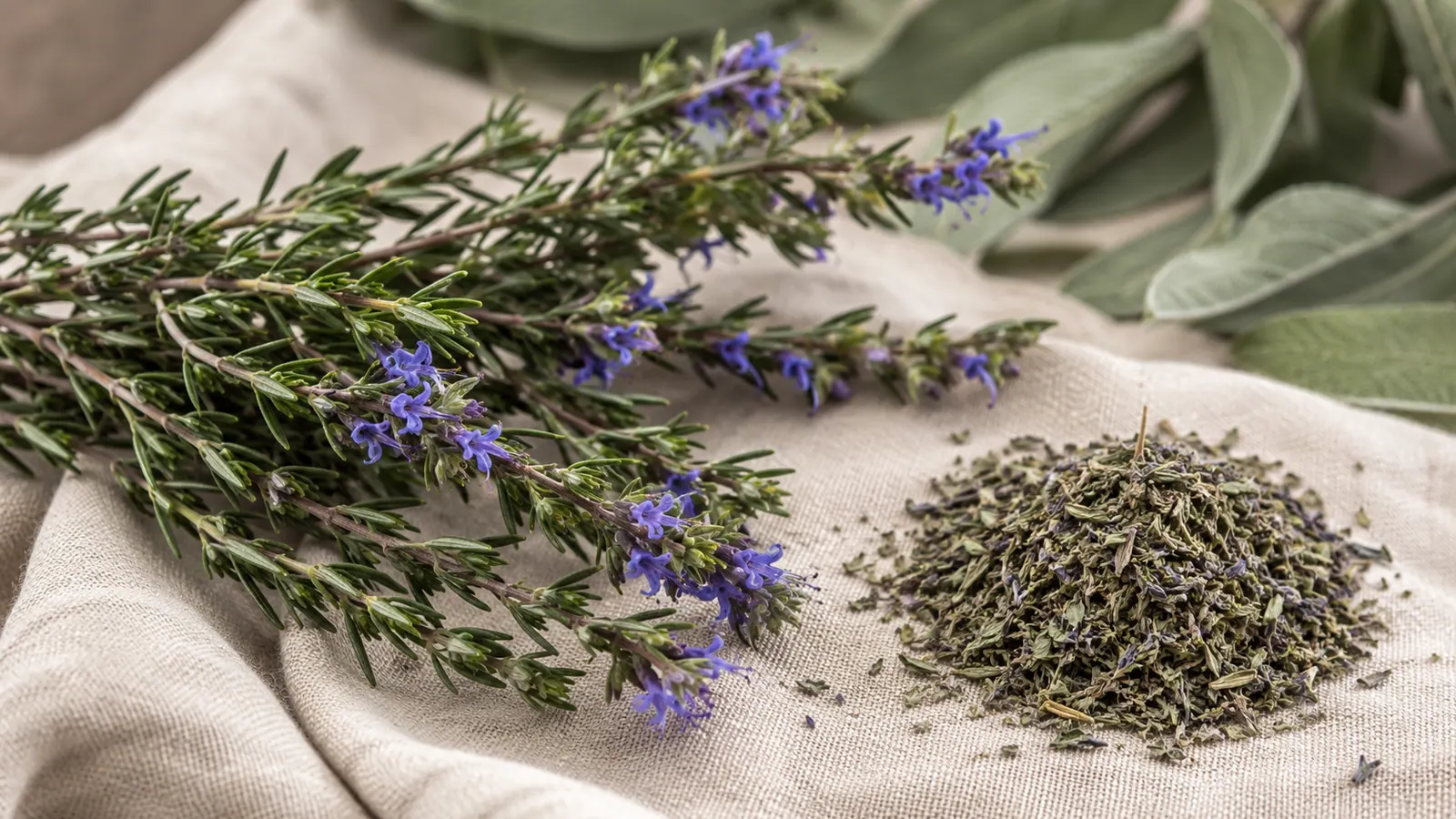
Hyssop at a glance
- Botanical name
- Hyssopus officinalis
- Family
- Lamiaceae
- Part used
- Leaf
- ITC-HS
- 0910 99 99
- Spices Board schedule
- #36
What is Hyssop and how is it exported from India?
Hyssop is the aromatic herb Hyssopus officinalis. It appears in India’s schedule but has negligible commercial cultivation; trade is minimal.
Overview
Hyssop is the aromatic above-ground herb of Hyssopus officinalis, a small woody-based perennial of the Lamiaceae, the mint and lavender family. It carries narrow leaves and spikes of blue-purple flowers, and a warm, minty-bitter, slightly camphorous aroma driven by an essential oil rich in pinocamphone and related ketones. It is a classic Mediterranean and Central-European culinary and monastic herb, used sparingly because the bitterness builds quickly, and long associated with herbal liqueurs.
Because the ketone-heavy oil raises safety questions at high intake, hyssop is more often used as a low-dose flavouring, a tea and a fragrance material than as a bulk cooking herb. Quality in the dried herb is judged on green leaf colour, aroma retention, freedom from excessive stalk, and clean drying without mustiness. As an essential-oil crop it is judged on oil yield and profile.
In the Indian schedule hyssop is a listed but essentially non-commercial entry. It is a temperate plant with no established Indian production base, so the domestic crop is negligible and there is no organised export supply. For a sourcing desk it is honest to treat hyssop as a specialty, largely-imported herb rather than an Indian-origin line.
Forms & export grades
Dried cut or rubbed herb for culinary, tea and liqueur use.
Steam-distilled essential oil for fragrance and flavour houses.
Growing regions
Hyssop is a temperate Mediterranean perennial and has no established commercial belt in India; any cultivation is confined to small trial or garden plantings in cooler hill zones rather than field-scale acreage. Harvest of aromatic herbs like this is taken around flowering, when oil content peaks. With negligible domestic production, hyssop in trade is generally imported, and India is not a meaningful origin.
Uses & applications
- A low-dose culinary herb for soups, stews, game and rich meat dishes
- A traditional flavouring botanical in herbal liqueurs and bitters (notably Chartreuse-style formulas)
- Herbal tea and infusion blends
- Essential-oil production for fragrance and flavour houses
- Aromatic and botanical component of potpourri and personal-care fragrance
- Traditional herbal and respiratory preparations
Sourcing & export considerations
- Available as dried herb (cut or rubbed) and, from oil-crop supply, as essential oil; India is not a bulk-supply origin for either
- Dried-herb quality turns on leaf colour, aroma retention, low stalk and clean, mould-free drying
- Cleaning and cut-and-sift sizing are coordinated with vetted third-party herb processors rather than owned lines
- Packaging: light- and moisture-barrier lined cartons or pouches; the volatile oil fades on exposure to air, heat and light
- Shelf life is aroma-driven rather than a fixed figure; dried leafy herbs lose character faster than seeds and hold best cool, dark and sealed
- Reports under residual HS 0910 99, so there is no separable bilateral hyssop trade figure
- Because the ketone-rich oil carries intake-safety considerations, confirm the intended use and any market-specific limits before contracting for food or beverage use
- Specify on contract: dried herb vs oil, cut size, aroma/oil expectation, and origin, given India is not a genuine source
ITC-HS classification
- 0910 99 99 — Spices — other, not elsewhere specified (residual basket line)
Frequently asked
Does India actually produce hyssop?
Not commercially. Hyssop is scheduled in India but is a temperate Mediterranean herb with negligible domestic cultivation. Supply in trade is generally imported, so we do not present hyssop as a genuine Indian-origin line.
Why is hyssop used only in small amounts?
Its aroma is strongly minty-bitter and its essential oil is high in ketones, so it is used as a low-dose flavouring in dishes, teas and liqueurs rather than a bulk herb, and some markets watch intake in food and beverage applications.
What this page does not tell you
- Volume
- Negligible Indian production.
Related spices
Sources
- Spices Board of India — Export statistics· Tier 1, retrieved 2026-07-16
- Spices Board Act, 1986 — Schedule of spices· Tier 1, retrieved 2026-07-16