Basil export from India
Ocimum basilicum · Lamiaceae · Leaf
Grown for dried leaf, basil seed (sabja) and essential oil across the seasoning and beverage trade.
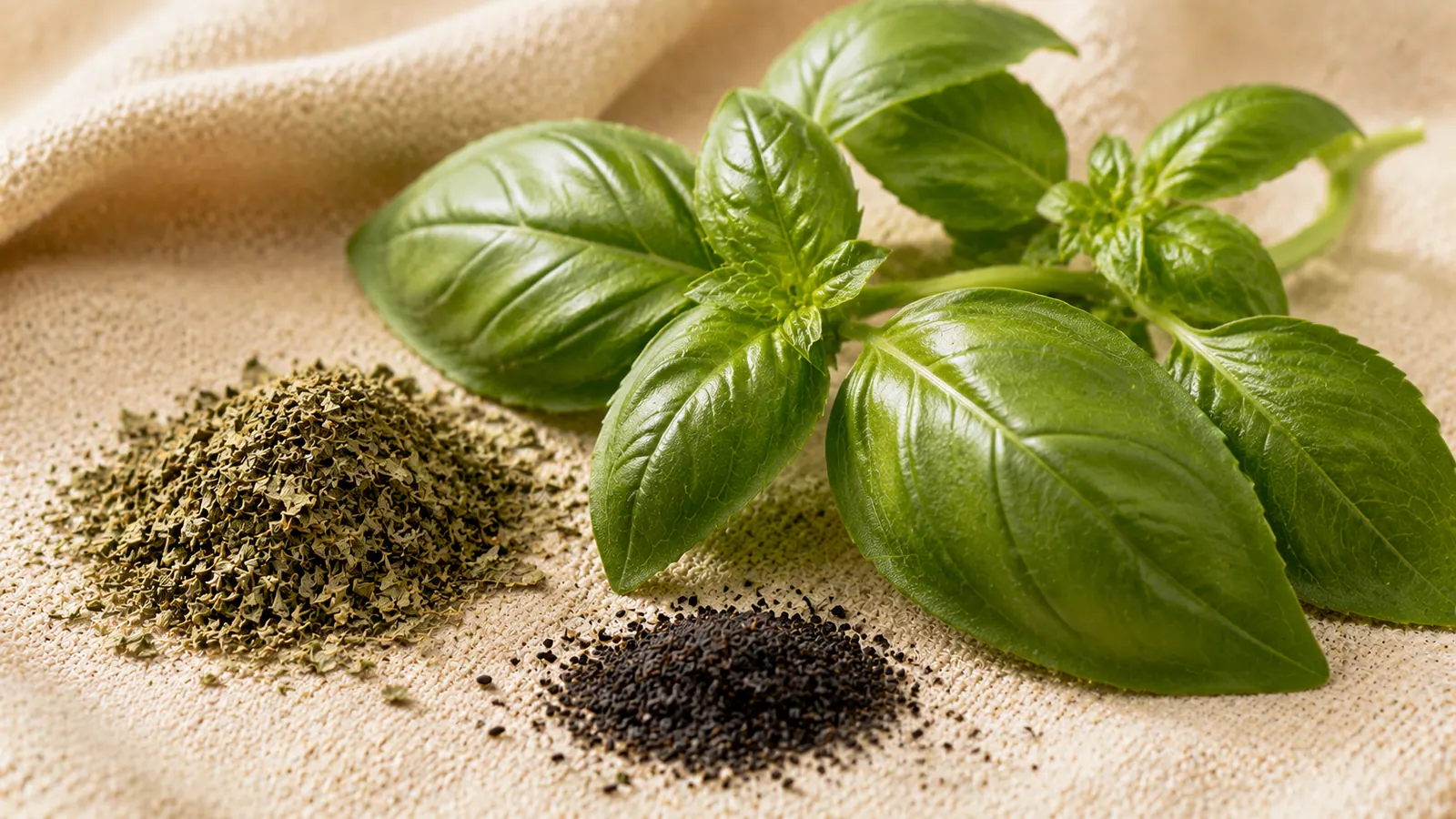
Basil at a glance
- Botanical name
- Ocimum basilicum
- Family
- Lamiaceae
- Part used
- Leaf
- Also known as
- Sabja (seed), Sweet basil
- Forms exported
- Dried, Essential oil, Seed
- ITC-HS
- 1211 90 99
- Spices Board schedule
- #43
What is Basil and how is it exported from India?
Basil is Ocimum basilicum, exported as dried leaf, as basil/sabja seed for beverages, and as basil oil. India also grows holy basil (tulsi) for the nutraceutical trade.
Overview
Basil is Ocimum basilicum, a warm-season annual of the mint family (Lamiaceae) grown in India for three quite different trade streams: dried leaf for the seasoning market, basil seed (sabja/tukmaria) for the beverage and dessert trade, and basil essential oil for flavour and fragrance. The plant is fast-growing and cut several times a season; the leaf is stripped, dried and sieved to a defined cut, while the small black mucilage-forming seed is harvested separately from mature flower spikes. India also grows holy basil (tulsi, Ocimum tenuiflorum) for the nutraceutical and herbal-supplement trade, a related but distinct crop from culinary sweet basil.
Sensory character depends on chemotype and drying discipline. Sweet basil is defined by its aromatic volatile oil, and the aroma balance shifts between linalool-led sweetness and more anise or camphor-forward notes depending on variety and growing conditions. The commercial problem for dried leaf is that basil aroma is fragile and colour-sensitive: over-fast or over-hot drying browns the leaf and strips the top notes, so gentle drying and a good green colour retention are what separate a premium dried-leaf lot from a dull one. Basil seed, by contrast, is bought not for aroma but for its ability to swell into a gelatinous coat in water, which is why it is graded on cleanliness, swell and freedom from immature or foreign seed.
For the India export trade basil sits across culinary herb, beverage ingredient and essential-oil categories rather than in a single lane. Dried leaf competes on colour and aroma; basil seed competes on swell and cleanliness in the fast-growing functional-beverage segment; basil oil competes on chemotype and volatile-oil profile. As a dried herb, basil leaf also carries the herb-sector compliance concern of pyrrolizidine alkaloids from co-harvested weeds, which the EU regulates, so weed-clean fields and careful harvesting feed directly into export acceptability.
Forms & export grades
Dried, sieved basil leaf to a specified cut for seasoning blends.
Cleaned basil/sabja seed for the beverage and dessert trade, graded on swell and cleanliness.
Distilled basil essential oil sold on chemotype and volatile-oil profile.
Varieties & types
- Sweet basil (culinary)
- Standard Ocimum basilicum grown for aromatic dried leaf and for essential-oil distillation.
- Basil / sabja seed type
- Grown and harvested for the mucilaginous black seed used in beverages and desserts rather than for leaf.
- Holy basil (tulsi)
- Ocimum tenuiflorum, a related species grown for the herbal-supplement and nutraceutical trade, distinct from culinary sweet basil.
Growing regions
Basil is grown across warm plains and lower hill zones in India as a quick multi-cut crop, with seed and oil-type cultivation spread through central and peninsular states and tulsi grown widely for the herbal trade. Being a warm-season annual it is planted to the frost-free growing window and cut repeatedly through the season. Fresh, well-dried new-season leaf carries the best green colour and aroma, which matters most for the dried-leaf grades.
Uses & applications
- Dried leaf for Italian-style and mixed-herb seasoning blends, pizza and pasta seasonings and QSR supply chains
- Culinary garnish and seasoning for the diaspora and food-service retail packs
- Basil (sabja/tukmaria) seed for falooda, sherbet, lemonade and functional/hydration beverages where the seed swells and gels
- Dessert and confectionery inclusions using the swollen seed as a texture element
- Basil essential oil for flavouring, beverages and confectionery, and for fragrance/aromatherapy compounding
- Herbal-supplement and nutraceutical use, especially holy basil (tulsi) extract and dried leaf
- Personal-care and cosmetic formulations drawing on basil oil
- Spice-blend and seasoning-house raw material where a green, aromatic dried leaf is specified
Sourcing & export considerations
- Available as dried leaf (specify cut size), cleaned basil/sabja seed, and basil essential oil; these are three different products with different buyers.
- Dried leaf is graded on green colour retention, aroma and freedom from stem and foreign matter; basil seed is graded on swell, cleanliness and freedom from immature/foreign seed.
- As a dried herb, basil leaf carries the pyrrolizidine-alkaloid concern from co-harvested weeds (EU limit 400 µg/kg for dried herbs), so weed-clean sourcing and testing support EU acceptability.
- Where microbial reduction is needed, steam treatment on dried leaf can be coordinated with vetted third parties to protect colour and volatile oil.
- Aroma and colour fade with time and heat, so shelf life is best protected by cool, dry, light-protected storage; new-crop leaf is preferable for premium grades.
- Packaging in food-grade lined bags/cartons; leaf is bulky and low-density so it "cubes out" and ships light relative to seed spices.
- Order sizes and any MOQ are trade practice; align them to whether the buyer wants leaf, seed or oil, which behave very differently in logistics.
- On the contract specify product (leaf/seed/oil), cut or swell spec, colour/aroma target, PA test where relevant and crop season.
ITC-HS classification
- 1211 90 99 — Plants/parts used in perfumery/pharmacy — other (culinary herbs)
Frequently asked
Is basil seed (sabja) the same product as basil leaf?
No. They come from the same plant but serve different markets. Leaf is dried for seasoning and bought on colour and aroma; sabja seed is bought for its water-swelling, gelling behaviour in beverages and desserts and is graded on swell and cleanliness.
What is the difference between sweet basil and holy basil (tulsi)?
Sweet basil (Ocimum basilicum) is the culinary herb grown for aromatic leaf and oil. Holy basil (Ocimum tenuiflorum, tulsi) is a related species grown mainly for the herbal-supplement and nutraceutical trade. Buyers should specify which they want.
What compliance issue applies to dried basil leaf for the EU?
Like other dried herbs, basil can carry pyrrolizidine alkaloids from weeds harvested alongside it, which the EU limits at 400 µg/kg. Weed-clean fields, careful harvesting and testing are the practical controls for EU-bound leaf.
What this page does not tell you
- Volume
- Reports under herb/plant lines.
Related spices
Sources
- Spices Board of India — Export statistics· Tier 1, retrieved 2026-07-16
- Spices Board Act, 1986 — Schedule of spices· Tier 1, retrieved 2026-07-16
- Reg. (EU) 2023/915 — maximum levels for certain contaminants· Tier 1, retrieved 2026-07-16
- CBI — Entering the European market for spices and herbs· Tier 2, retrieved 2026-07-16