Savory export from India
Satureja hortensis · Lamiaceae · Leaf
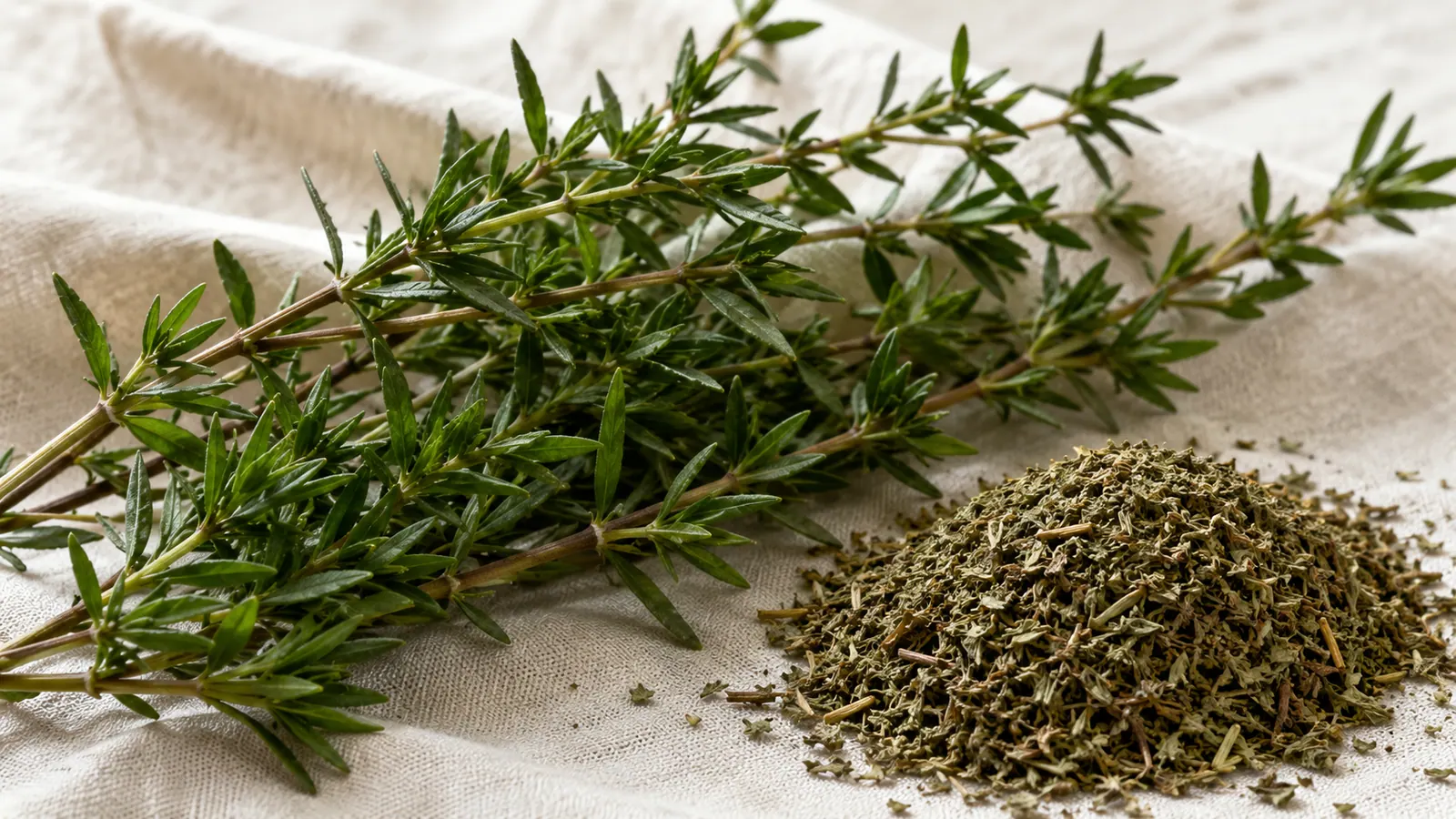
Summer savory — a peppery culinary herb scheduled in India with minimal commercial cultivation.
Savory at a glance
- Botanical name
- Satureja hortensis
- Family
- Lamiaceae
- Part used
- Leaf
- ITC-HS
- 1211 90 99
- Spices Board schedule
- #48
What is Savory and how is it exported from India?
Savory is Satureja hortensis, a peppery Lamiaceae herb. It is scheduled but scarcely grown commercially in India.
Overview
Savory is Satureja hortensis, summer savory, a small annual of the mint family with narrow leaves and a warm, peppery, thyme-adjacent aroma. It is a European culinary herb carried on India's Spices Board schedule but grown only marginally here, so it is best understood as a real but minor-cultivation line rather than a bulk Indian crop. Its aroma comes from a volatile oil in which carvacrol and thymol-type phenols feature, giving the sharp, peppery, faintly resinous note that puts savory close to thyme and oregano in the seasoning palette.
In the kitchen and in seasoning manufacture savory is a "bean herb" and a peppery accent, traditionally paired with pulses, sausages and stuffings and used in mixed-herb blends such as herbes de Provence. Because Indian commercial cultivation is minimal, a buyer sourcing savory from India should treat provenance and continuity of supply as the key questions, and should expect that continuity may depend on contract growing rather than on a standing bulk crop. There are no verified Indian trade specs for savory, so its depth for a buyer is in botany, character and how it is specified, not in numbers.
Quality on dried savory turns on green colour retention, aroma, leaf-to-stem ratio and cleanliness. As a dried culinary herb it shares the herb-sector compliance concerns, including pyrrolizidine alkaloids from co-harvested weeds under EU limits, so weed-clean harvesting and gentle drying are the practical quality levers, exactly as for the other Lamiaceae herbs on the schedule.
Forms & export grades
Dried savory leaf for the seasoning trade, graded on colour and aroma.
Savory essential oil for flavour and fragrance, in small quantity.
Growing regions
Savory is scheduled in India but scarcely grown commercially, so there is no established Indian growing-region or seasonality story to quote; as a summer annual it fits a warm growing-season window where it is planted. Supply from India is more likely to rest on contract or small-scale growing than on a standing bulk crop, which makes provenance and continuity the practical sourcing questions.
Uses & applications
- Dried leaf as a peppery seasoning for pulses and bean dishes (its classic "bean herb" role)
- Sausage, stuffing and processed-meat seasoning blends
- Mixed-herb blends such as herbes de Provence and general Mediterranean seasoning
- Culinary retail and food-service herb packs
- Savory essential oil for flavour and fragrance
- Herbal and infusion use
Sourcing & export considerations
- Available mainly as dried leaf, with savory essential oil in smaller quantity; Indian commercial cultivation is minimal, so continuity of supply is a key question.
- Graded on green colour retention, aroma, leaf-to-stem ratio and cleanliness; there are no verified Indian trade specs, so grade is described qualitatively.
- As a dried herb, leaf carries the pyrrolizidine-alkaloid concern from co-harvested weeds (EU limit 400 µg/kg for dried herbs), so weed-clean sourcing and testing support EU acceptability.
- Where microbial reduction is required, steam treatment can be coordinated with vetted third parties to protect colour and volatile oil.
- Reports under herb/plant lines, so it lacks separable bilateral spice-trade data; describe supply qualitatively rather than by tonnage.
- Low-density dried leaf ships light; pack in food-grade lined bags/cartons with moisture protection.
- Order sizes and any MOQ are trade practice; because cultivation is thin, expect availability to depend on contract growing. On the contract specify form, colour/aroma target, PA test where relevant and provenance.
ITC-HS classification
- 1211 90 99 — Plants/parts used in perfumery/pharmacy — other (culinary herbs)
Frequently asked
How does savory differ from thyme and oregano?
All three are peppery Lamiaceae herbs with carvacrol/thymol-type aromas, so they overlap. Savory (summer savory) is a warm, peppery "bean herb" traditionally used with pulses and sausage; it sits between thyme's sharpness and oregano's pungency in the seasoning palette.
Is savory grown at scale in India?
No. Savory is on India's spice schedule but is scarcely grown commercially, so supply is minor and may rest on contract growing rather than a standing bulk crop. Provenance and continuity of supply are the practical questions for a buyer.
What this page does not tell you
- Volume
- Negligible Indian production.
Related spices
Sources
- Spices Board of India — Export statistics· Tier 1, retrieved 2026-07-16
- Spices Board Act, 1986 — Schedule of spices· Tier 1, retrieved 2026-07-16
- Reg. (EU) 2023/915 — maximum levels for certain contaminants· Tier 1, retrieved 2026-07-16