Sage export from India
Salvia officinalis · Lamiaceae · Leaf
A Mediterranean culinary herb grown in Indian hill zones for the dried-herb trade.
Sage at a glance
- Botanical name
- Salvia officinalis
- Family
- Lamiaceae
- Part used
- Leaf
- Forms exported
- Dried, Essential oil
- ITC-HS
- 1211 90 99
- Spices Board schedule
- #47
What is Sage and how is it exported from India?
Sage is Salvia officinalis, exported as dried leaf and oil for seasoning. Indian production is hill-grown and modest.
Overview
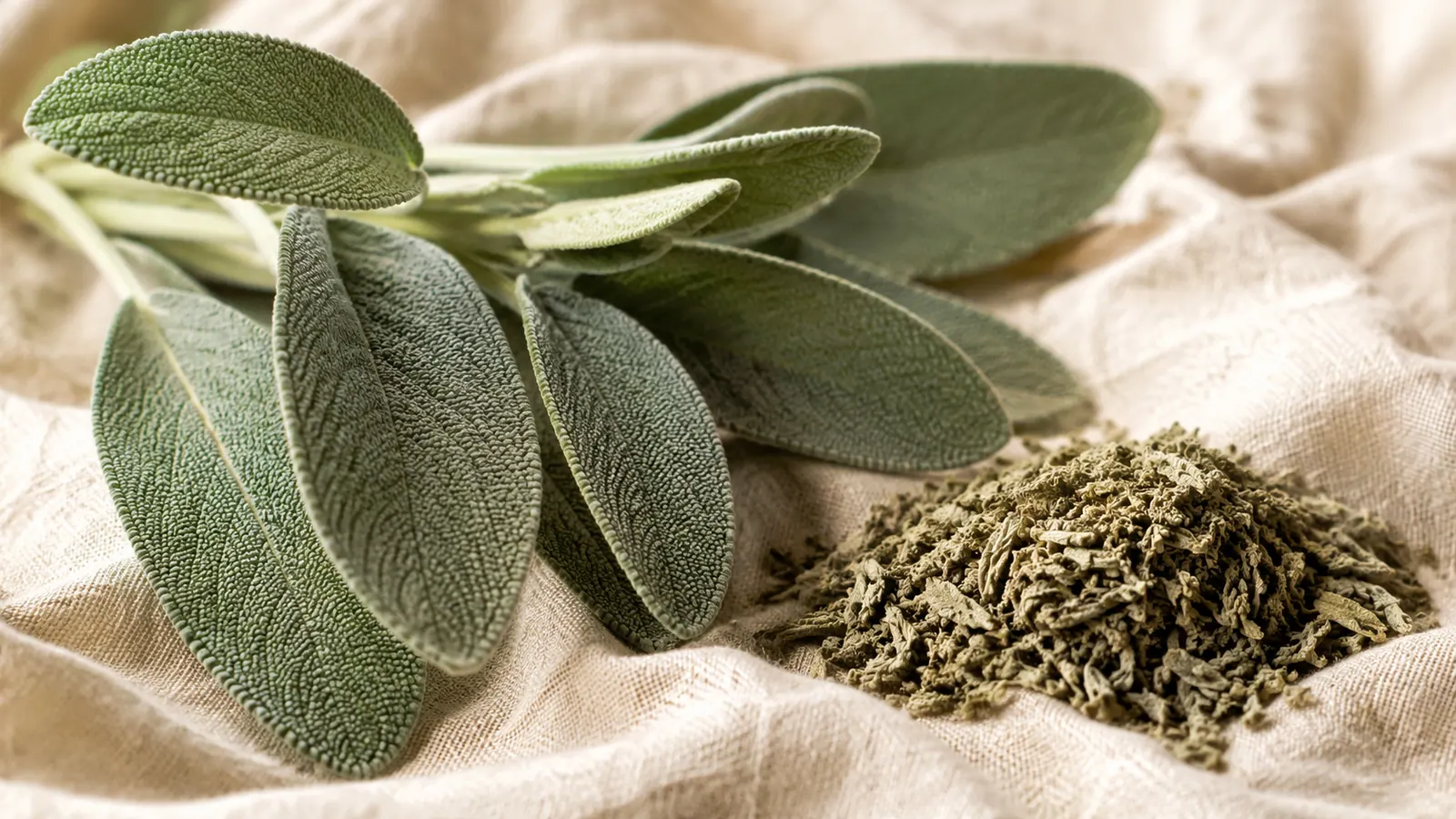
Sage is Salvia officinalis, a woody perennial of the mint family with soft, grey-green, velvety leaves and a warm, savoury, slightly camphoraceous aroma. It is a Mediterranean culinary herb grown in India's cooler hill zones for the dried-herb and essential-oil trade. The leaf is stripped and gently dried to hold its distinctive muted green colour; its character comes from a volatile oil in which thujone and cineole feature, giving the earthy, faintly bitter, pine-savoury note that defines sage in seasoning.
Sage is a classic seasoning herb for rich and fatty foods, most familiarly in poultry stuffing, sausage and processed-meat blends, where its aroma cuts through fat. In the India trade it is a modest, hill-grown line rather than a bulk crop, supplied as dried leaf and, in smaller quantity, as sage oil for flavour and fragrance. Because the leaf is soft and colour-sensitive, careful drying to avoid browning and aroma loss is what separates a premium lot from a dull, hay-like one.
Quality turns on colour retention, aroma, leaf integrity and cleanliness rather than on any single measurable spec. As with other dried culinary herbs, sage carries the herb-sector compliance concerns, including pyrrolizidine alkaloids from co-harvested weeds under EU limits, so weed management, clean harvesting and gentle drying are the practical levers that decide export acceptability and grade.
Forms & export grades
Dried sage leaf, whole or rubbed, for the seasoning trade.
Distilled sage essential oil for flavour and fragrance.
Varieties & types
- Common / culinary sage
- Standard Salvia officinalis grown for aromatic grey-green dried leaf, graded on colour and aroma.
- Rubbed sage
- Dried leaf rubbed to a light, fluffy texture rather than a fine powder, a common seasoning-trade form.
Growing regions
Sage is grown in Indian hill and temperate zones that suit a Mediterranean perennial, and production is modest and hill-based rather than a plains bulk crop. As a perennial it is cut through the growing season. Fresh, gently dried new leaf holds the best muted-green colour and aroma for the premium grades.
Uses & applications
- Dried leaf for poultry stuffing, sausage and processed-meat seasoning blends
- Mediterranean and mixed-herb seasoning mixes for the seasoning and QSR trade
- Culinary retail and food-service herb packs for the diaspora market
- Sage essential oil for flavour, fragrance and aromatherapy
- Herbal-tea and infusion blends
- Personal-care and cosmetic formulations using leaf extract and oil
- Nutraceutical and herbal-supplement use
Sourcing & export considerations
- Available as dried leaf (whole and rubbed) and, in smaller quantity, as sage essential oil.
- Graded on grey-green colour retention, aroma, leaf integrity and cleanliness; there is no single verified trade spec, so grade is described qualitatively.
- As a dried herb, leaf carries the pyrrolizidine-alkaloid concern from co-harvested weeds (EU limit 400 µg/kg for dried herbs), so weed-clean sourcing and testing support EU acceptability.
- Soft, colour-sensitive leaf needs gentle drying; where microbial reduction is required, steam treatment can be coordinated with vetted third parties to protect colour and volatile oil.
- Reports under herb/plant lines, so it lacks separable bilateral spice-trade data; describe supply qualitatively.
- Low-density dried leaf "cubes out" and ships light relative to seed spices; pack in food-grade lined bags/cartons with moisture protection.
- Order sizes and any MOQ are trade practice; on the contract specify form (whole/rubbed/oil), colour/aroma target, PA test where relevant and crop season.
ITC-HS classification
- 1211 90 99 — Plants/parts used in perfumery/pharmacy — other (culinary herbs)
Frequently asked
What is rubbed sage?
Rubbed sage is dried sage leaf rubbed into a light, fluffy texture rather than milled to a fine powder. It disperses evenly in seasoning blends and stuffings and is a common trade form alongside whole dried leaf.
What compliance point applies to dried sage for the EU?
As with other dried herbs, sage can carry pyrrolizidine alkaloids from weeds harvested alongside it, which the EU limits at 400 µg/kg. Weed-clean fields, careful harvesting and testing are the practical controls for EU-bound leaf.
What this page does not tell you
- Volume
- Herb lines; not separable.
Related spices
Sources
- Spices Board of India — Export statistics· Tier 1, retrieved 2026-07-16
- Spices Board Act, 1986 — Schedule of spices· Tier 1, retrieved 2026-07-16
- Reg. (EU) 2023/915 — maximum levels for certain contaminants· Tier 1, retrieved 2026-07-16
- CBI — Entering the European market for spices and herbs· Tier 2, retrieved 2026-07-16