Rosemary export from India
Salvia rosmarinus · Lamiaceae · Leaf
Grown for dried leaf and for rosemary extract, a natural antioxidant in demand from food manufacturers.
Rosemary at a glance
- Botanical name
- Salvia rosmarinus
- Family
- Lamiaceae
- Part used
- Leaf
- Forms exported
- Dried, Essential oil, Extract
- ITC-HS
- 1211 90 99
- Spices Board schedule
- #46
What is Rosemary and how is it exported from India?
Rosemary is the herb Salvia rosmarinus, exported dried and as rosemary extract — a carnosic-acid antioxidant used to extend shelf life in food manufacturing.
Overview
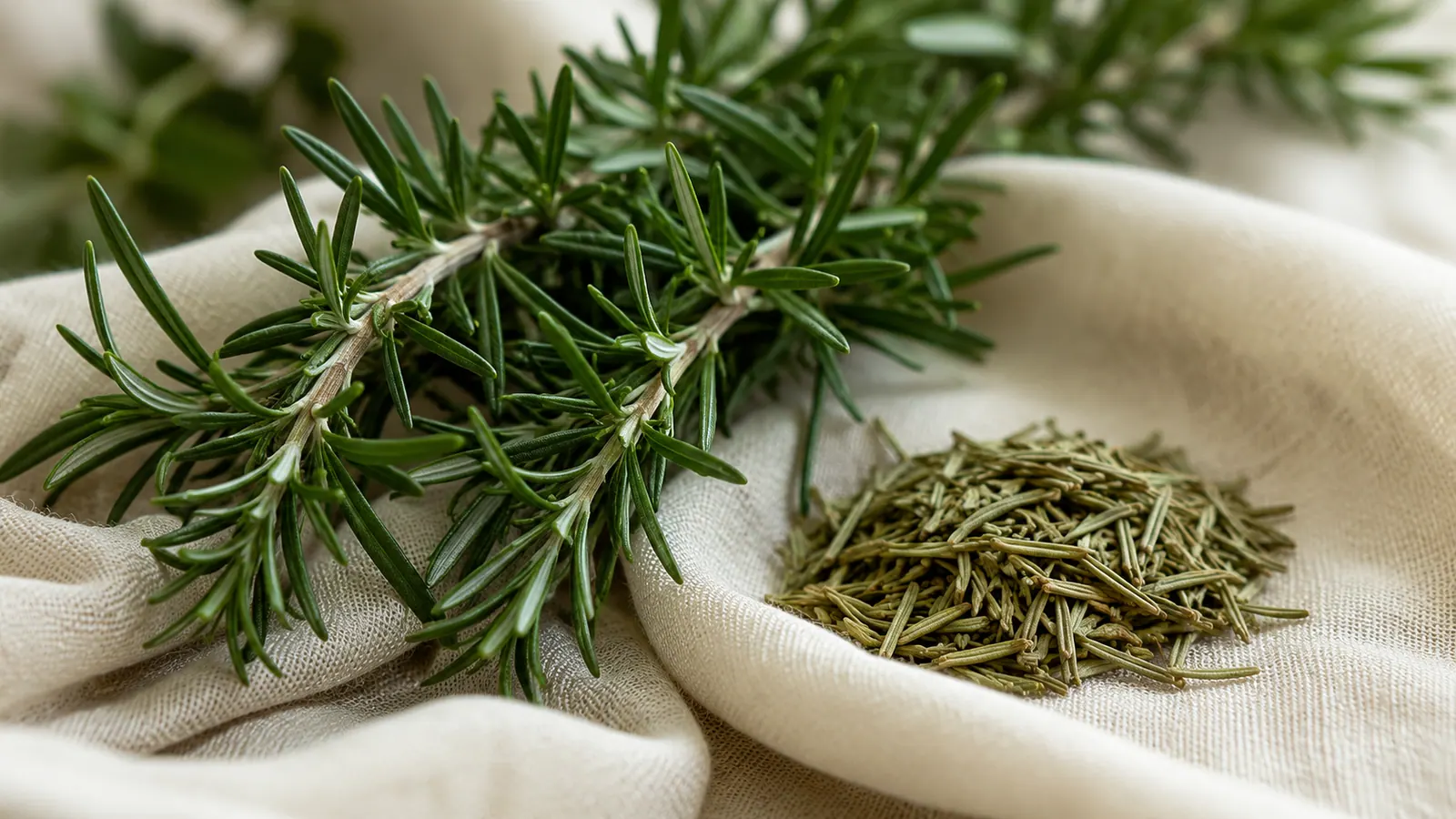
Rosemary is Salvia rosmarinus (long known as Rosmarinus officinalis), a woody evergreen shrub of the mint family with narrow needle-like leaves. It is grown in India for two connected products: dried leaf for the seasoning trade and rosemary extract, an antioxidant used by food manufacturers. The leaf is stripped and dried to a needle or cut form; its aroma is resinous, pine-like and camphoraceous, carried by a volatile oil rich in cineole and camphor, while a separate non-volatile fraction of phenolic diterpenes (chiefly carnosic acid and carnosol) is what drives the antioxidant business.
That antioxidant fraction is the reason rosemary matters well beyond the spice rack. Rosemary extract standardised on carnosic acid is a widely used natural antioxidant that food manufacturers add to fats, oils, meat and snack products to slow rancidity and extend shelf life, positioned as a clean-label alternative to synthetic antioxidants. Demand for rosemary as a raw material is therefore driven as much by the extract and natural-preservative market as by culinary seasoning, and a buyer sourcing rosemary should be clear which stream they are in, because leaf destined for extraction is specified on active-compound content while culinary leaf is specified on colour and aroma.
For the India trade rosemary sits in the herb-and-botanical-extract category rather than the classic seed-spice basket. Cultivation has grown with domestic and export demand for both dried herb and extract feedstock. As a dried herb it shares the herb-sector compliance concerns, including pyrrolizidine alkaloids from co-harvested weeds under EU limits, so weed-clean fields, clean drying and, for extract feedstock, consistent active content are the practical quality levers.
Forms & export grades
Dried rosemary leaf (whole or cut) for the seasoning trade.
Rosemary extract standardised on carnosic acid, sold as a natural antioxidant.
Distilled rosemary essential oil for flavour, fragrance and personal care.
Varieties & types
- Culinary dried leaf
- Whole or cut dried needles graded on green colour and aroma for the seasoning trade.
- Extract-grade leaf
- Leaf sourced for rosemary extract and specified on antioxidant (carnosic acid) content rather than appearance.
Growing regions
Rosemary is grown in Indian hill and semi-arid zones suited to a drought-tolerant Mediterranean shrub, with cultivation expanding to serve both the dried-herb and extract-feedstock demand. As a perennial evergreen it is cut through the growing season rather than harvested as a single annual crop. New, well-dried leaf carries the best colour and aroma for culinary grades, while extract buyers care more about active-compound content than season.
Uses & applications
- Dried leaf for Mediterranean and mixed-herb seasoning blends, marinades and roast-vegetable/meat seasonings
- Rosemary extract standardised on carnosic acid as a natural antioxidant to extend shelf life of fats, oils, meat and snacks
- Clean-label natural-preservative applications replacing synthetic antioxidants in food manufacturing
- Rosemary essential oil for flavour, fragrance and aromatherapy
- Personal-care and cosmetic formulations (hair and skin products) using leaf extract and oil
- Herbal-supplement and nutraceutical use of leaf and extract
- Beverage and infusion blends
- Seasoning-house raw material where a green, aromatic dried needle is specified
Sourcing & export considerations
- Available as dried leaf (whole/cut), rosemary extract (antioxidant), and rosemary essential oil; leaf, extract and oil are distinct products with distinct specs.
- Culinary leaf is graded on green colour, aroma and cleanliness; extract-feedstock leaf is specified on carnosic-acid/antioxidant content, so state the intended use up front.
- Rosemary extract for shelf-life/antioxidant use is a growing demand line; buyers should specify carnosic-acid standardisation and carrier where relevant.
- As a dried herb, leaf carries the pyrrolizidine-alkaloid concern from co-harvested weeds (EU limit 400 µg/kg for dried herbs), so weed-clean sourcing and testing support EU acceptability.
- Where microbial reduction is needed, steam treatment on dried leaf can be coordinated with vetted third parties to protect colour and volatile oil.
- Reports under herb/plant lines, so it lacks separable bilateral spice-trade data; describe supply qualitatively.
- Packaging in food-grade lined bags/cartons; dried needle is low-density and ships light relative to seed spices.
- On the contract specify product (leaf/extract/oil), cut, colour/aroma or active-content target, PA test where relevant and crop season.
ITC-HS classification
- 1211 90 99 — Plants/parts used in perfumery/pharmacy — other (culinary herbs)
Frequently asked
Why do food manufacturers buy rosemary extract?
Rosemary extract standardised on carnosic acid is a natural antioxidant that slows rancidity in fats, oils, meat and snacks, extending shelf life. It is used as a clean-label alternative to synthetic antioxidants, which drives much of the raw-material demand.
Is culinary rosemary the same as extract-grade rosemary?
They start from the same plant but are specified differently. Culinary leaf is graded on green colour and aroma; extract-grade leaf is sourced on antioxidant (carnosic acid) content. Buyers should state which stream they need before contracting.
What this page does not tell you
- Volume
- Herb/extract lines; not separable.
Related spices
Sources
- Spices Board of India — Export statistics· Tier 1, retrieved 2026-07-16
- Spices Board Act, 1986 — Schedule of spices· Tier 1, retrieved 2026-07-16
- Reg. (EU) 2023/915 — maximum levels for certain contaminants· Tier 1, retrieved 2026-07-16
- CBI — Entering the European market for spices and herbs· Tier 2, retrieved 2026-07-16