Paprika export from India
Capsicum annuum · Solanaceae · Fruit
India’s colour play — low-heat Capsicum grown and extracted for ASTA colour and paprika oleoresin rather than pungency.
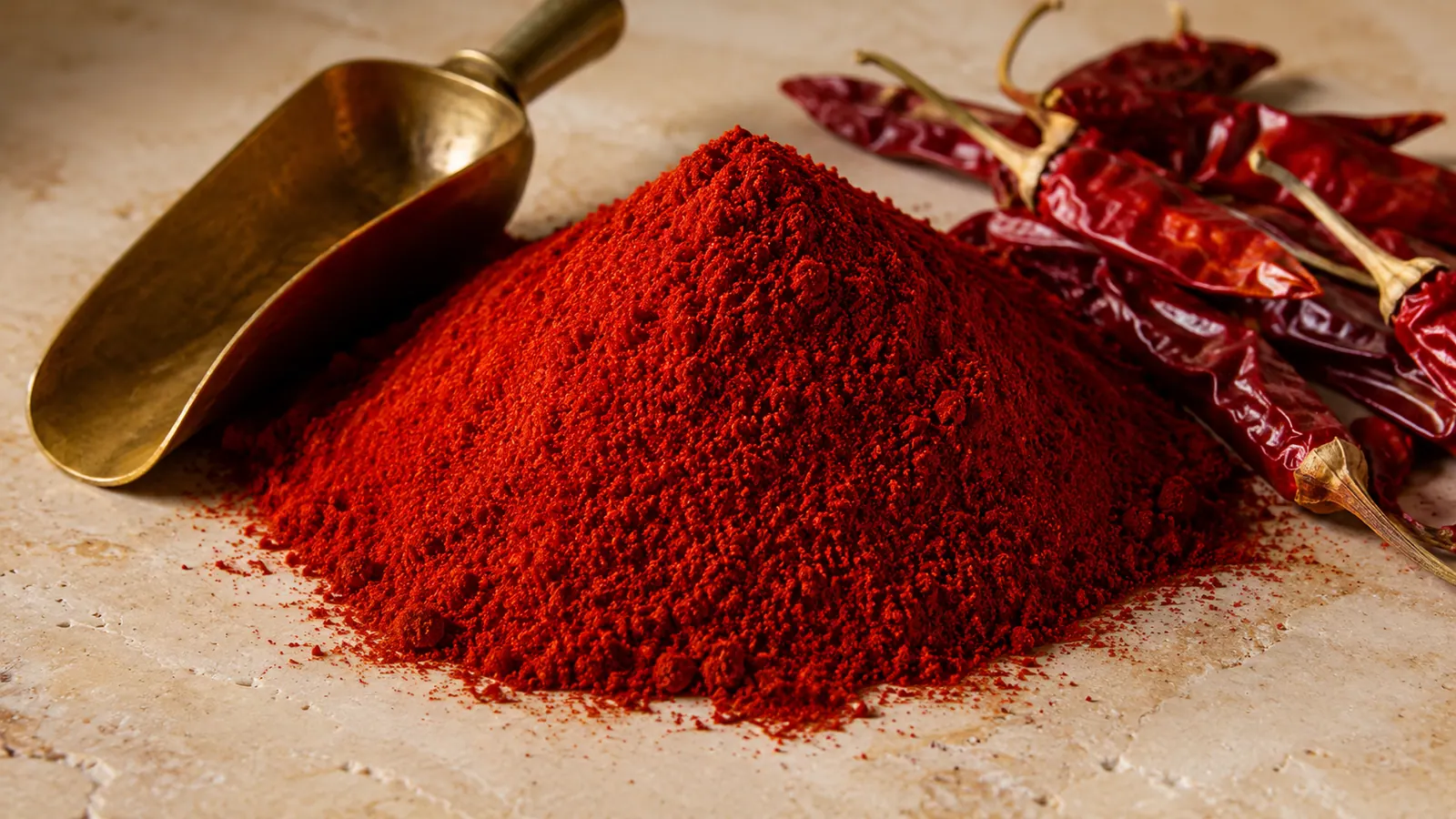
Paprika at a glance
- Botanical name
- Capsicum annuum
- Family
- Solanaceae
- Part used
- Fruit
- Also known as
- Deggi mirch (adjacent), Colour chilli
- Forms exported
- Ground, Oleoresin
- ITC-HS
- 0904 21 10, 0904 22 11
- Spices Board schedule
- #3
What is Paprika and how is it exported from India?
Paprika-type Capsicum annuum is grown in India (notably Byadgi and hybrids) for high surface colour at low heat. It is exported as ground powder and as paprika oleoresin, a natural colourant for food manufacturing.
Overview
Paprika-type Capsicum annuum is India’s colour play: chilli grown and processed not for heat but for its deep-red surface colour and its yield of natural colourant. The material is dominated by low-heat, high-colour types, above all the Byadgi chilli and modern colour hybrids, whose wrinkled, oleoresin-rich pods deliver ASTA colour in the 130–150 range at only mild pungency. It is exported both as ground paprika powder and, importantly, as paprika oleoresin, a concentrated natural food colour.
The commercial logic is that many food manufacturers want redness without adding heat, or want a standardised, particulate-free colourant they can dose precisely. Ground paprika serves the first need; oleoresin serves the second, expressed in colour value (ASTA or colour units) so a sauce, snack or meat product hits a target shade batch after batch. Because the value sits in colour and extract, growing and grading decisions optimise ASTA and oleoresin content rather than Scoville heat.
Paprika does not report under a separate customs line: it moves under the same chilli/Capsicum HS codes as hot chilli, so a clean paprika-only trade figure is not separately published, and volumes are best described qualitatively. Its compliance profile follows chilli, with aflatoxin as the governing contaminant under EU limits and Indian material subject to increased EU border controls, making tested, traceable lots the norm.
Forms & export grades
Paprika powder milled to a target ASTA colour and mesh for direct food use.
Concentrated paprika oleoresin sold on standardised colour value for precise dosing.
Whole colour chilli (Byadgi-type) pods traded within the chilli stream for grinding or extraction.
Varieties & types
- Byadgi (Kaddi/Dabbi)
- The classic Indian colour chilli, wrinkled and deep red, at ASTA 130–150 and low heat; the mainstay of paprika-style supply.
- Colour hybrids (high-ASTA lines)
- Bred low-heat, high-colour hybrids grown specifically to lift oleoresin and ASTA colour yield.
- Deggi-type (adjacent)
- A mild, bright-red blend positioning close to paprika, used where colour with only gentle heat is wanted.
Growing regions
Colour-chilli cultivation centres on the Byadgi belt of Karnataka and adjoining parts of Andhra Pradesh and Telangana, with hybrid colour types grown across the same chilli-producing zones. The crop follows the chilli calendar, planted after the monsoon and harvested and sun-dried from late winter into spring, with pods selected for colour rather than pungency.
Uses & applications
- Natural red colouring of processed foods, sauces, snacks, seasonings and ready meals
- Paprika oleoresin as a standardised, particulate-free colourant dosed to a target colour value
- Meat and sausage colouring in the processed-meat industry
- Colour component of spice blends, rubs and seasoning mixes
- Colouring of poultry feed and, in some markets, egg-yolk and aquaculture pigmentation
- Snack coatings and cheese-analogue colouring
- Cosmetic and personal-care tinting where a natural red is required
- A mild colour-and-flavour base in ethnic-foods and QSR blends
Sourcing & export considerations
- Available as ground paprika powder and as paprika oleoresin; whole colour pods also move within the chilli trade
- Specify ASTA colour (or colour value) as the primary parameter, with heat kept low and stated separately
- Oleoresin is bought on standardised colour units for precise dosing; powder is bought on ASTA and mesh
- Cleaned and sortex-sorted; steam-sterilised, ETO-free lots available for regulated markets
- Compliance flags: aflatoxin under EU limits with increased EU border controls, following the chilli regime
- Lacks a separable trade figure because paprika reports under the same Capsicum HS lines as hot chilli; describe volume qualitatively
- Colour fades with light and time, so buyers favour current-crop material and opaque, moisture-controlled packing
- Sample and blend-scale MOQs follow standard chilli trade practice; require a recent aflatoxin and colour test
ITC-HS classification
- 0904 21 10 — Fruits of genus Capsicum, dried, neither crushed nor ground — chilli
- 0904 22 11 — Chilli powder (Capsicum, crushed or ground)
- 3301 90 16 — Spice oleoresins
Compliance that applies
Frequently asked
What is the difference between paprika powder and paprika oleoresin?
Paprika powder is milled dried chilli used for colour and mild flavour; paprika oleoresin is a solvent-extracted concentrate sold on colour value, added in small doses to hit an exact shade without particulate or added flavour.
Is Indian paprika hot?
No, it is bred and selected for colour, not heat. Byadgi-type and colour hybrids reach ASTA 130–150 at only mild pungency, which is exactly why food manufacturers use them to add redness without adding significant heat.
What this page does not tell you
- Separate paprika trade volume
- Paprika reports under the same chilli/Capsicum HS lines as hot chilli; a clean paprika-only figure is not separately published.
Related spices
Sources
- Spices Board of India — Export statistics· Tier 1, retrieved 2026-07-16
- Spices Board Act, 1986 — Schedule of spices· Tier 1, retrieved 2026-07-16
- Reg. (EU) 2019/1793 — temporary increase of official controls· Tier 1, retrieved 2026-07-16
- Reg. (EU) 2023/915 — maximum levels for certain contaminants· Tier 1, retrieved 2026-07-16