What Is Sudan Dye in Chilli, and Why It Matters
The illegal red colourant behind repeat chilli rejections, and the zero-tolerance testing that keeps it out.
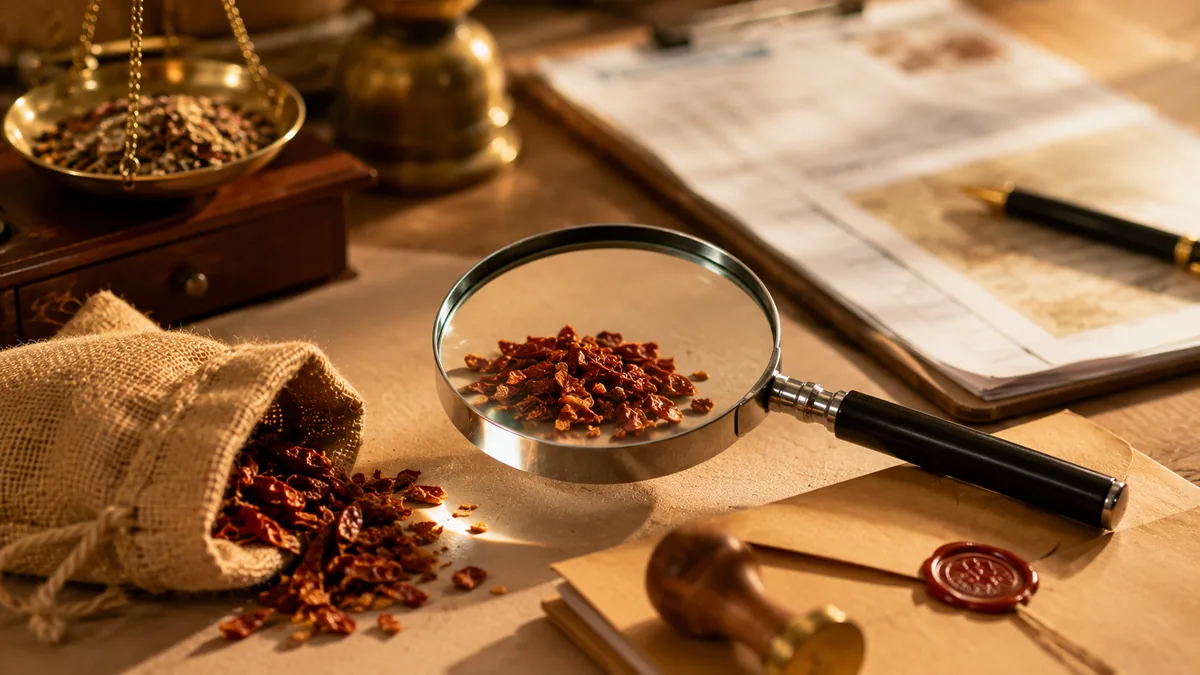
What is Sudan dye in chilli powder and how do I avoid it?
Sudan dyes are illegal industrial red colourants sometimes added to chilli and paprika to fake vivid colour. They carry zero tolerance in food. Avoid them by requiring a Sudan dye screen on the export lot, not the seller’s word.
Why Sudan dye shows up in chilli
Chilli is frequently bought on colour. Byadgi chilli, for example, is prized for an ASTA colour of 130–150 rather than heat. That colour premium creates an incentive to fake redness cheaply, and Sudan dyes — industrial colourants never permitted in food — are the classic illegal shortcut.
Because tolerance is zero, even a trace detection can trigger a RASFF alert and rejection. It is treated as a food-safety violation, not a quality dispute.
How to source clean chilli
- Require a Sudan dye screen on the specific export lot.
- Buy colour on verified ASTA value (e.g. Byadgi 130–150, Guntur Sannam S4 100–120), not on how red a sample looks.
- Prefer whole dried chilli you can inspect over powder where feasible.
- For high-risk lots, test on arrival at destination.
Frequently asked
What is the legal limit for Sudan dye?
There is effectively zero tolerance: Sudan dyes are not permitted in food at all, so any confirmed detection is a violation and grounds for rejection.
Is redder chilli always better?
No. Judge colour on lab-verified ASTA value. Unnaturally uniform, intense red can indicate added dye rather than natural pigment.
Sourcing this? Tell us the spice, grade and destination and we return a documented offer — vetted supply, QC oversight, and the test dossier your market needs.
Start a sourcing enquiry →What this page does not tell you
- Frequency of Sudan dye detections
- We do not quote how often Sudan dye is found; we describe the zero-tolerance rule and testing rather than an unsourced detection rate.
Reviewed 16 July 2026.
Sources
- Spices Board of India — Export statistics· Tier 1, retrieved 2026-07-16
- Reg. (EU) 2023/915 — maximum levels for certain contaminants· Tier 1, retrieved 2026-07-16
- RASFF Window — EU rapid alert for food and feed· Tier 1, retrieved 2026-07-16