Oregano export from India
Origanum vulgare · Lamiaceae · Leaf
A fast-growing demand herb — dried oregano for the pizza-seasoning and QSR supply chain.
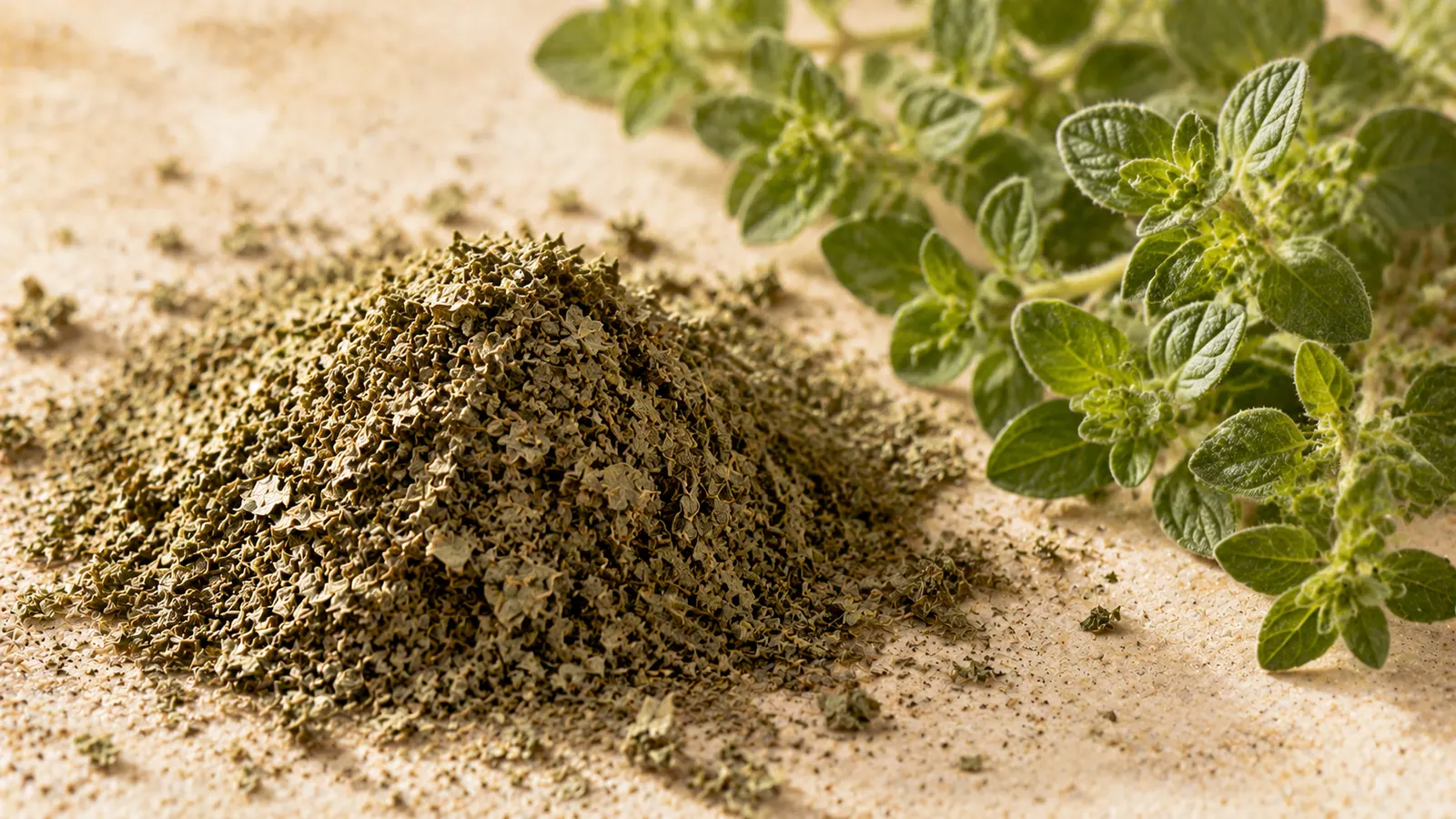
Oregano at a glance
- Botanical name
- Origanum vulgare
- Family
- Lamiaceae
- Part used
- Leaf
- Forms exported
- Dried
- ITC-HS
- 1211 90 99
- Spices Board schedule
- #50
What is Oregano and how is it exported from India?
Oregano is Origanum vulgare, exported dried for pizza seasoning and Italian-style blends. Indian cultivation has expanded with domestic and export demand.
Overview
Oregano is Origanum vulgare, a hardy perennial of the mint family and one of the fastest-growing demand herbs in the Indian trade. It is grown for dried leaf, above all for the pizza-seasoning and Italian-blend market that has expanded with the spread of quick-service restaurants and packaged foods. Its aroma is warm, pungent and slightly bitter, carried by a volatile oil in which carvacrol and thymol dominate; the balance of those two phenols, which shifts by chemotype and growing conditions, is what makes one oregano lot bolder or milder than another.
The commercial story is demand-led. Oregano was once a specialty import into India, but domestic cultivation has expanded to serve both the home QSR and packaged-food market and export seasoning buyers, making it one of the more dynamic herb lines rather than a static tail spice. For the pizza-seasoning supply chain the leaf is bought as a defined cut and rubbed grade with consistent green colour and strong aroma, because it is a visible, aroma-forward topping rather than a background note.
Quality turns on carvacrol-led aroma strength, green colour retention, a clean leaf-to-stem ratio and freedom from foreign matter, rather than on a single verified spec. As a high-volume dried culinary herb, oregano also carries the herb-sector compliance concern of pyrrolizidine alkaloids from co-harvested weeds under EU limits, and, as with any dried leaf going into ready-to-eat seasoning, microbial control matters, so weed-clean fields, clean drying and, where required, steam treatment coordinated with vetted third parties are the practical levers.
Forms & export grades
Dried oregano leaf in defined cuts (pizza-cut/rubbed/whole) for the seasoning trade.
Carvacrol-rich oregano essential oil for flavour and functional use.
Varieties & types
- Pizza-cut / rubbed oregano
- Dried leaf processed to a consistent cut and rubbed texture for the pizza-seasoning trade, graded on colour and aroma.
- Whole dried leaf
- Less-processed dried oregano leaf for buyers who cut or blend it themselves.
Growing regions
Oregano cultivation in India has expanded from specialty plantings into wider hill and plateau growing as domestic QSR and export demand has risen, so it is a growing rather than a static crop. As a perennial it is cut through the growing season. Fresh, well-dried new leaf carries the strongest carvacrol aroma and best green colour, which the pizza-seasoning trade grades on closely.
Uses & applications
- Dried leaf for pizza seasoning and Italian-style herb blends across the QSR and packaged-food supply chain
- Pasta, sauce and pizza-topping seasoning in food manufacturing
- Mixed-herb and Mediterranean seasoning blends
- Table-top and sachet seasoning packs for food service and retail
- Oregano essential oil (carvacrol-rich) for flavour, and as a functional/antimicrobial ingredient
- Herbal-supplement and nutraceutical use of leaf and oil
- Marinade and dressing seasoning
Sourcing & export considerations
- Available as dried leaf in defined cuts (pizza-cut/rubbed) and as whole leaf, plus carvacrol-rich oregano oil.
- Graded on aroma strength (carvacrol-led), green colour retention, leaf-to-stem ratio and cleanliness; there is no single verified trade spec, so grade is described qualitatively.
- Demand is expanding with the QSR and packaged-food market, so continuity and a consistent cut/colour matter to seasoning buyers.
- As a dried herb, leaf carries the pyrrolizidine-alkaloid concern from co-harvested weeds (EU limit 400 µg/kg for dried herbs), so weed-clean sourcing and testing support EU acceptability.
- For ready-to-eat seasoning, microbial control matters; steam treatment can be coordinated with vetted third parties to protect colour and aroma.
- Reports under herb/plant lines, so it lacks separable bilateral spice-trade data; describe supply qualitatively.
- Low-density dried leaf "cubes out" and ships light; pack in food-grade lined bags/cartons with moisture protection.
- On the contract specify cut (pizza-cut/rubbed/whole), colour/aroma target, microbial spec, PA test where relevant and crop season.
ITC-HS classification
- 1211 90 99 — Plants/parts used in perfumery/pharmacy — other (culinary herbs)
Frequently asked
Why has Indian oregano cultivation grown so fast?
Demand from quick-service restaurants and packaged foods for pizza and Italian-style seasoning has risen sharply, and domestic cultivation has expanded to serve both that home market and export buyers, making oregano one of the more dynamic herb lines rather than a static tail spice.
What is "pizza-cut" oregano?
It is dried oregano leaf processed to a consistent cut and rubbed texture specifically for pizza seasoning, where the herb is a visible, aroma-forward topping. Buyers grade it on green colour and carvacrol-led aroma strength as well as cut consistency.
What determines whether an oregano lot is bold or mild?
The balance of carvacrol and thymol in the volatile oil, which shifts by chemotype and growing conditions. Carvacrol-led lots are more pungent. Buyers who need a consistent seasoning profile should specify aroma strength and, where relevant, request lot consistency.
What this page does not tell you
- Volume
- Herb lines; not separable.
Related spices
Sources
- Spices Board of India — Export statistics· Tier 1, retrieved 2026-07-16
- Spices Board Act, 1986 — Schedule of spices· Tier 1, retrieved 2026-07-16
- Reg. (EU) 2023/915 — maximum levels for certain contaminants· Tier 1, retrieved 2026-07-16
- CBI — Entering the European market for spices and herbs· Tier 2, retrieved 2026-07-16