Long Pepper export from India
Piper longum · Piperaceae · Fruit
Pippali — a piperine-rich Ayurvedic pepper distinct from Piper nigrum.
Long Pepper at a glance
- Botanical name
- Piper longum
- Family
- Piperaceae
- Part used
- Fruit
- Also known as
- Pippali
- ITC-HS
- 0910 99 99
- Spices Board schedule
- #27
What is Long Pepper and how is it exported from India?
Long pepper is the dried fruit spike of Piper longum, hotter and sweeter than black pepper and important in Ayurvedic formulations as pippali.
Overview
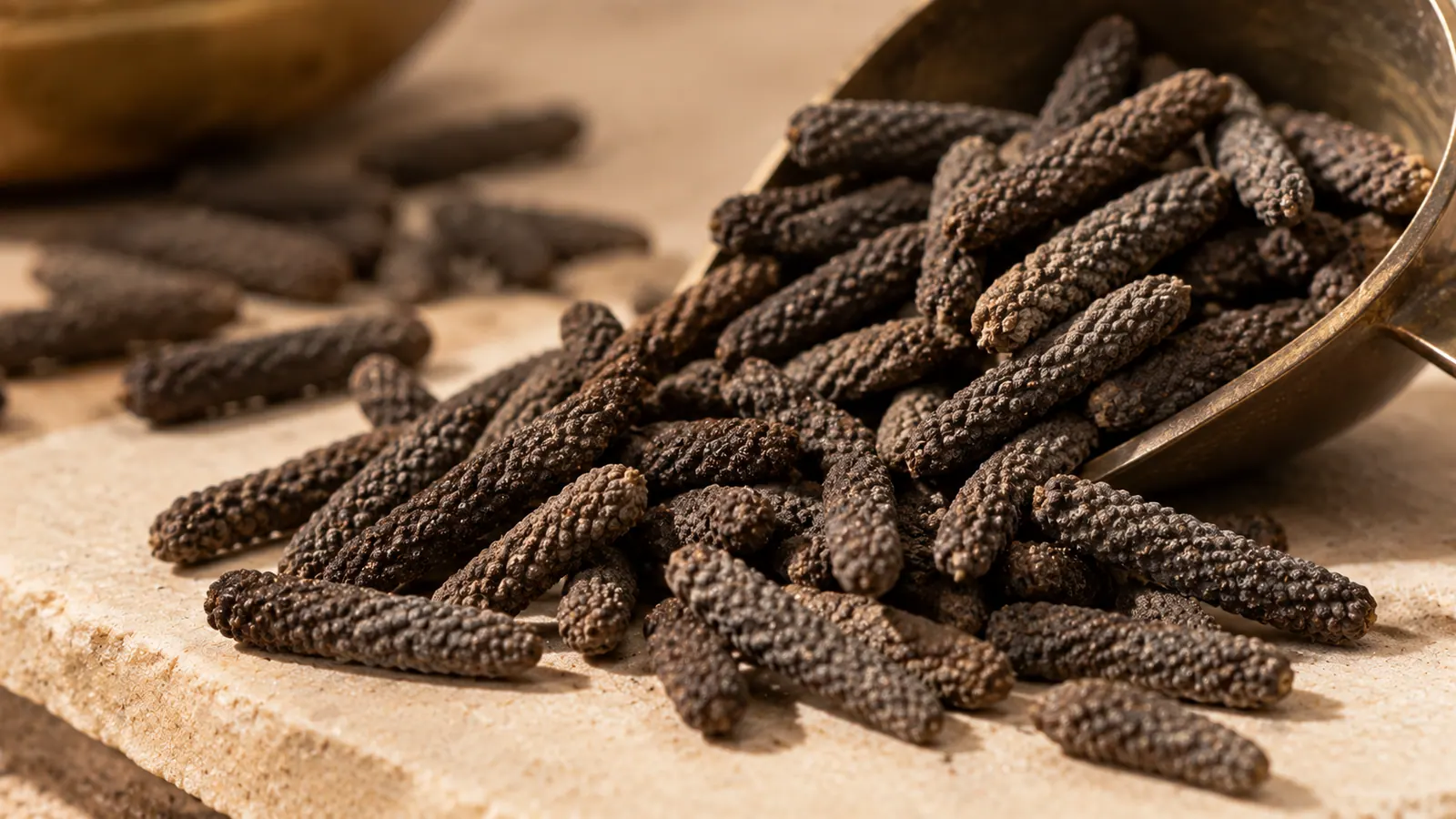
Long pepper is the dried fruit spike of Piper longum, known in Ayurveda as pippali, a close relative of black pepper (Piper nigrum) in the Piperaceae family but a distinct spice with its own character. Instead of loose round berries, the fruit is a small elongated catkin, a cylindrical spike a couple of centimetres long made of many tiny fused fruits, dried to a hard, dark grey-brown rod. Its flavour is hotter, sweeter and more lingering than black pepper, with a complex peppery-sweet warmth prized in both cooking and traditional medicine.
The pungency of long pepper comes largely from piperine, the same alkaloid as in black pepper, and the spice is valued both culinarily and as an important Ayurvedic drug (pippali is a classical medicine and a component of formulations such as trikatu). This dual identity, culinary spice and nutraceutical/traditional-medicine raw material, shapes its trade: buyers may want it as whole spikes for cooking and speciality blends, or as a raw material for piperine and standardised extract manufacturing.
Quality is judged on the size and intactness of the spikes, colour, aroma and pungency, and freedom from stalk, grit and mould. There is also a related Indonesian/Javanese long pepper (Piper retrofractum) in the wider market, so botanical identity is worth specifying. Long pepper is a niche spice reporting under the residual HS 0910 99 basket, carrying no separable bilateral trade data.
For an export buyer the practical questions are botanical identity (P. longum for the classical pippali), whole-spike grade and size, pungency/piperine expectation for extraction buyers, and clean, well-dried, mould-free material.
Forms & export grades
Whole dried long-pepper spikes graded by size and intactness, the principal culinary and Ayurvedic form.
Ground long pepper for speciality blends and gourmet ranges.
Standardised long-pepper / piperine extract for the nutraceutical trade.
Varieties & types
- Indian long pepper (Piper longum, pippali)
- The classical Ayurvedic long pepper, small dark spikes grown and gathered in India and the reference material for pippali.
- Javanese / Balinese long pepper (Piper retrofractum)
- A related, often larger long pepper from Southeast Asia found in the wider market; a different species, so specify P. longum where the classical spice is required.
Growing regions
Piper longum is grown and gathered in the humid forests and plantations of the Western Ghats and Northeast India, with supply from Kerala and the eastern/northeastern hill regions. It is a perennial vine whose spikes are harvested when still green-to-just-mature and then dried; it is a collected and small-plantation crop rather than a large field commodity.
Uses & applications
- Whole dried spikes as a culinary spice in select Indian, Southeast-Asian and speciality cuisines
- Component of Ayurvedic formulations (pippali, trikatu and allied preparations) for the traditional-medicine trade
- Raw material for piperine extraction and standardised long-pepper extract
- Nutraceutical and bioavailability-enhancer applications that use piperine-rich material
- Ground long pepper for speciality spice blends and gourmet ranges
- Herbal-tea, tonic and traditional-remedy preparations
- Retail-pack whole spikes for the diaspora, Ayurvedic and gourmet markets
Sourcing & export considerations
- Available as whole dried spikes (graded by size and intactness) and as ground long pepper; also as raw material for piperine/extract manufacturing
- Graded on spike size and wholeness, colour, aroma and pungency, and freedom from stalk, grit and mould
- Botanical identity is a flag: specify Piper longum for the classical pippali versus the related Piper retrofractum found in the wider market
- For extraction buyers, piperine/pungency expectation should be stated; for culinary buyers, spike size and aroma dominate
- Reports under residual HS 0910 99, so it lacks separable bilateral trade data
- Packed in lined bags or cartons with moisture barriers; a hard, well-dried spike stores well, but mould risk rises if moisture is not controlled
- Cleaning, grading and any decontamination are coordinated with vetted third-party processors; pesticide-residue and microbial testing should accompany food-use and nutraceutical lots
- Specify botanical (P. longum), whole-spike vs ground, size grade, pungency expectation and packaging on the contract
ITC-HS classification
- 0910 99 99 — Spices — other, not elsewhere specified (residual basket line)
Frequently asked
How is long pepper different from black pepper?
Long pepper (Piper longum) is a different species from black pepper (Piper nigrum). Its fruit is an elongated spike of many tiny fused fruits, not loose round berries, and its flavour is hotter, sweeter and more lingering. Both owe their pungency largely to piperine.
Which species should I specify for classical pippali?
Specify Piper longum for the classical Ayurvedic pippali. A related long pepper, Piper retrofractum (Javanese/Balinese), circulates in the wider market and is often larger; stating the botanical name avoids getting the wrong species.
What this page does not tell you
- Volume
- HS 0910 99; niche.
Related spices
Sources
- Spices Board of India — Export statistics· Tier 1, retrieved 2026-07-16
- Spices Board Act, 1986 — Schedule of spices· Tier 1, retrieved 2026-07-16