Bay Leaf export from India
Laurus nobilis · Lauraceae · Leaf
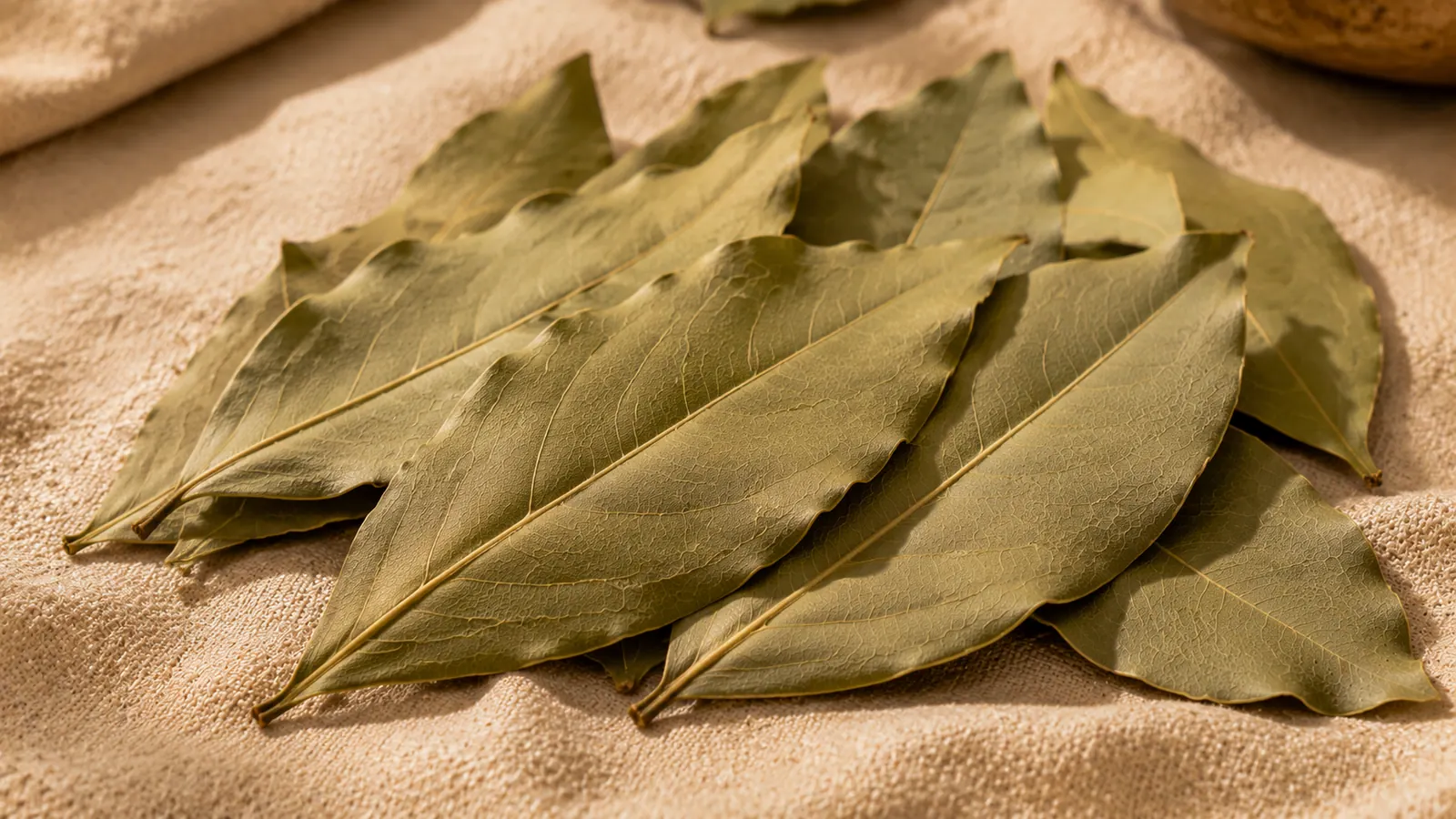
True Mediterranean bay (Laurus nobilis) — not to be confused with the Cinnamomum "Indian bay leaf" (tejpat).
Bay Leaf at a glance
- Botanical name
- Laurus nobilis
- Family
- Lauraceae
- Part used
- Leaf
- Also known as
- True bay, Laurel
- ITC-HS
- 0910 99 99
- Spices Board schedule
- #38
What is Bay Leaf and how is it exported from India?
Bay leaf is the leaf of Laurus nobilis. It is distinct from tejpat (Cinnamomum tamala), which the Indian market often mislabels as "bay leaf". True Laurus bay is only marginally grown in India.
Overview
True bay leaf is the leaf of Laurus nobilis, the Mediterranean laurel, an evergreen of the Lauraceae. The leaf is stiff, glossy and elliptical, and its aroma is clean, sweet-herbaceous and faintly eucalyptus-like, built on an essential oil dominated by 1,8-cineole. It is used whole as a background aromatic in slow-cooked dishes and lifted out before serving, contributing depth rather than a foreground flavour. Quality is judged on whole unbroken leaves, even olive-to-grey-green colour, aroma retention and freedom from yellowing, spotting and stalk.
The single most important commercial point about bay leaf in the Indian context is a naming confusion that costs buyers real money. The leaf the Indian market routinely calls "bay leaf" or tejpat is usually Cinnamomum tamala, a Lauraceae cousin with a completely different, cinnamon-clove aroma and three prominent longitudinal veins, not the single central mid-vein of Laurus. They are not interchangeable in a recipe: a European dish specifying bay leaf wants Laurus nobilis, while tejpat belongs in garam-masala-style Indian cooking. A contract that just says "bay leaf" is ambiguous.
True Laurus bay is only marginally grown in India; it is not a mainstream Indian field crop, and much of the Mediterranean-style bay in world trade comes from Turkey and the Mediterranean basin. So a meaningful share of what moves as "bay leaf" through Indian channels is either tejpat or imported Laurus. For a sourcing desk the disciplined practice is to pin the botanical name on every contract and confirm origin rather than let the common name paper over two different spices.
Forms & export grades
Whole dried leaf, the standard and most verifiable trade format.
Milled bay for seasoning blends; loses aroma faster than whole leaf.
Varieties & types
- True bay / laurel (Laurus nobilis)
- The Mediterranean laurel leaf, clean and cineole-led; what European recipes mean by bay leaf.
- Indian bay leaf / tejpat (Cinnamomum tamala)
- A different Lauraceae species with a cinnamon-clove aroma and three long veins; scheduled separately as tejpat.
- Whole hand-selected leaf
- Unbroken, evenly coloured leaves; the premium presentation grade.
Growing regions
True Laurus nobilis is not a significant Indian field crop; it grows only marginally in cooler Indian pockets, while the tejpat commonly sold as Indian bay leaf is a Himalayan and sub-Himalayan Cinnamomum tamala crop (including GI-tagged Uttarakhand tejpat). Most Mediterranean-type bay in world trade is Turkish and Mediterranean in origin. Indian channels therefore mix genuine tejpat with imported or re-exported Laurus, which makes species and origin verification the key task.
Uses & applications
- Whole leaf as a background aromatic in soups, stocks, stews, braises and sauces
- A component of bouquet garni and classical French and Mediterranean mother sauces
- Pickling and brining spice blends and marinades
- Rice, pulse and slow-cooked dishes across many cuisines
- Ground bay in seasoning mixes where whole-leaf removal is impractical
- Bay (laurel) essential oil for flavour and fragrance
- Food-manufacturing stock, soup and ready-meal seasoning bases
Sourcing & export considerations
- Pin the botanical name on every enquiry: Laurus nobilis (true bay) and Cinnamomum tamala (tejpat) are different spices with different aromas and are not interchangeable
- Available whole (hand-selected or field-run) and ground; whole leaf is the premium and most verifiable format
- Grading turns on whole unbroken leaves, even colour, aroma retention and freedom from yellowing, spotting and stalk
- Cleaning, de-stemming and grading are coordinated with vetted third-party processors rather than owned lines
- Packaging: flat cartons or lined sacks that limit leaf breakage; light and moisture barriers protect the cineole aroma
- Shelf life is aroma-driven rather than a fixed figure; whole leaf holds far better than ground, which fades quickly
- Reports under residual HS 0910 99, and with tejpat and Laurus both moving as "bay leaf" there is no clean species-level trade figure
- Specify on contract: exact species, whole vs ground, leaf grade, and confirmed origin (India-grown tejpat vs imported/re-exported Laurus)
ITC-HS classification
- 0910 99 99 — Spices — other, not elsewhere specified (residual basket line)
Frequently asked
Is Indian "bay leaf" the same as true bay leaf?
Usually not. The leaf commonly sold as Indian bay leaf is tejpat (Cinnamomum tamala), a different species with a cinnamon-clove aroma. True bay is Laurus nobilis, a Mediterranean laurel with a cleaner note. Specify the botanical name to avoid buying the wrong one.
How do I tell Laurus bay from tejpat?
Aroma and veining. True bay (Laurus nobilis) smells clean and eucalyptus-sweet and has one central mid-vein; tejpat (Cinnamomum tamala) smells of cinnamon and clove and shows three prominent lengthwise veins. They are not recipe-interchangeable.
Does India grow true bay leaf?
Only marginally. Laurus nobilis is not a mainstream Indian crop; much Mediterranean-type bay is Turkish or Mediterranean. India-grown material is largely tejpat, so we confirm species and origin before certifying a lot as true bay.
What this page does not tell you
- Origin
- Much "bay leaf" in Indian trade is tejpat or imported Laurus; origin needs care.
Related spices
Sources
- Spices Board of India — Export statistics· Tier 1, retrieved 2026-07-16
- Spices Board Act, 1986 — Schedule of spices· Tier 1, retrieved 2026-07-16
- Geographical Indications Registry, India — Registered GIs· Tier 1, retrieved 2026-07-16