Saffron export from India
Crocus sativus · Iridaceae · Stigma
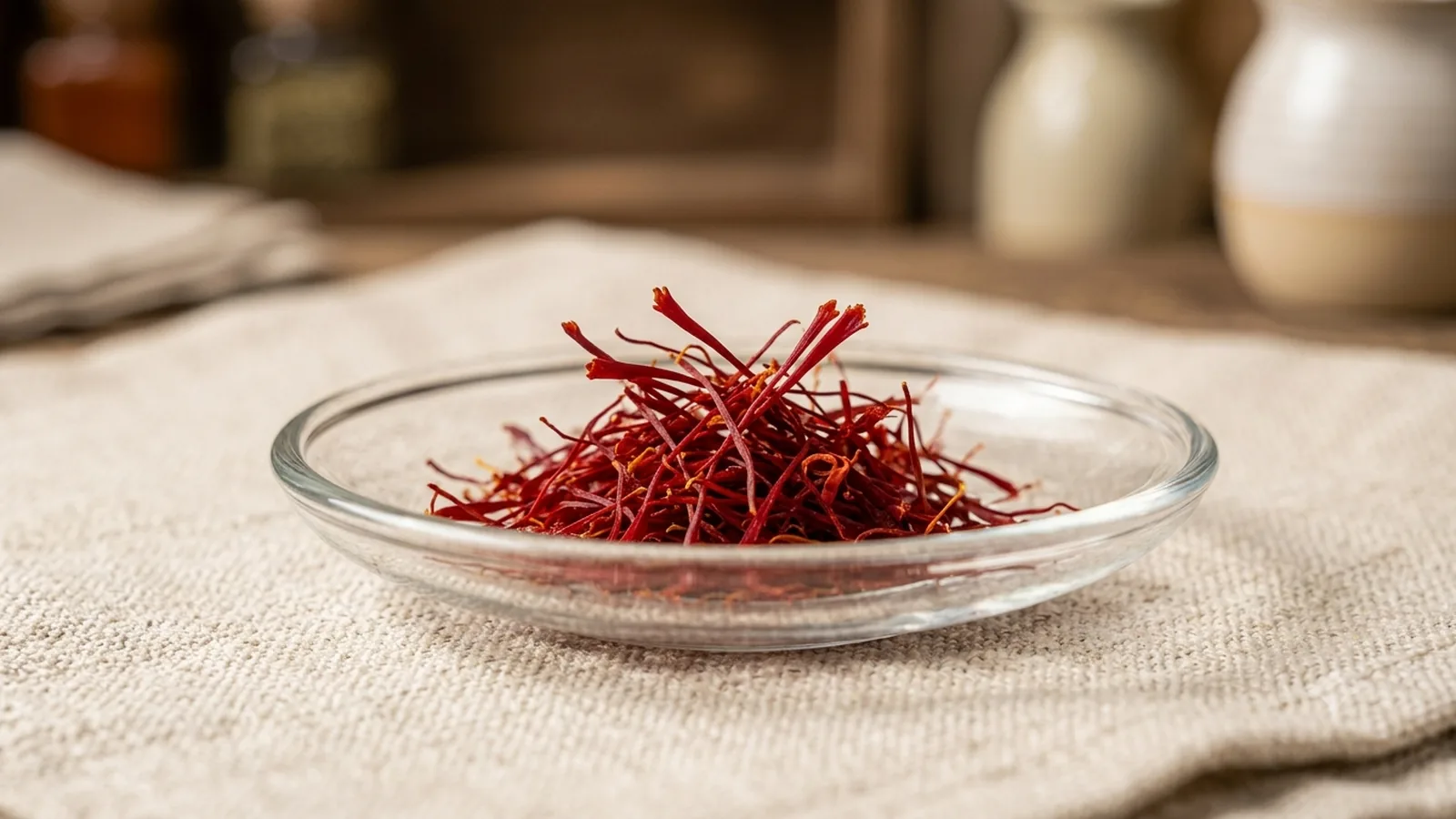
Kashmir’s GI-tagged Mongra saffron — among the world’s highest-crocin, and sold by the gram, not the tonne.
Saffron at a glance
- Botanical name
- Crocus sativus
- Family
- Iridaceae
- Part used
- Stigma
- Also known as
- Kesar, Zafran
- ITC-HS
- 0910 20 10, 0910 20 90
- Spices Board schedule
- #24
What is Saffron and how is it exported from India?
Saffron is the dried stigma of Crocus sativus. Indian saffron is grown almost entirely in Kashmir (GI-tagged), prized for high crocin (colour) and safranal (aroma). It air-freights from small quantities.
Overview
Saffron is the dried stigma of the autumn crocus, Crocus sativus, and India's crop is grown almost entirely in Kashmir, where it holds a GI registration. It is the world's most valuable spice by weight because each flower yields only three stigmas, all hand-picked and hand-separated, so a very large number of flowers is needed for a small quantity of finished saffron. What a buyer sources is a labour-intensive, quality-graded thread traded by the gram and air-freighted, not a bulk commodity moved in containers.
Kashmir saffron is prized for its intensity: it is noted qualitatively as among the world's highest in crocin, the pigment responsible for saffron's deep colouring power, alongside strong safranal (aroma) and picrocrocin (the bitter-tasting principle). These three attributes, colour, aroma and flavour, are the axes on which saffron is graded, and the deep-red, thick, trumpet-shaped stigma tips (the Mongra/Lacha grades) carry the highest value while paler, yellow-styled portions are worth less.
Authenticity is the defining trade issue. Saffron is among the most adulterated spices in the world, faced with dyed safflower or maize-silk substitution, added colourings, moisture loading and blending of lower grades. Serious buyers therefore rely on laboratory grading against colour, aroma and flavour strength and on GI provenance, treating documentation and testing as central rather than optional.
For the India export trade saffron is a small-volume, high-attention product: quantities are measured in kilograms, lots are often confidential, and the whole commercial proposition rests on genuineness, grade and Kashmir GI provenance rather than on price competition or scale.
Forms & export grades
Whole dried saffron threads by grade (Mongra/Lachha, Guchhi), the principal and most verifiable traded form.
Standardised saffron extract for the nutraceutical, flavour and supplement trade.
Varieties & types
- Mongra / Lachha (Kashmir)
- The top grade: deep-red, pure stigma tips with the highest colouring and aroma strength, and the most sought-after Kashmir type.
- Guchhi (Kashmir)
- Whole dried stigmas bundled with some yellow style attached, a traditional grade below pure Mongra.
Growing regions
Indian saffron is grown almost entirely on the karewa plateaux of Kashmir, centred on Pampore, where the crocus flowers in a short autumn window (roughly late October into November). The flowers are picked at dawn and the stigmas separated and dried the same day, a labour-intensive harvest concentrated into a few weeks that determines the year's supply and grade profile.
Uses & applications
- Premium culinary saffron threads for rice dishes (biryani, pulao), sweets and festive cooking
- Colour-and-flavour ingredient for confectionery, bakery and dairy (saffron milk, kulfi, ice cream)
- Beverage and infusion use in premium teas, kahwa and saffron-based drinks
- Nutraceutical and traditional-medicine formulations that use standardised saffron extract
- Cosmetic and personal-care use in premium skincare and fragrance ranges
- Saffron extract and standardised preparations for the flavour and supplement trade
- Gifting and luxury retail packs for the diaspora and gourmet markets
Sourcing & export considerations
- Available as whole threads by grade (Mongra/Lachha, Guchhi) and, for some buyers, as standardised saffron extract
- Graded on the three ISO-style axes qualitatively stated on this site: colouring strength (crocin), aroma (safranal) and flavour/bitterness (picrocrocin), plus the proportion of pure red stigma to yellow style
- Kashmir saffron carries a GI registration and is noted as among the world's highest-crocin saffron; specify GI provenance where authenticity and grade matter (sourceKey giRegistry)
- Authenticity/adulteration is the central compliance flag: dyed safflower, maize-silk substitution, added colourant and moisture loading are the known frauds, so laboratory grading and provenance verification are essential
- Traded by the gram/kilogram, not the container; it is light and high-value and typically moves by air freight from small quantities
- Packed in airtight, light-protected containers (tins, amber glass, sealed pouches) since colour and aroma degrade with light, air and moisture; store cool and dark
- Reports under HS 0910 20; saffron volumes are small and often confidential, so bulk trade splits are limited
- Specify grade, colour/aroma/flavour expectation, GI provenance, moisture ceiling and lab-test/CoA requirements on the contract
ITC-HS classification
- 0910 20 10 — Saffron
- 0910 20 90 — Saffron — other
Frequently asked
What makes Kashmir saffron distinctive?
Kashmir saffron holds a GI registration and is noted as among the world's highest in crocin, the pigment that gives colouring strength, with strong aroma (safranal) and flavour (picrocrocin). The deep-red Mongra grade is the most valued.
How is saffron authenticity verified?
Through laboratory grading of colouring strength, aroma and flavour against recognised methods, plus GI provenance. Because saffron is heavily adulterated (dyed safflower, maize-silk, added colour, moisture loading), buyers should require testing and documentation rather than relying on appearance.
Why does saffron ship by air in small quantities?
Saffron is extremely high-value by weight and light, so quantities are measured in grams and kilograms rather than tonnes. Air freight from small volumes, in airtight light-protected packing, protects both the economics and the colour and aroma of the threads.
What this page does not tell you
- Bulk export volume
- Saffron trades in kilograms, not containers; volume figures are small and often confidential.
Related spices
Sources
- Spices Board of India — Export statistics· Tier 1, retrieved 2026-07-16
- Spices Board Act, 1986 — Schedule of spices· Tier 1, retrieved 2026-07-16
- Geographical Indications Registry, India — Registered GIs· Tier 1, retrieved 2026-07-16