Large Cardamom export from India
Amomum subulatum · Zingiberaceae · Fruit, seed
A smoke-dried Himalayan capsule that is a different species from green cardamom, not a darker grade of it.
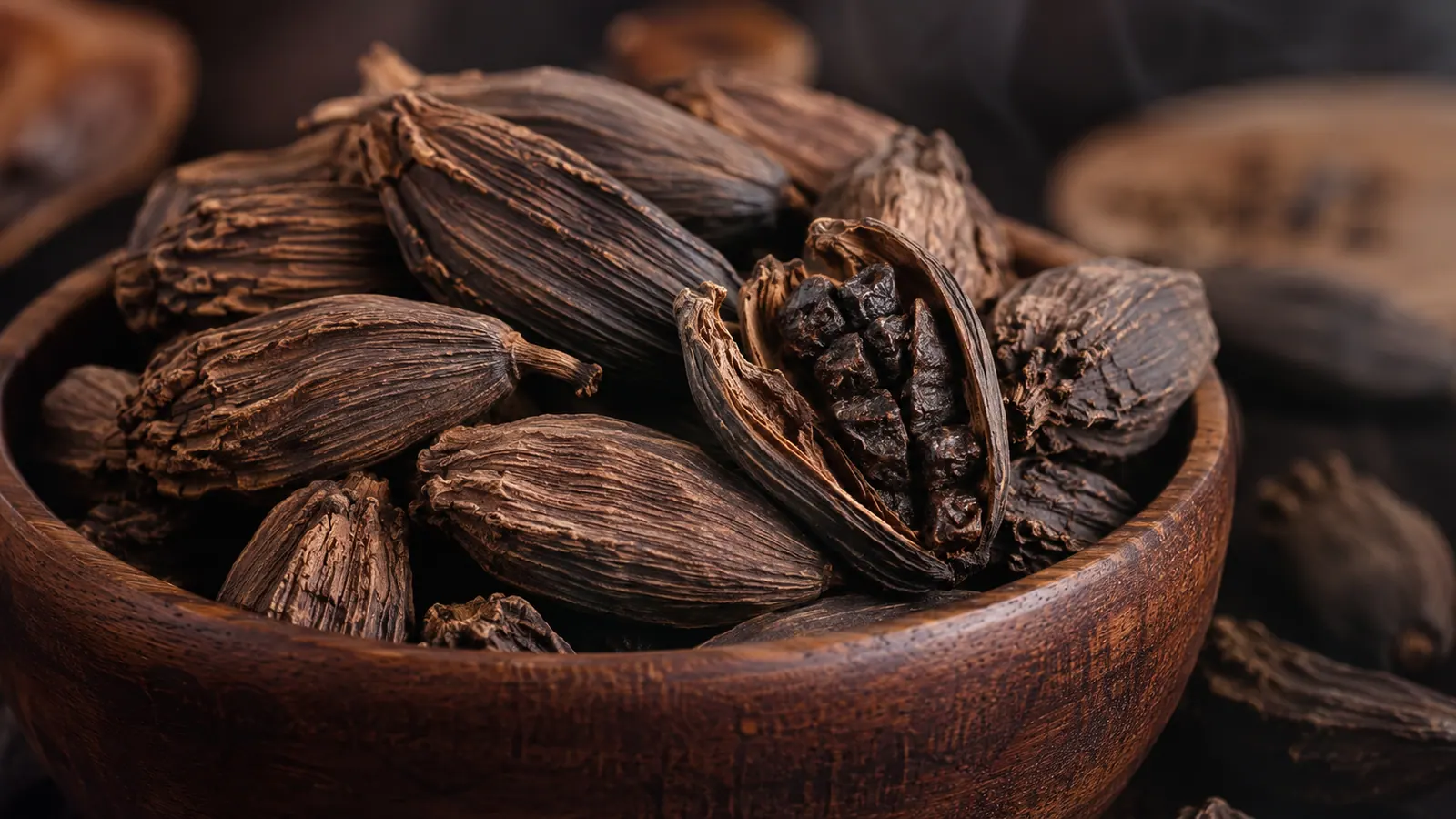
Large Cardamom at a glance
- Botanical name
- Amomum subulatum
- Family
- Zingiberaceae
- Part used
- Fruit, seed
- Also known as
- Black cardamom, Badi elaichi
- Forms exported
- Whole
- ITC-HS
- 0908 31 10
- Spices Board schedule
- #1
What is Large Cardamom and how is it exported from India?
Large cardamom is the dried fruit of Amomum subulatum, traditionally cured over open fires which gives it a smoky note. It is grown in Sikkim, Darjeeling and the eastern Himalaya and used whole in savoury blends.
Overview
Large cardamom is the dried capsule of Amomum subulatum, a separate species from green cardamom rather than a darker grade of the same plant. The pods are large, reddish-brown to nearly black, ribbed and leathery, containing a mass of sticky, aromatic seeds. It is grown as an understorey crop in the shade of alder and other trees across the eastern Himalaya, where the cool, moist, high-altitude conditions differ entirely from the Western Ghats habitat of small cardamom.
The defining sensory feature comes from curing. Traditionally the capsules are dried over open wood fires, which imparts the characteristic warm, smoky, resinous aroma that distinguishes large cardamom in savoury cooking. Improved flue-pipe (bhatti) dryers reduce the harshest smoke and tar notes while preserving the signature character, and buyers increasingly distinguish clean flue-cured lots from heavily smoke-tarred traditional material. Quality is judged on capsule size, colour, dryness, seed fill and the balance of that smoky aroma.
Commercially this is a much smaller and more regional trade than green cardamom, used almost entirely whole and for savoury rather than sweet applications. It shares the HS sub-heading with small cardamom, so clean partner-level export splits are not consistently published; the honest position is to describe the trade qualitatively rather than attach an invented bilateral figure. Sikkim large cardamom is a GI origin, though buyers should verify the current standing of any GI mark before relying on it.
Forms & export grades
Dried reddish-brown capsules, the standard and dominant export form.
Extracted seeds for grinding and specialist blends.
Solvent-extracted oleoresin for flavour applications.
Varieties & types
- Ramsey
- A hardy, high-altitude cultivar type widely grown in Sikkim, tolerant of cold and prized for bold capsules.
- Sawney
- A vigorous mid-elevation type giving large, well-filled pods.
- Golsey
- A lower-altitude type with bold, round capsules and good yield.
Growing regions
Sikkim is the historic heart of the crop, with significant cultivation in the Darjeeling and Kalimpong hills of West Bengal and across the eastern Himalayan states into Nepal and Bhutan. It is grown under forest or alder shade at elevation, harvested through the autumn and cured immediately after picking. Sikkim large cardamom is a GI-registered origin.
Uses & applications
- A whole-spice base note in North Indian, Nepali, Tibetan and Bhutanese savoury cooking, curries and dals
- Garam masala, biryani, pulao and meat-masala blends where a smoky depth is wanted
- Broths, stocks and slow-cooked meat dishes across Himalayan and Central Asian cuisines
- Pickling and brining spice mixes
- Ethnic-foods and diaspora retail spice packs
- Traditional-medicine (Ayurvedic/Tibetan) preparations
- Extraction of essential oil and oleoresin for specialist flavour use
- Chai and warm-beverage blends seeking a robust, smoky character
Sourcing & export considerations
- Traded almost entirely as whole dried capsules; seed, ground and extract forms are niche
- Grade distinctions turn on capsule size, colour, dryness and whether curing is clean flue-dried or heavily smoke-tarred
- Buyers should specify curing method, moisture and capsule grade, as smoke character and tar residue vary widely between lots
- Sorted for foreign matter, immature pods and mould; dryness matters because incompletely cured capsules spoil in transit
- Packed in lined bags or cartons; the leathery capsule is robust but aroma and colour fade with long ambient storage, so current-season material is preferred
- Sample quantities typically 50–100 kg as trade practice; larger commitments follow the harvest calendar
- Lacks a separable bilateral trade figure because it shares an HS sub-line with small cardamom; describe volumes qualitatively rather than quoting a number
- Where a GI origin (e.g. Sikkim) is claimed, verify the current registration status before relying on the mark
ITC-HS classification
- 0908 31 10 — Large cardamom (Amomum), neither crushed nor ground
Frequently asked
Is large cardamom the same as green cardamom, just dried longer?
No. Large cardamom is a different species (Amomum subulatum), grown in the eastern Himalaya and fire-cured, with a smoky savoury profile. Green cardamom (Elettaria cardamomum) is a Western Ghats crop with a sweet aroma used in desserts and coffee.
Why do some large-cardamom lots smell strongly of smoke?
Traditional open-fire curing leaves a heavy smoky, sometimes tarry aroma. Improved flue-pipe dryers give a cleaner smoke character. Specify the curing method you want, since it materially changes the flavour and any surface residue.
What this page does not tell you
- Bilateral export volumes
- Large cardamom shares HS heading 0908 31 with small cardamom at the sub-line; clean partner-level splits are not consistently published.
Related spices
Sources
- Spices Board of India — Export statistics· Tier 1, retrieved 2026-07-16
- Spices Board Act, 1986 — Schedule of spices· Tier 1, retrieved 2026-07-16
- Geographical Indications Registry, India — Registered GIs· Tier 1, retrieved 2026-07-16