How to Import Spices From India: A Buyer’s Guide
The full buyer journey for importing Indian spices: define the spec, vet the supplier, order a sample, then scale to a container.
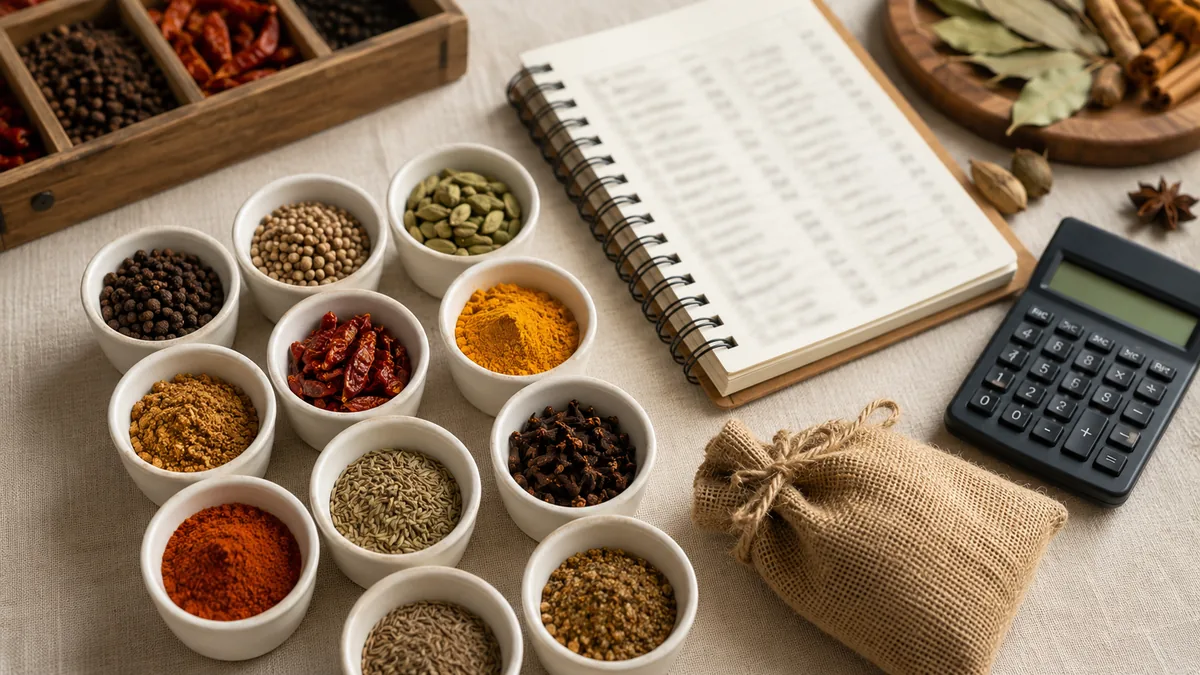
Start with the specification, not the price
Every reliable import begins with a written specification. Before you approach a single supplier, decide the botanical species, grade, form (whole, cracked, ground), moisture ceiling, cleanliness (extraneous matter), and the microbiological and contaminant limits your market enforces. Price without a spec is meaningless because two lots of “turmeric” can differ by half in curcumin and by an order of magnitude in aflatoxin.
India exported 17.34 lakh tonnes of spices worth US$4,430.90 million in FY2025-26, so the supply base is deep. That depth is exactly why a tight spec matters: it is how you filter thousands of sellers down to the few who can actually meet your destination’s law.
Confirm the supplier can legally export
To export any of India’s 52 scheduled spices, a supplier must hold a Certificate of Registration as Exporter of Spices (CRES) from the Spices Board, plus an Importer-Exporter Code (IEC), PAN, GST and FSSAI registration. Ask for the CRES number and validity date up front. A trader without CRES is either not a real exporter or is shipping through someone else’s licence, which hides accountability.
- CRES — mandatory, fee ₹5,000, valid three years, requires IEC, PAN, GST, FSSAI and a bank certificate.
- IEC — the DGFT code that appears on every customs document.
- FSSAI licence — India’s food-safety registration; confirm it is current.
Order a sample against your spec
A paid sample of 50–100 kg lets you run destination-market lab tests before committing capital. Test what your regulator actually screens: aflatoxins, pesticide residues, Salmonella, and any adulterant history for that spice (Sudan dye in chilli, lead chromate in turmeric). Keep a sealed retained portion so the container can be checked against the approved sample later.
Agree Incoterms, documents and payment
Pin the Incoterm so responsibility is unambiguous: FOB puts freight and risk on you from the ship’s rail, CFR has the seller pay ocean freight, CIF adds insurance. Then confirm the document set: commercial invoice and packing list, phytosanitary certificate, certificate of origin (preferential through DGFT if you are claiming a trade-agreement duty, otherwise non-preferential), and the destination test dossier.
How YouPals helps
YouPals is a sourcing desk, not a processor. We do not own a factory or a grinding line. What we do is translate your specification into a shortlist of CRES-registered suppliers we have vetted, coordinate sampling and third-party lab testing, consolidate multiple spices into one container where that saves you freight, and run pre-shipment quality control against your approved sample. You keep control of the contract; we remove the legwork and the blind spots.
Frequently asked
Do I need my own Indian licence to import spices from India?
No. The Indian export licences (CRES, IEC) sit with your supplier. You need your own destination-country import registrations, such as FDA Prior Notice and FSVP for the United States.
How long does a first order typically take?
Plan on several weeks for sampling and lab testing, then production and documentation. The exact timeline depends on the spice, the season, and how quickly your lab returns results.
Sourcing this? Tell us the spice, grade and destination and we return a documented offer — vetted supply, QC oversight, and the test dossier your market needs.
Start a sourcing enquiry →What this page does not tell you
- Total landed cost
- Freight, insurance and destination duties vary by lane and date; we do not publish a single all-in figure.
- Order lead time in weeks
- Lead time is season- and spice-specific; stating a fixed number would be misleading.
Reviewed 16 July 2026.
Sources
- Spices Board of India — Export statistics· Tier 1, retrieved 2026-07-16
- Spices Board — Certificate of Registration as Exporter of Spices (CRES)· Tier 1, retrieved 2026-07-16
- CBI — Entering the European market for spices and herbs· Tier 2, retrieved 2026-07-16
- DGFT — Notifications· Tier 1, retrieved 2026-07-16