First-Time Spice Importer’s Guide to India
A plain-language walkthrough for a buyer importing Indian spices for the first time, from registrations to your first container.
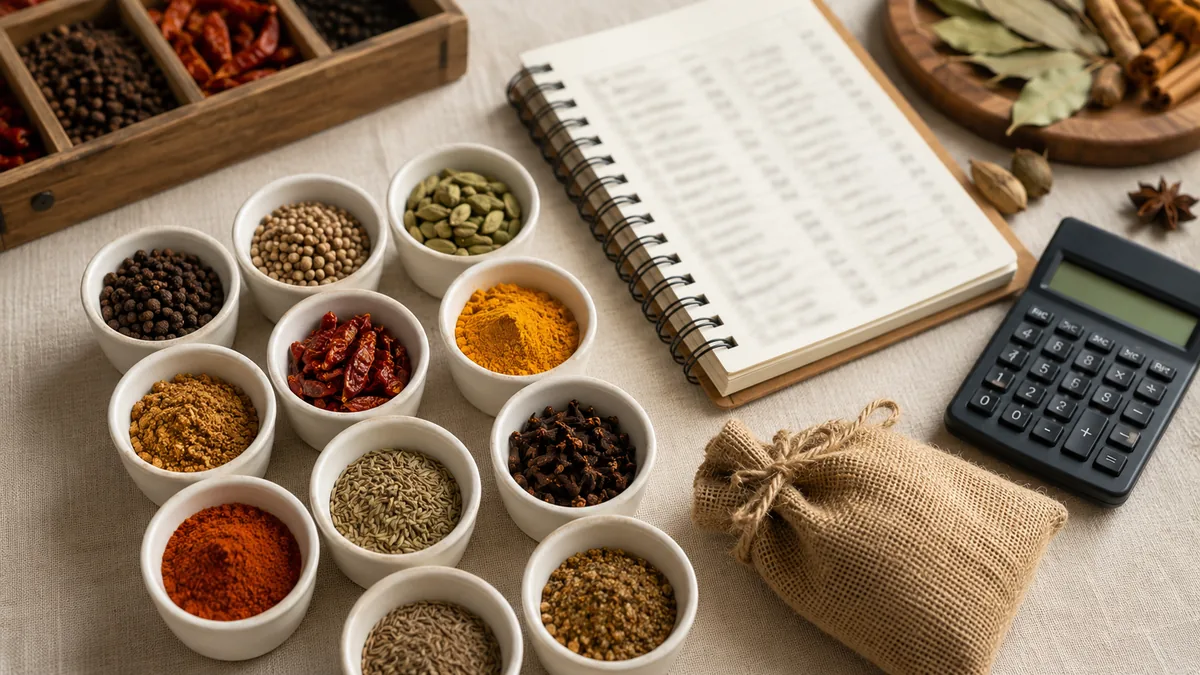
What you register on your side
The Indian export licences belong to your supplier. Your job is the import side. In the United States that means understanding FDA Prior Notice (filed per shipment) and the Foreign Supplier Verification Program, which puts the duty to verify your supplier’s safety on you. Every destination has an equivalent; sort your own registrations before you place an order, not after.
Pick one spice and one market to start
First-time importers over-reach by launching several spices into several markets at once. Start with one spice you understand and one destination whose rules you can learn. India’s FY2025-26 export basket is led by chilli (27% of value), then cumin, spice oils and oleoresins (12% each), and cardamom (9%) — mature categories with deep, competitive supply if you choose one of them.
Sample before you commit
Buy a paid sample of 50–100 kg and run it through a destination-accredited lab. Test for what your regulator screens — aflatoxins, pesticide residues, Salmonella — and for the classic adulterants of your chosen spice. Keep a sealed retained sample so your full order can be checked against what you approved. This single step prevents most first-import disasters.
Understand who pays for what
Incoterms decide the split. FOB means you take freight and risk once the goods are on the vessel; CFR means the seller pays ocean freight; CIF adds insurance on top. A first-timer often prefers CIF for simplicity, then moves to FOB once they have their own freight relationships. Whatever you choose, write it into the purchase order.
Budget the whole journey, not just the price
The invoice price is one line. Add ocean or air freight, insurance, destination duty (US HTS 0904–0910 duties run 0–3%), port and clearance charges, lab testing and any storage. Only the all-in landed cost tells you whether the deal works.
How YouPals helps
For a first import, a sourcing desk removes the parts most likely to trip you up. YouPals vets CRES-registered suppliers, arranges the sample and the lab work, explains the Incoterm and document set in plain terms, and runs pre-shipment QC against your approved sample. We do not process spice ourselves; where processing is needed we coordinate vetted partners and keep you in the decision seat.
Frequently asked
Do I need an Indian company to import spices from India?
No. You buy from an Indian exporter who holds the Indian licences. You need your own destination-country import registrations, such as FDA Prior Notice and FSVP in the United States.
Should a first-timer choose FOB or CIF?
Many first-time importers start with CIF because the seller arranges freight and insurance, then switch to FOB once they have their own logistics relationships.
Sourcing this? Tell us the spice, grade and destination and we return a documented offer — vetted supply, QC oversight, and the test dossier your market needs.
Start a sourcing enquiry →What this page does not tell you
- Exact landed cost
- Freight, duty and clearance vary by lane and date; we do not quote a single all-in figure.
Reviewed 16 July 2026.
Sources
- Spices Board of India — Export statistics· Tier 1, retrieved 2026-07-16
- USITC — Harmonized Tariff Schedule· Tier 1, retrieved 2026-07-16
- CBI — Entering the European market for spices and herbs· Tier 2, retrieved 2026-07-16
- FDA — Foreign Supplier Verification Programs· Tier 1, retrieved 2026-07-16