Tamarind export from India
Tamarindus indica · Fabaceae · Fruit
A high-volume souring fruit — exported as pods, deseeded pulp, paste and concentrate to the food-manufacturing trade.
Tamarind at a glance
- Botanical name
- Tamarindus indica
- Family
- Fabaceae
- Part used
- Fruit
- Also known as
- Imli
- Forms exported
- Dried, Paste, Extract
- ITC-HS
- 0810 90 00, 0813 40 90
- Spices Board schedule
- #52
What is Tamarind and how is it exported from India?
Tamarind is the fruit pulp of Tamarindus indica, a major souring agent. India exports it as whole pods, deseeded slab pulp, paste and concentrate; the seed yields tamarind kernel powder for industry.
Overview
Tamarind is the fruit of Tamarindus indica, a large leguminous tree (Fabaceae) whose brown pods hold a sticky, sweet-sour pulp around hard seeds. The pulp is the product: it is India's workhorse souring agent, valued for a tartness driven by a high tartaric-acid content combined with natural sugars, giving the characteristic sweet-sour depth that distinguishes it from sharper acids like lime or vinegar. Unlike most schedule spices, tamarind is a high-volume, food-manufacturing raw material as much as a retail spice, and it moves in several processed forms rather than as a single whole product.
The forms are the heart of the tamarind trade. Buyers source it as whole pods, as deseeded slab or block pulp (the common bulk trade form), as ready-to-use paste, and as concentrate, a boiled-down, standardised extract that food manufacturers dose for consistent acidity. Each form sits at a different point on the processing ladder and suits a different buyer: whole pod and slab pulp for repackers and traditional trade, paste and concentrate for industrial sauce, chutney, beverage and ready-meal manufacture where a consistent, seed-free, standardised sour base is needed. The seed is not waste either: it yields tamarind kernel powder, a galactomannan gum used as a sizing and thickening agent by industry.
For the India export trade tamarind is a bulk, price-competitive line where form, colour, seed/fibre content, moisture and consistency of acidity decide grade rather than any single spice spec. Deseeded pulp is graded on how clean it is of seed, shell and fibre and on colour (reddish-brown vs darker); concentrate is graded on standardised acidity and solids. One classification point matters for buyers reading trade data: tamarind reports under fruit lines (HS 0810/0813), not the Chapter 9 spice headings, so its trade figures are not comparable with seed-spice statistics.
Forms & export grades
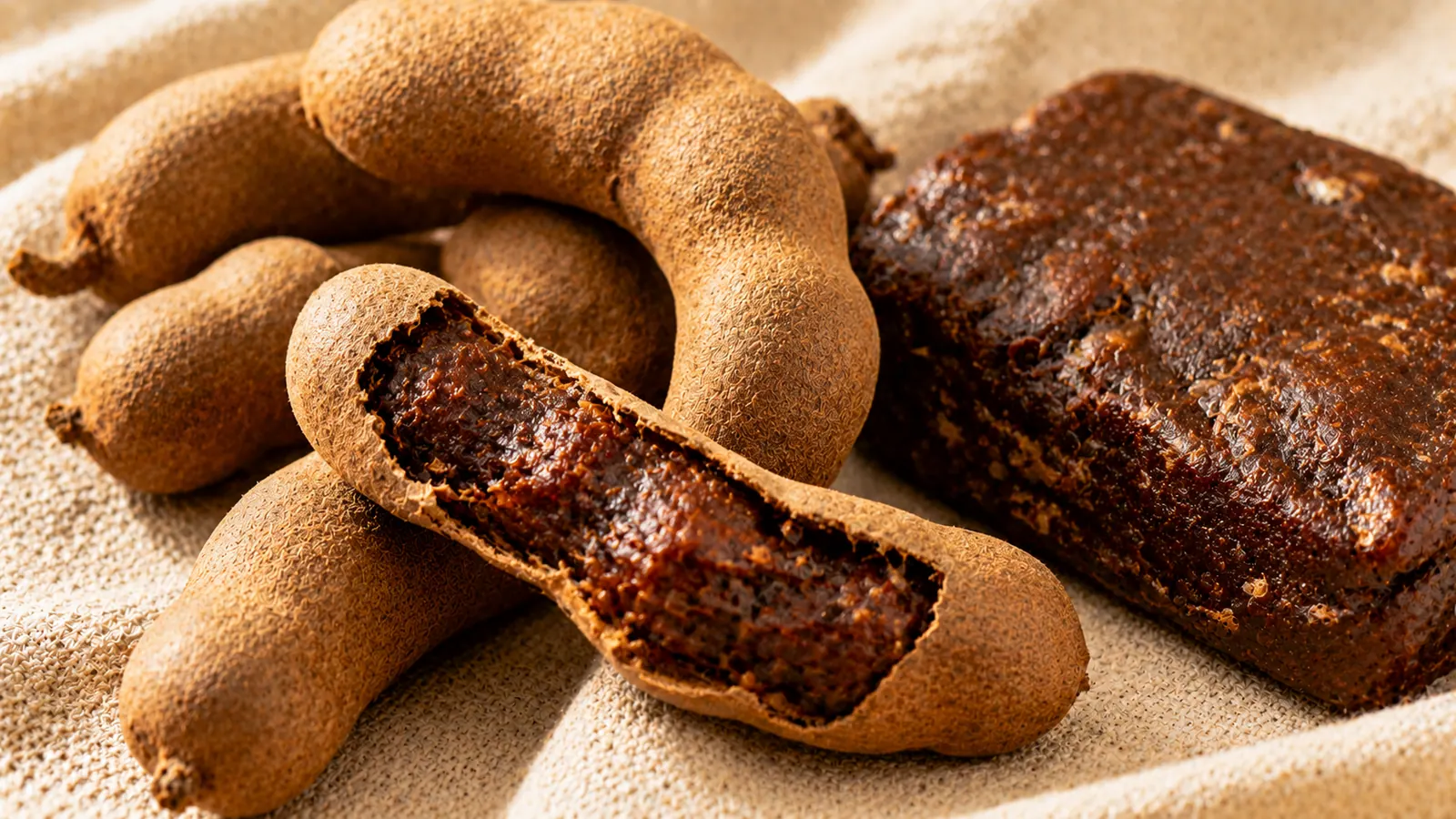
Whole dried pods, the least-processed trade form.
Deseeded slab/block pulp and ready-to-use paste, the common bulk and culinary forms.
Boiled-down concentrate standardised on acidity and solids for industrial acidulant use.
Varieties & types
- Whole pod
- Unprocessed dried pods; the least-processed trade form, for repackers and traditional trade.
- Deseeded slab / block pulp
- Pressed, seed-removed pulp in slabs, the common bulk export form graded on freedom from seed, shell and fibre.
- Tamarind paste
- Ready-to-use smooth paste for direct culinary and manufacturing use.
- Tamarind concentrate
- Boiled-down, standardised extract dosed by manufacturers for consistent acidity and solids.
Growing regions
Tamarind is grown across the warm plains and dry tracts of peninsular and central India, where the drought-hardy tree is common on farmland edges, avenues and dry-zone plantations rather than in intensive orchards. The pods mature and are harvested in the dry, cooler months, giving a defined new-crop window when fresh pulp is at its best colour and moisture. Because much fruit comes from scattered trees, aggregation, cleaning and grading are where a sourcing desk adds value.
Uses & applications
- Deseeded pulp and paste as the souring base for chutneys, sauces, ketchups and Worcestershire-style condiments
- Concentrate as a standardised acidulant for industrial sauce, ready-meal and beverage manufacturing
- Sambar, rasam and South Indian curry bases in food service and packaged-food supply
- Confectionery and candy (tamarind sweets, balls and inclusions)
- Beverage and drink bases (tamarind juice, coolers and traditional drinks)
- Whole pod and slab pulp for repacking and the retail/diaspora grocery trade
- Tamarind kernel powder (from the seed) as a galactomannan thickening and textile/paper sizing agent for industry
- Nutraceutical and functional use of tamarind extract
Sourcing & export considerations
- Available as whole pods, deseeded slab/block pulp, ready-to-use paste and standardised concentrate; each form suits a different buyer, so specify the form up front.
- Deseeded pulp is graded on freedom from seed, shell and fibre, on colour (reddish-brown vs darker) and on moisture; concentrate is graded on standardised acidity and solids.
- Cleaning and deseeding to a specified seed/fibre tolerance is the core processing step and can be coordinated with vetted third parties; sortex/sieving removes grit and shell.
- High moisture and natural sugars make pulp prone to fermentation and mould if under-dried or poorly stored, so moisture control and cool storage set shelf life; new-crop pulp holds the best colour.
- Reports under fruit lines (HS 0810 for fresh/dried fruit, HS 0813 for dried), not Chapter 9, so tamarind trade data is not comparable with seed-spice figures.
- Bulk, price-competitive line: order sizes run large for pulp and concentrate, and any MOQ should be treated as trade practice, not statute.
- Packaging in food-grade lined cartons/blocks for slab pulp and food-grade drums/pails for paste and concentrate; concentrate and paste need airtight, contamination-protected packing.
- On the contract specify form (pod/pulp/paste/concentrate), deseeded/seed-in, seed and fibre tolerance, colour, moisture or acidity/solids target and crop year.
ITC-HS classification
- 0810 90 00 — Fresh fruit — other, incl. fresh tamarind
- 0813 40 90 — Dried fruit — other, incl. tamarind
Frequently asked
In what forms is tamarind exported?
As whole pods, deseeded slab or block pulp (the common bulk form), ready-to-use paste, and standardised concentrate. Whole pod and slab pulp suit repackers and traditional trade; paste and concentrate suit industrial manufacturers who need a seed-free, consistent sour base.
What is the difference between tamarind pulp, paste and concentrate?
Pulp is pressed, deseeded fruit in slabs; paste is a smooth ready-to-use form; concentrate is boiled down and standardised on acidity and solids so manufacturers can dose consistent tartness. They sit at rising points on the processing ladder for different buyers.
Why does tamarind trade data not match seed-spice statistics?
Tamarind reports under fruit headings (HS 0810 and 0813), not the Chapter 9 spice lines. Its trade figures therefore sit in the fruit tables and are not directly comparable with cumin, coriander or other seed-spice export data.
Is tamarind seed useful or is it waste?
Not waste. The hard seed yields tamarind kernel powder, a galactomannan gum used as a thickening and sizing agent by the food, textile and paper industries, so deseeding produces a saleable by-product alongside the culinary pulp.
What this page does not tell you
- Chapter classification
- Tamarind reports under fruit lines (HS 0810/0813), not Chapter 9; not comparable to seed-spice figures.
Related spices
Sources
- Spices Board of India — Export statistics· Tier 1, retrieved 2026-07-16
- Spices Board Act, 1986 — Schedule of spices· Tier 1, retrieved 2026-07-16
- Spices Board — ITC-HS classification of spices· Tier 1, retrieved 2026-07-16
- CBI — Entering the European market for spices and herbs· Tier 2, retrieved 2026-07-16