Fenugreek export from India
Trigonella foenum-graecum · Fabaceae · Seed
A dual-use seed — culinary spice and the raw material for diosgenin and soluble-fibre nutraceuticals.
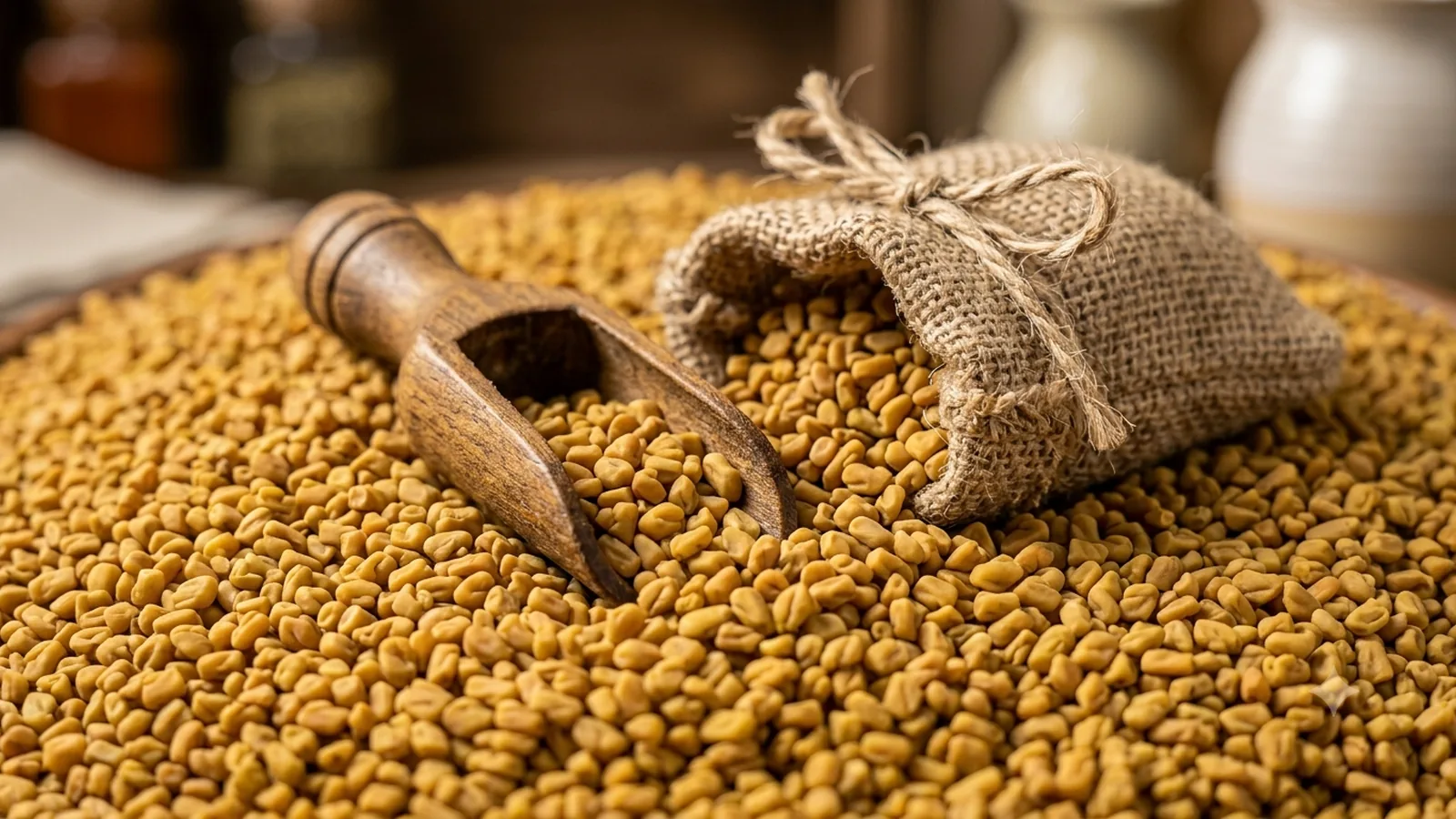
Fenugreek at a glance
- Botanical name
- Trigonella foenum-graecum
- Family
- Fabaceae
- Part used
- Seed
- Also known as
- Methi, Methi dana
- Forms exported
- Seed, Ground
- ITC-HS
- 0910 99 24
- Spices Board schedule
- #9
What is Fenugreek and how is it exported from India?
Fenugreek is the seed of Trigonella foenum-graecum, a legume. India is the leading producer; the seed is used whole and ground as a spice and processed for galactomannan fibre and steroidal saponin extraction.
Overview
Fenugreek is a cool-season annual legume whose small, hard, angular seeds carry a distinctive smell of maple and burnt sugar from the aroma compound sotolon, over a base note that turns bitter when the seed is raw and mellows to nutty on dry-roasting. Because it is a Fabaceae seed rather than an umbellifer, it behaves differently in the trade: the endosperm is unusually rich in galactomannan, a soluble mucilage that swells and gels in water, which is why fenugreek is bought as much for its functional fibre as for its flavour.
The commercial seed is graded first on cleanliness and colour. A good export lot is uniform golden-yellow to amber, free of the dark, shrivelled and stony seed that drags down machine-cleaned yield, and low in the admixture of other legume and weed seed that grows alongside it. Buyers milling the seed care about grindability and residual moisture, because fenugreek is hygroscopic and cakes if packed damp; buyers extracting it care about the intact endosperm and the saponin fraction.
India is the dominant world origin, and fenugreek runs on two parallel demand streams that rarely meet at the same buyer. One is the culinary and ethnic-food channel that wants whole and coarse-ground seed for spice blends and pickles. The other is the ingredient channel that treats fenugreek as a raw material for galactomannan gum, for steroidal-saponin (diosgenin) chemistry, and for standardised extracts sold into the nutraceutical and blood-sugar-support market. The leaf (methi) and the dried leaf (kasuri methi) are a related but separate trade.
Forms & export grades
Whole cleaned/sortex golden seed, the mainstream culinary and sowing form.
Milled powder for blends and pickle masalas, moisture-controlled to limit caking.
Galactomannan, saponin and standardised seed extracts for the nutraceutical and food-ingredient trade.
Varieties & types
- Kasuri (Qasuri) type
- A small-seeded, strongly aromatic North Indian type whose leaf is dried as kasuri methi; the name is used loosely across seed and leaf trade.
- Common yellow seed grade
- The bulk machine-cleaned export seed, selected for uniform amber colour and low admixture rather than a named cultivar.
- High-diosgenin / extraction grade
- Lots bought by the saponin and nutraceutical trade on assayed diosgenin and total saponin content rather than on culinary appearance.
Growing regions
Fenugreek is grown as a rabi (winter) crop across the semi-arid north and centre of India, with Rajasthan and Madhya Pradesh the principal seed-producing states and Gujarat, Uttar Pradesh and Haryana also material. It is sown after the monsoon into the cooler months and harvested in late winter to early spring, so new-crop seed enters the market from roughly February onward. Nagaur and the Rajasthan seed-spice belt are recognised trading centres for the seed.
Uses & applications
- Whole and coarse-ground seed for South Asian spice blends, curry powders, panch phoron and sambar/rasam masalas
- A defining seed in pickle (achaar) masalas and in commercial pickle manufacturing
- Dry-roasted and ground as a bittering and body note in seasoning houses that blend to a flavour brief
- Germinated and sold as microgreen/sprout seed, and as sowing seed for the methi leaf crop
- Galactomannan gum extraction for use as a food thickener, stabiliser and dietary-fibre ingredient
- Diosgenin and steroidal-saponin feedstock for the semi-synthetic steroid and nutraceutical trade
- Standardised seed extracts for blood-sugar-support, lactation and sports-nutrition supplements
- Fenugreek oleoresin and flavour fractions for savoury and imitation-maple flavourings
- Dried leaf (kasuri methi) as an adjacent finished product for the diaspora retail and HORECA trade
Sourcing & export considerations
- Available as whole seed, coarse-ground and fine-ground powder, and as extract/oleoresin fractions through the specialist ingredient trade
- Cleaning is by air-screen and gravity separation with sortex colour-sorting to strip dark, stony and off-colour seed and other-legume admixture; specify cleaned vs sortex-grade on the contract
- Whole seed is robust and stores well; ground fenugreek loses aroma and cakes if it takes up moisture, so moisture control and barrier packing matter more for powder
- Packed in new food-grade PP/jute bags for whole seed, and in multiwall paper or lined bags for powder; palletised container loads for sea freight
- As a dense seed spice it loads a full container to weight well before volume, which keeps freight economic on whole seed
- MOQ follows trade practice rather than statute: sample lots of roughly 50-100 kg, private-label runs from about 100 kg per variant, larger blend and extraction contracts by tonnage (cbi)
- For EU and US buyers, specify a recent pesticide-residue and microbial (Salmonella-absent) panel; steam treatment for microbial reduction is arranged with vetted third-party facilities, not performed in-house
- Fenugreek reports under residual HS 0910 99, so there is no clean bilateral trade series for the seed alone; buyers should not plan against an invented volume
- For extraction buyers, specify the target assay (galactomannan, diosgenin or total saponin) and test method up front, since these define the lot far more than culinary appearance
ITC-HS classification
- 0910 99 24 — Fenugreek seed
Frequently asked
Why is fenugreek sourced both as a spice and as a nutraceutical raw material?
The seed is dual-use. Its endosperm is rich in soluble galactomannan fibre and it carries steroidal saponins including diosgenin, so the same seed feeds culinary blends and the fibre, diosgenin and standardised-extract trade.
How do I stop ground fenugreek from caking in storage?
Fenugreek is hygroscopic. Grind to the agreed moisture ceiling, pack in barrier or lined packaging, and hold it cool and dry. Whole seed is far more stable, so many buyers grind close to use.
What is the difference between fenugreek seed and kasuri methi?
Fenugreek seed is the dried seed used whole or ground as a spice. Kasuri methi is the dried fenugreek leaf, a separate finished product with a herbaceous aroma used as a garnish and flavouring.
What this page does not tell you
- Bilateral trade figures
- Fenugreek reports under HS 0910 99 (other spices), which cannot support a per-country figure for fenugreek alone.
Related spices
Sources
- Spices Board of India — Export statistics· Tier 1, retrieved 2026-07-16
- Spices Board Act, 1986 — Schedule of spices· Tier 1, retrieved 2026-07-16
- CBI — Entering the European market for spices and herbs· Tier 2, retrieved 2026-07-16
- UN Comtrade — reporter India, Chapter 09· Tier 1, retrieved 2026-07-16
- Reg. (EU) 2023/915 — maximum levels for certain contaminants· Tier 1, retrieved 2026-07-16