Mustard export from India
Brassica juncea · Brassicaceae · Seed
Indian brown/oriental mustard seed (rai) for the condiment, pickle and oil trade.
Mustard at a glance
- Botanical name
- Brassica juncea
- Family
- Brassicaceae
- Part used
- Seed
- Also known as
- Rai, Sarson (adjacent)
- Forms exported
- Seed, Ground, Essential oil
- ITC-HS
- 1207 50 00
- Spices Board schedule
- #21
What is Mustard and how is it exported from India?
Mustard is the seed of Brassica juncea (brown/oriental mustard), used whole in tempering, ground for condiment, and pressed for pungent mustard oil. India is a major producer.
Overview
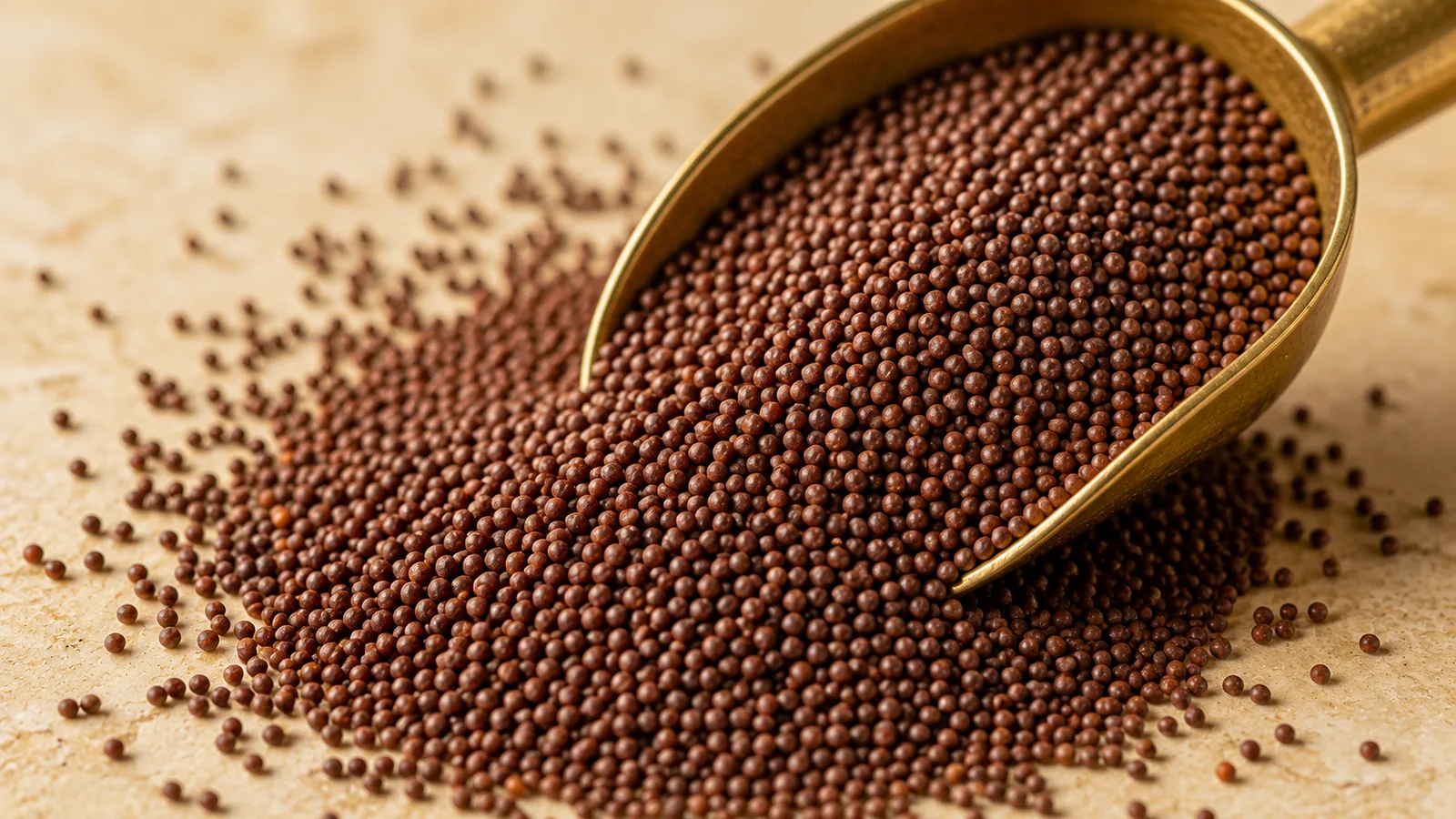
Indian mustard for the spice and condiment trade is chiefly Brassica juncea, the brown or oriental mustard known locally as rai, a small round seed ranging from reddish-brown to near-black. It is distinct from yellow/white mustard (Sinapis alba) and from the oilseed rapeseed-mustard grown primarily for cooking oil. In cooking the whole seed is used for tempering (tadka), where it pops in hot oil and turns nutty; ground, it develops the sharp, pungent bite that defines pickles and prepared condiments.
The pungency of brown mustard comes from sinigrin, a glucosinolate that releases allyl isothiocyanate when the crushed seed meets water and the enzyme myrosinase acts. This is why mustard is mild whole but fiercely hot when ground and wetted, and why condiment and pickle manufacturers care about the seed's glucosinolate strength and oil content. India is one of the world's largest producers, and the seed feeds both the culinary spice trade and the domestic pungent-mustard-oil industry.
Sensory quality is judged on seed size and uniformity, colour, cleanliness and pungency development, alongside freedom from admixture with other Brassica seeds. Buyers distinguish culinary/condiment use, where a bright, clean, uniform brown seed is wanted, from crush use for oil, where oil content dominates. Because mustard seed classifies under HS 1207 (oilseeds) rather than Chapter 9, its trade data is not comparable to the seed-spice figures and it is often contracted through the oilseed rather than the spice channel.
For an export buyer the practical picture is a high-availability, competitively priced seed with a clear split between food/condiment grade and crush grade. The value-add lies in cleaning, sizing, colour sorting and, for condiment houses, consistent pungency, rather than in exotic varietal distinctions.
Forms & export grades
Whole brown/oriental mustard seed in condiment/culinary and crush grades, the primary traded form.
Milled mustard flour and condiment base for prepared mustards, sauces and pickle manufacturing.
Pungent expressed mustard oil, subject to destination-specific food-use regulation on erucic acid.
Varieties & types
- Brown / oriental mustard (Brassica juncea, rai)
- The mainstream Indian condiment and tempering seed, small, brown to near-black and pungent when ground.
- Yellow / white mustard (Sinapis alba)
- A larger, milder yellow seed used in mild table mustards and as a thickener; grown and traded in smaller volumes in India.
- Black mustard (Brassica nigra)
- A traditional very pungent small black seed, now less widely cultivated than juncea but still specified by some condiment buyers.
Growing regions
Mustard is a rabi (winter) crop grown across the northern and western plains, with Rajasthan the leading state alongside Uttar Pradesh, Haryana, Madhya Pradesh and West Bengal. It is sown after the monsoon in October-November and harvested in February-March, so new-crop seed comes to market in the late-winter and spring window that buyers watch for the freshest, brightest lots.
Uses & applications
- Whole seed for tempering (tadka) in Indian and South Asian cooking and for the diaspora retail trade
- Ground/milled mustard flour and condiment base for prepared mustards, sauces and dressings
- Pickle manufacturing, where crushed mustard supplies both pungency and preservative character
- Mustard oil expression, the pungent cold-pressed cooking oil widely used in North and East India (regulatory status varies by destination market)
- Spice-blend and seasoning manufacturing (curry pastes, marinades, savoury mixes)
- Deheusked/split mustard (mustard dal) and speciality condiment forms for niche buyers
- Food-service and industrial condiment supply where consistent pungency and colour are specified
- Sprouting and micro-green use for the fresh and health-food trade
Sourcing & export considerations
- Available as whole seed (condiment/culinary grade and crush/oil grade), split/dehusked mustard, and milled mustard flour
- Graded on seed size and uniformity, colour, admixture and cleanliness; condiment buyers also care about pungency (glucosinolate) development and oil content
- Machine cleaning, sieving and colour/sortex sorting remove stones, chaff and off-colour and admixed seed; specify the cleaning standard and maximum foreign matter on the contract
- Packed in new PP/jute bags or bulk according to buyer preference; a dry, low-moisture seed stores well, but rancidity risk rises once cracked or milled, so milled forms have a shorter shelf life
- Classifies under HS 1207 (oilseeds), not Chapter 9, so it is not comparable to seed-spice trade figures and is often contracted via the oilseed channel
- Pesticide-residue testing is the main compliance flag for EU/food-grade buyers; a recent residue panel should accompany food-use lots
- For mustard oil, destination regulatory status varies (some markets restrict cold-pressed mustard oil for food use over erucic acid), so confirm the destination's rules before contracting oil rather than seed
- Specify grade (condiment vs crush), seed size, colour, pungency expectation, cleaning standard and packaging on the contract
ITC-HS classification
- 1207 50 00 — Mustard seeds
Frequently asked
What is the difference between brown and yellow mustard?
Brown/oriental mustard (Brassica juncea, rai) is the small, pungent seed India mainly grows for tempering and pickles. Yellow/white mustard (Sinapis alba) is larger and milder, used in mild table mustards. They are different species with different heat.
Why is mustard seed under HS 1207 and not Chapter 9?
Mustard classifies as an oilseed under HS 1207, reflecting its major use for oil expression, rather than under the Chapter 9 spice lines. Its trade figures are therefore not directly comparable to seed spices like cumin or coriander.
Can you supply food-grade condiment mustard rather than crush grade?
Yes. Condiment/culinary grade is sorted for clean, uniform, bright brown seed with consistent pungency, distinct from crush grade selected mainly for oil content. Specify grade, size, colour and cleaning standard on the contract.
What this page does not tell you
- Chapter classification
- Mustard seed reports under HS 1207 (oilseeds), not Chapter 9; not comparable to seed-spice figures.
Related spices
Sources
- Spices Board of India — Export statistics· Tier 1, retrieved 2026-07-16
- Spices Board Act, 1986 — Schedule of spices· Tier 1, retrieved 2026-07-16