Horseradish export from India
Armoracia rusticana · Brassicaceae · Root
A temperate pungent root, a minor entry in India’s schedule grown in hill regions.
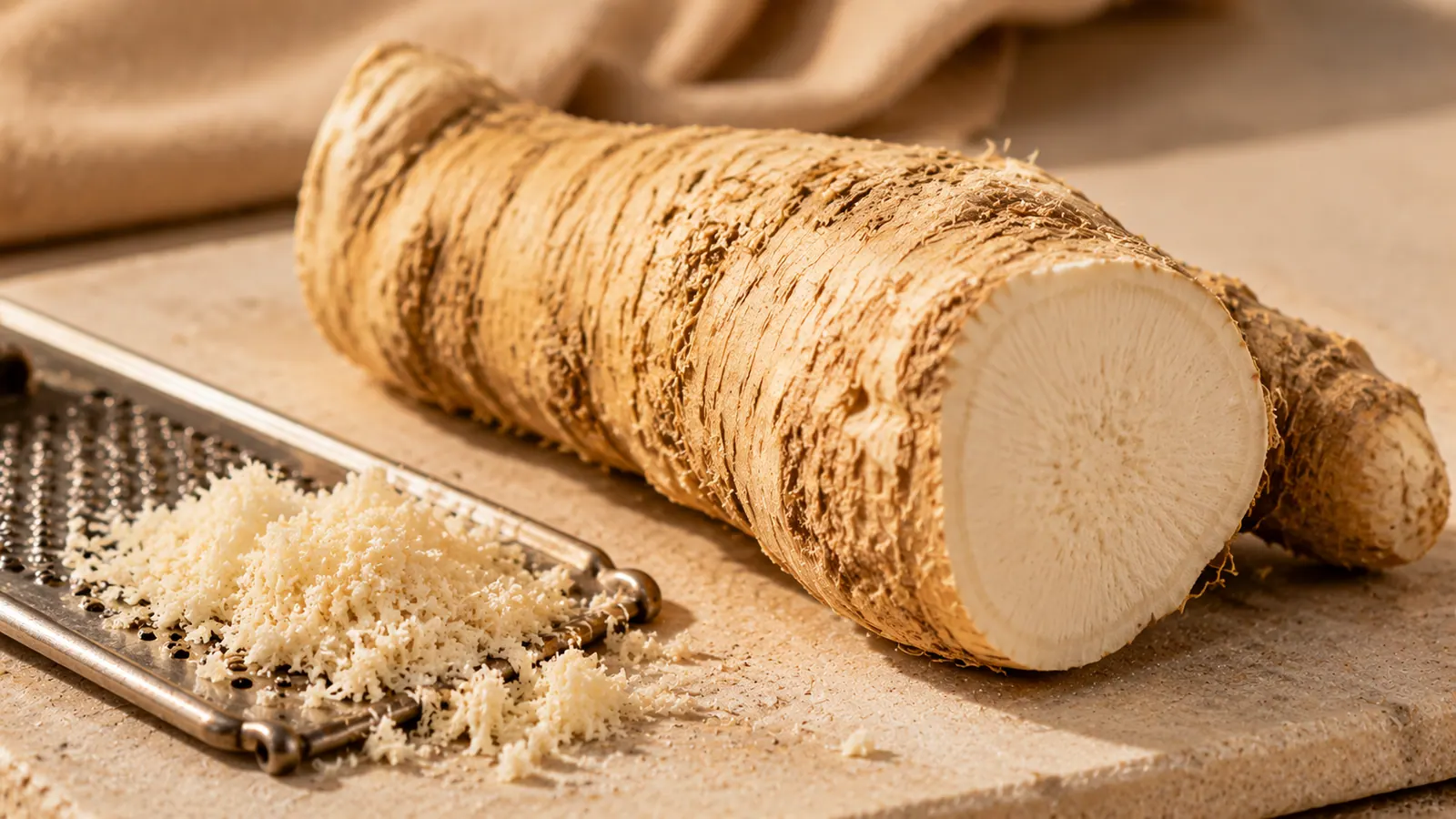
Horseradish at a glance
- Botanical name
- Armoracia rusticana
- Family
- Brassicaceae
- Part used
- Root
- ITC-HS
- 0910 99 99
- Spices Board schedule
- #31
What is Horseradish and how is it exported from India?
Horseradish is the root of Armoracia rusticana, a pungent Brassica used as a condiment. It is a marginal crop in India, grown in temperate hills.
Overview
Horseradish is the thick, cream-coloured taproot of Armoracia rusticana, a hardy perennial of the Brassicaceae (the same family as mustard and wasabi). An intact root is almost odourless; the characteristic sinus-clearing pungency appears only when the tissue is grated or crushed and the glucosinolate sinigrin is hydrolysed by the enzyme myrosinase into allyl isothiocyanate, the same volatile that drives mustard and wasabi heat. That heat is fugitive: it peaks within minutes of grating and fades on exposure to air and warmth, which is why the trade values how a root is stabilised almost as much as the root itself.
The commercial character buyers assess is root diameter and straightness, freedom from forking and side-rooting, white flesh with no greening or hollow-heart, and pungency strength once processed. Because the flavour compound is generated on demand rather than stored, dried and dehydrated horseradish is judged on how much pungency survives drying, and prepared (vinegared) horseradish on how well acidification arrests the reaction to lock the note in.
In the Indian schedule horseradish sits at the far margin of the basket. It is a temperate crop that needs a cold dormancy, so what little is grown domestically comes from Himalayan and high-hill pockets rather than the plains, and India is not a meaningful origin on the world map, which is dominated by Central and Eastern Europe and North America. For a sourcing desk the relevance is as a specialty and dehydrated-ingredient line rather than a bulk export commodity.
Forms & export grades
Dried root pieces for further grinding or rehydration by the buyer.
Powder and granules for dry seasoning and imitation-wasabi bases.
Prepared grated-and-vinegared horseradish stabilised for table and sauce use.
Growing regions
Horseradish is a cold-climate perennial and does not thrive in mainstream Indian spice belts; the small domestic crop is confined to temperate Himalayan hill zones with a genuine winter dormancy. Roots are lifted after the tops die back in the cold season. Because volumes are negligible, most horseradish moving through Indian trade for premium food-service use is imported or re-exported rather than field-grown here.
Uses & applications
- Prepared (grated-and-vinegared) horseradish sold as a table condiment and sandwich spread
- Horseradish sauce and cream bases for roast beef, seafood and cold cuts in food service
- Cocktail sauce and seafood-sauce manufacturing, where it supplies the bite behind ketchup-based blends
- Dehydrated horseradish powder and granules for dry seasoning mixes, rubs and dressing bases
- A cheaper stand-in or extender for wasabi in imitation-wasabi pastes and powders
- Isothiocyanate-driven flavour extract for savoury flavour houses
- Charcuterie and delicatessen seasoning where a clean pungent note is wanted without added colour
- Traditional and herbal preparations that use the root for its pungent principle
Sourcing & export considerations
- Available as fresh root (highly perishable), dehydrated powder/granules, and prepared vinegared paste; fresh root rarely travels well over long ocean legs
- Fresh roots need cold-chain handling and lose pungency quickly once cut; dehydrated and acidified forms are the practical export formats
- Cleaning and grading focus on washing off soil, removing forked/fibrous roots and sorting by diameter; sortex has limited relevance to a root crop
- Packaging: dehydrated forms in moisture-barrier lined sacks or drums with desiccant; prepared paste in food-grade lined pails or jars, kept chilled
- Shelf life is driven by moisture and volatile retention rather than a fixed figure; dehydrated forms hold longest when kept cool, dry and sealed against oxygen
- MOQ behaves as a specialty line rather than a container commodity; sampling and small trial lots are the norm before any standing order
- Reports under residual HS 0910 99, so there is no separable bilateral horseradish trade figure to plan against
- Specify on contract: form (fresh/dehydrated/prepared), pungency expectation, mesh size for powder, added acid/preservative for paste, and whether wasabi-substitute grade is acceptable
ITC-HS classification
- 0910 99 99 — Spices — other, not elsewhere specified (residual basket line)
Frequently asked
Why does horseradish lose its heat, and how is it preserved for export?
Its pungency is created when the root is grated and only lasts minutes in air. Export forms lock it in by acidifying (vinegared paste) or by drying quickly to powder, so the volatile isothiocyanate is captured rather than lost.
Is horseradish an Indian-origin spice?
Not in any meaningful volume. It needs a cold winter dormancy, so only tiny quantities grow in Himalayan hill zones. Most horseradish in Indian trade is imported or re-exported, which we state plainly rather than passing off as India-grown.
Can horseradish substitute for wasabi?
Yes. Both carry heat from allyl isothiocyanate, and much commercial "wasabi" paste is coloured horseradish. If you want a wasabi-substitute grade, specify it, because pungency strength and colour are dialled differently from table horseradish.
What this page does not tell you
- Volume
- Negligible Indian export; no separable data.
Related spices
Sources
- Spices Board of India — Export statistics· Tier 1, retrieved 2026-07-16
- Spices Board Act, 1986 — Schedule of spices· Tier 1, retrieved 2026-07-16
- CBI — Entering the European market for spices and herbs· Tier 2, retrieved 2026-07-16