Mace export from India
Myristica fragrans · Myristicaceae · Aril
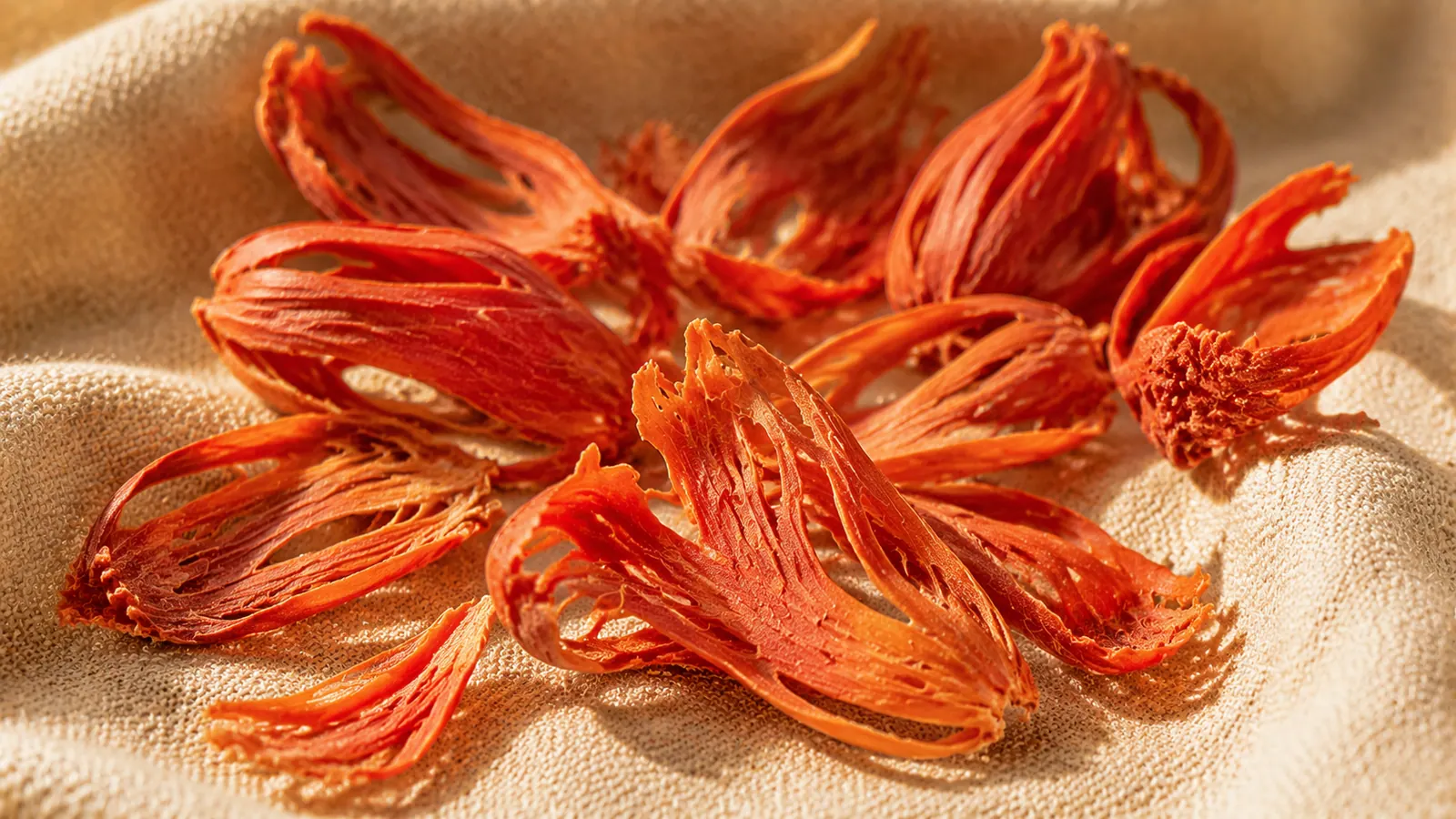
The crimson aril wrapping the nutmeg seed — a separate, higher-value spice from the same fruit.
Mace at a glance
- Botanical name
- Myristica fragrans
- Family
- Myristicaceae
- Part used
- Aril
- Also known as
- Javitri
- Forms exported
- Whole, Ground
- ITC-HS
- 0908 21 00, 0908 22 00
- Spices Board schedule
- #42
What is Mace and how is it exported from India?
Mace (javitri) is the lacy red aril surrounding the nutmeg seed of Myristica fragrans, graded by colour and wholeness. It is a distinct, typically higher-value product than nutmeg.
Overview
Mace is the lacy, net-like aril that wraps the nutmeg seed inside the fruit of Myristica fragrans, an evergreen of the Myristicaceae grown in India mainly in the Kerala midlands. One fruit yields a single seed and a single fragile cage of aril around it; the aril is peeled off by hand at harvest, flattened, and sun-dried into "blades". Because each fruit gives far less mace than nutmeg by weight, and because the aril carries a finer, more delicate aroma, mace is treated as the higher-value half of the nutmeg-and-mace pair and is bought as a distinct spice, not a by-product.
The sensory character sits between nutmeg and a warm floral note: mace is more aromatic and less resinous than the seed, with a lighter, slightly peppery sweetness prized in pale-coloured dishes and manufactured sauces where nutmeg would darken the product. Fresh aril is crimson; on drying it fades toward orange, amber and finally a pale brownish-yellow depending on origin and curing. Colour is the first thing a buyer grades on, since it signals both origin and freshness, and blade wholeness is the second, because unbroken blades command a premium over broken and "BWP" (broken with pieces) fractions.
Quality on mace turns on colour retention, blade integrity, volatile-oil aroma and cleanliness rather than on any single measurable number. Like nutmeg, mace carries a real aflatoxin exposure because the fruit is dried in the open and mould can develop if curing is rushed or storage is damp, so mould-management in drying and dry, ventilated storage are the practical levers on quality. For the India export trade mace is a small-tonnage, high-unit-value line where careful lotting, colour sorting and moisture control decide whether a consignment sells as premium whole-blade or falls back into the ground and broken grades.
Forms & export grades
Colour-sorted whole blades, the premium presentation and the form that best retains aroma.
Milled mace for direct seasoning use; specify freshness as ground aril fades quickly.
Solvent-extracted mace oleoresin for standardised flavour dosing in manufacturing.
Varieties & types
- Whole blade mace
- Unbroken, colour-sorted arils; the top grade sold to buyers who want visible whole blades and maximum aroma retention.
- Broken / BWP (broken with pieces)
- Fractured blades and fragments from the same lots, priced below whole blade and often destined for grinding.
- Ground mace
- Milled aril for direct blend use; buyers specify freshness and colour because ground mace loses aroma faster than blades.
Growing regions
Indian mace is grown alongside nutmeg in the humid, shaded midland belts of Kerala, with smaller pockets in the adjoining Western Ghats of Tamil Nadu and Karnataka. The tree fruits through much of the year in its warm equatorial climate, but there are heavier harvest flushes that concentrate fresh-aril availability, and lots are drawn from smallholder homestead plots rather than large estates. New-crop aril shows the brightest colour, which matters for buyers grading on appearance.
Uses & applications
- Ground into fine garam-masala and biryani/pulao blends where its lighter colour and aroma are preferred over darker nutmeg
- Whole blades infused into pale cream sauces, béchamel, soups and processed-cheese products that must not be discoloured
- Bakery and confectionery flavouring (doughnuts, cakes, custards) in the pre-ground seasoning supply chain
- Charcuterie, sausage and processed-meat seasoning blends where mace is a classic warm top-note
- Beverage and mulled-drink spice mixes, and premium chai/masala tea blends
- Mace oleoresin and essential-oil extraction for standardised flavour dosing in food manufacturing
- Pharmaceutical and traditional-medicine (Ayurveda/Unani) formulations that specify javitri
- Fragrance and personal-care compounding drawing on the aril's aromatic oil
Sourcing & export considerations
- Available as whole colour-sorted blades, broken/BWP fractions and ground mace; whole blade is the premium form and broken feeds the grinding trade.
- Cleaning is by colour and size sorting plus removal of adhering seed-coat and foreign matter; grade is set on colour, blade wholeness and aroma rather than a single spec number.
- Aflatoxin is the key compliance flag: mace shares the nutmeg group's exposure, and the EU sets aflatoxin limits (5 µg/kg B1, 10 µg/kg total for the nutmeg/mace group) with increased-control border checks, so accredited testing and clean, well-cured lots matter for EU-bound cargo.
- Where sterilisation is required, steam treatment can be coordinated with vetted third-party facilities to preserve colour and aroma; specify the method rather than assuming irradiation.
- Moisture control and dry, ventilated storage are decisive because damp storage both dulls colour and drives mould/aflatoxin risk.
- Small-tonnage, high-value line: order sizes run modest by weight, and buyers should treat any MOQ as trade practice, not a fixed rule.
- Packaging in food-grade lined cartons or bags that protect the fragile blades from crushing and moisture pick-up; whole blade needs gentler handling than seed spices.
- On the contract specify grade (whole blade vs broken vs ground), colour target, moisture, aflatoxin test method and crop year.
ITC-HS classification
- 0908 21 00 — Mace, neither crushed nor ground
- 0908 22 00 — Mace, crushed or ground
Frequently asked
Why is mace usually priced higher than nutmeg?
Each nutmeg fruit yields only a thin single cage of aril, far less mace than seed by weight, and the aril has a finer, more delicate aroma. Lower yield plus premium character makes mace the higher-unit-value half of the pair.
Does the colour of mace indicate quality?
Colour signals origin and freshness. Fresh aril is crimson and fades toward orange and amber on drying. Buyers colour-sort blades and match a target shade; faded or blotchy colour usually means older or poorly cured stock.
Is Indian mace subject to aflatoxin testing for the EU?
Yes. Mace shares the nutmeg group's aflatoxin exposure and falls under EU contaminant limits and increased border controls, so an accredited aflatoxin test on well-cured, dry-stored lots is effectively required for EU shipments.
Related spices
Sources
- Spices Board of India — Export statistics· Tier 1, retrieved 2026-07-16
- Spices Board Act, 1986 — Schedule of spices· Tier 1, retrieved 2026-07-16
- Reg. (EU) 2023/915 — maximum levels for certain contaminants· Tier 1, retrieved 2026-07-16
- Reg. (EU) 2019/1793 — temporary increase of official controls· Tier 1, retrieved 2026-07-16