Garcinia (Camboge) export from India
Garcinia cambogia · Clusiaceae · Rind
The HCA-bearing Malabar tamarind — a souring rind and a nutraceutical raw material.
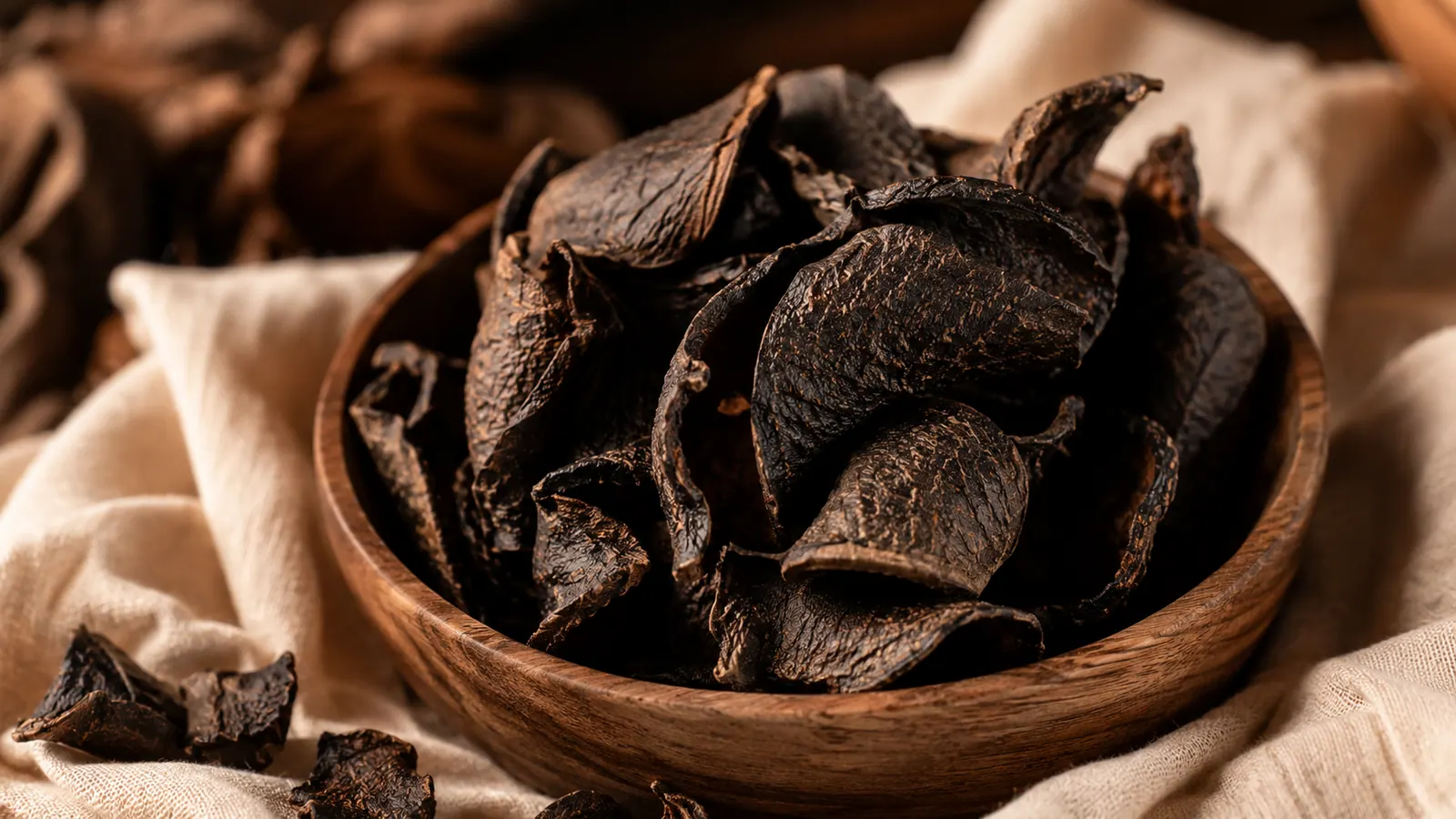
Garcinia (Camboge) at a glance
- Botanical name
- Garcinia cambogia
- Family
- Clusiaceae
- Part used
- Rind
- Also known as
- Malabar tamarind, Kudampuli
- ITC-HS
- 0910 99 99
- Spices Board schedule
- #35
What is Garcinia (Camboge) and how is it exported from India?
Garcinia cambogia (Malabar tamarind, kudampuli) is a souring fruit rind from the Western Ghats, used in Kerala fish curries and extracted for hydroxycitric acid (HCA).
Overview
Garcinia (camboge), better known in India as Malabar tamarind or kudampuli, is the dried rind of a Garcinia fruit of the Clusiaceae from the Western Ghats. The small pumpkin-shaped fruit is harvested ripe, the fleshy rind is separated and sun-dried, and it is traditionally smoked over a slow fire, which turns it near-black, leathery and gives the Kerala fish-curry rind its distinctive smoky-sour character. Unlike tamarind it contributes tartness with almost no sweetness, and it holds and colours a curry without going cloudy.
The rind is defined chemically by hydroxycitric acid (HCA), which is what drove its second, larger life as a nutraceutical raw material. Much of the internationally traded garcinia moves not as a culinary spice at all but as dried rind destined for HCA extraction and standardised extract used in weight-management supplements. Buyers therefore split sharply into two camps: food buyers wanting clean, well-cured souring rind, and ingredient buyers wanting rind qualified on HCA content for extraction.
Because so much value leaves as extract rather than whole spice, and because the rind reports under a residual HS line, garcinia has little separable spice-trade data. For a sourcing desk the distinctions that matter are food-grade versus extraction-grade rind, cure and moisture quality, and species clarity, since Malabar tamarind sits alongside related Garcinia souring fruits in the same trade language.
Forms & export grades
Dried and often fire-smoked rind (kudampuli), the culinary souring form.
Standardised HCA-bearing extract for the nutraceutical trade.
Varieties & types
- Kudampuli (smoked Malabar tamarind)
- The classic near-black, fire-smoked culinary rind of Kerala fish curries.
- Sun-dried unsmoked rind
- Lighter, unsmoked cure preferred where the smoky note is not wanted or for extraction feed.
- Extraction-grade rind
- Rind bought and qualified on HCA content as feedstock for standardised extract rather than table use.
Growing regions
Garcinia is a wet-forest tree of the Western Ghats, gathered across Kerala, coastal Karnataka and the Konkan, much of it from home gardens, homesteads and semi-wild trees rather than plantations. The fruit ripens through the monsoon and post-monsoon months, and the rind is dried and smoked in the humid season, when good curing is the main quality challenge. Supply is dispersed and smallholder-based, so lot uniformity varies more than with a plantation crop.
Uses & applications
- The souring agent in Kerala and coastal fish and prawn curries (meen curry), which it colours and preserves
- A no-sweetness tamarind alternative for savoury souring in South Indian cooking
- Dried rind for HCA (hydroxycitric acid) extraction
- Standardised garcinia extract for weight-management and appetite nutraceuticals
- Herbal, Ayurvedic and traditional digestive preparations
- Souring and flavour base for ready-to-cook curry kits and pastes
- Beverage and syrup bases using the fruit rind’s tart profile
Sourcing & export considerations
- Available as dried/smoked culinary rind and as extraction-grade rind (and, downstream, as HCA extract, which is a chemical rather than a spice line)
- Food buyers grade on cure, colour, pliability, low mould and clean smoky aroma; extraction buyers grade on HCA content and consistency
- Cleaning removes grit, insect damage and mouldy pieces; smoked rind must be free of over-charring and off-notes
- Packaging: moisture-barrier lined sacks; the leathery rind reabsorbs humidity readily, so moisture control guards against mould in transit
- Shelf life is moisture- and mould-driven rather than a fixed figure; well-cured, dry rind kept sealed and cool holds best
- Reports under residual HS 0910 99, and much trade is as extract, so there is no clean bilateral spice-trade figure to plan against
- Specify on contract: culinary vs extraction grade, smoked vs unsmoked, moisture ceiling, HCA expectation if for extraction, and species/botanical clarity
ITC-HS classification
- 0910 99 99 — Spices — other, not elsewhere specified (residual basket line)
Frequently asked
Is garcinia cambogia a spice or a supplement ingredient?
Both, sold differently. As a spice it is the dried, often smoked rind (kudampuli) that sours Kerala fish curries. As an ingredient it is rind qualified on hydroxycitric acid for extraction into weight-management supplements. Specify which grade you need.
How is Malabar tamarind different from ordinary tamarind?
They are unrelated fruits. Tamarind (Tamarindus indica) is sweet-sour pulp; Malabar tamarind (Garcinia) is a tart, near-sweetness-free rind that also adds a smoky note when cured over fire, and it colours a curry without turning it cloudy.
Smoked or unsmoked rind?
Smoked kudampuli gives the authentic Kerala fish-curry character; unsmoked sun-dried rind is milder and often preferred as extraction feed or where the smoky note is unwanted. State the cure, moisture ceiling and intended use on the contract.
What this page does not tell you
- Volume
- HS 0910 99; much trade is as extract, not spice.
Related spices
Sources
- Spices Board of India — Export statistics· Tier 1, retrieved 2026-07-16
- Spices Board Act, 1986 — Schedule of spices· Tier 1, retrieved 2026-07-16
- CBI — Entering the European market for spices and herbs· Tier 2, retrieved 2026-07-16