Star Anise export from India
Illicium verum · Illiciaceae · Fruit
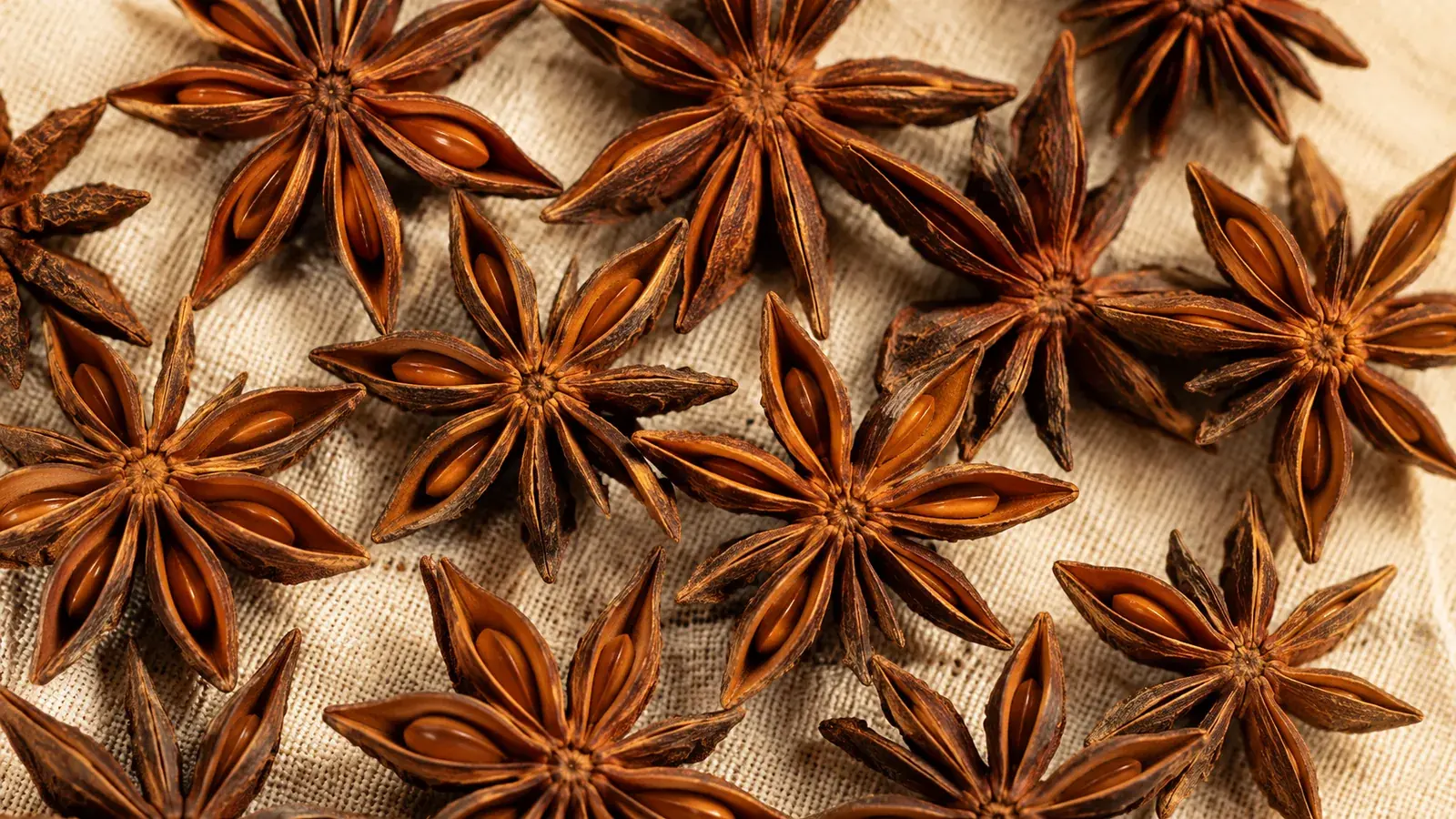
The star-shaped badian of garam-masala blends — largely re-exported, as India grows little.
Star Anise at a glance
- Botanical name
- Illicium verum
- Family
- Illiciaceae
- Part used
- Fruit
- Also known as
- Chakra phool, Badian
- ITC-HS
- 0909 61 00
- Spices Board schedule
- #28
What is Star Anise and how is it exported from India?
Star anise is the fruit of Illicium verum, a distinct botanical from true aniseed. India uses and re-exports it in blends; domestic cultivation is limited to the Northeast.
Overview
Star anise is the dried star-shaped fruit of the evergreen tree Illicium verum, an eight-pointed woody pericarp whose warm, sweet, liquorice-anise aroma comes chiefly from anethole. It is botanically unrelated to true aniseed (Pimpinella anisum, an Apiaceae seed) despite the shared flavour note, and it is a signature component of Indian garam masala and Chinese five-spice. What a buyer receives is the whole dried star, its seeded segments, or ground material, with the intact eight-armed stars commanding the culinary premium.
The honest commercial picture for India is that most star anise in Indian trade is not India-grown. Illicium verum is native to and grown mainly in southern China and northern Vietnam; Indian cultivation is limited and confined to the Northeast, so a large share of what moves through Indian channels is imported and re-exported or used in domestic blends. Any origin claim therefore needs care, and a buyer sourcing "from India" should understand they are usually buying re-exported or blend-incorporated material, not an Indian-grown crop.
Quality is judged on the wholeness and size of the stars, colour, aroma strength, and, importantly, botanical safety. A critical flag is possible contamination or adulteration with Japanese star anise (Illicium anisatum), a toxic look-alike that is not safe for food use; reputable supply must be verified as genuine Illicium verum. Star anise is also a raw material for shikimic acid, historically relevant to pharmaceutical manufacturing.
For an export buyer the practical concerns are genuine I. verum identity (screened against toxic I. anisatum), whole-star grade and aroma, honest disclosure of origin given the re-export reality, and clean, mould-free, well-dried material.
Forms & export grades
Whole dried stars graded by wholeness and size, the premium culinary form (largely re-exported, not India-grown).
Ground star anise for spice-house blends and bakery use.
Star-anise oil and oleoresin for the flavour and fragrance trade.
Growing regions
Illicium verum is native to and cultivated mainly in southern China and northern Vietnam, not India; Indian cultivation is limited and confined to the Northeast (Arunachal Pradesh and adjacent hills). As a result, much of the star anise moving through Indian trade is imported and re-exported or incorporated into domestic blends rather than grown from an Indian crop, and origin should be represented accordingly.
Uses & applications
- Whole stars in Indian garam-masala and biryani cooking and in Chinese five-spice blends
- Whole-spice blend manufacturing (garam masala, five-spice, mulling and pho-style spice mixes)
- Beverage and infusion flavouring for teas, mulled drinks, syrups and liqueurs
- Ground star anise for spice-house blends and bakery/confectionery applications
- Star-anise oil and oleoresin for the flavour and fragrance trade
- Pharmaceutical raw material (historically a source of shikimic acid)
- Retail-pack whole stars for the diaspora and gourmet spice trade
Sourcing & export considerations
- Available as whole stars (graded by wholeness and size), broken/segment star anise, and ground; also as star-anise oil/oleoresin
- Graded on the proportion of intact whole stars, size, colour and aroma strength, and freedom from grit, dust and mould
- Botanical safety is the critical flag: material must be verified as genuine Illicium verum and screened against the toxic look-alike Illicium anisatum (Japanese star anise), which is not safe for food use
- Origin must be represented honestly: much Indian-channel star anise is imported (China/Vietnam) and re-exported or blend-incorporated, not India-grown, so avoid unqualified "Indian origin" claims
- Reports under HS 0909 61 (with anise/fennel/caraway) and, as a re-exported item, lacks a clean India-grown trade split
- Whole stars are light and bulky and cube out in a container; packed in lined cartons or bags with moisture barriers to protect aroma and prevent mould
- Cleaning, screening and any decontamination are coordinated with vetted third-party processors; pesticide-residue, microbial and I. verum authenticity testing should accompany food-use lots
- Specify genuine I. verum (with authenticity screening), whole-star grade, origin disclosure and packaging on the contract
ITC-HS classification
- 0909 61 00 — Seeds of anise, badian, caraway or fennel — neither crushed nor ground
Frequently asked
Is star anise grown in India?
Only marginally. Illicium verum is grown mainly in southern China and northern Vietnam; Indian cultivation is limited to the Northeast. Much star anise in Indian trade is imported and re-exported or used in blends, so it is honest to represent it as re-exported rather than India-grown.
How is toxic Japanese star anise ruled out?
By verifying material as genuine Illicium verum and screening against Illicium anisatum (Japanese star anise), a toxic look-alike unsafe for food. Reputable supply uses authenticity checks; buyers should require confirmation of species on food-use lots.
Is star anise a source of shikimic acid?
Yes. Star anise is a historical raw material for shikimic acid used in pharmaceutical manufacturing, which is one reason demand and price have periodically spiked. For food buyers, however, culinary grade is specified on whole-star quality and aroma.
What this page does not tell you
- Origin
- Much star anise in Indian trade is re-exported, not India-grown; origin claims need care.
Related spices
Sources
- Spices Board of India — Export statistics· Tier 1, retrieved 2026-07-16
- Spices Board Act, 1986 — Schedule of spices· Tier 1, retrieved 2026-07-16