Parsley export from India
Petroselinum crispum · Apiaceae · Leaf
Grown and dried for the dehydrated-herb and seasoning trade.
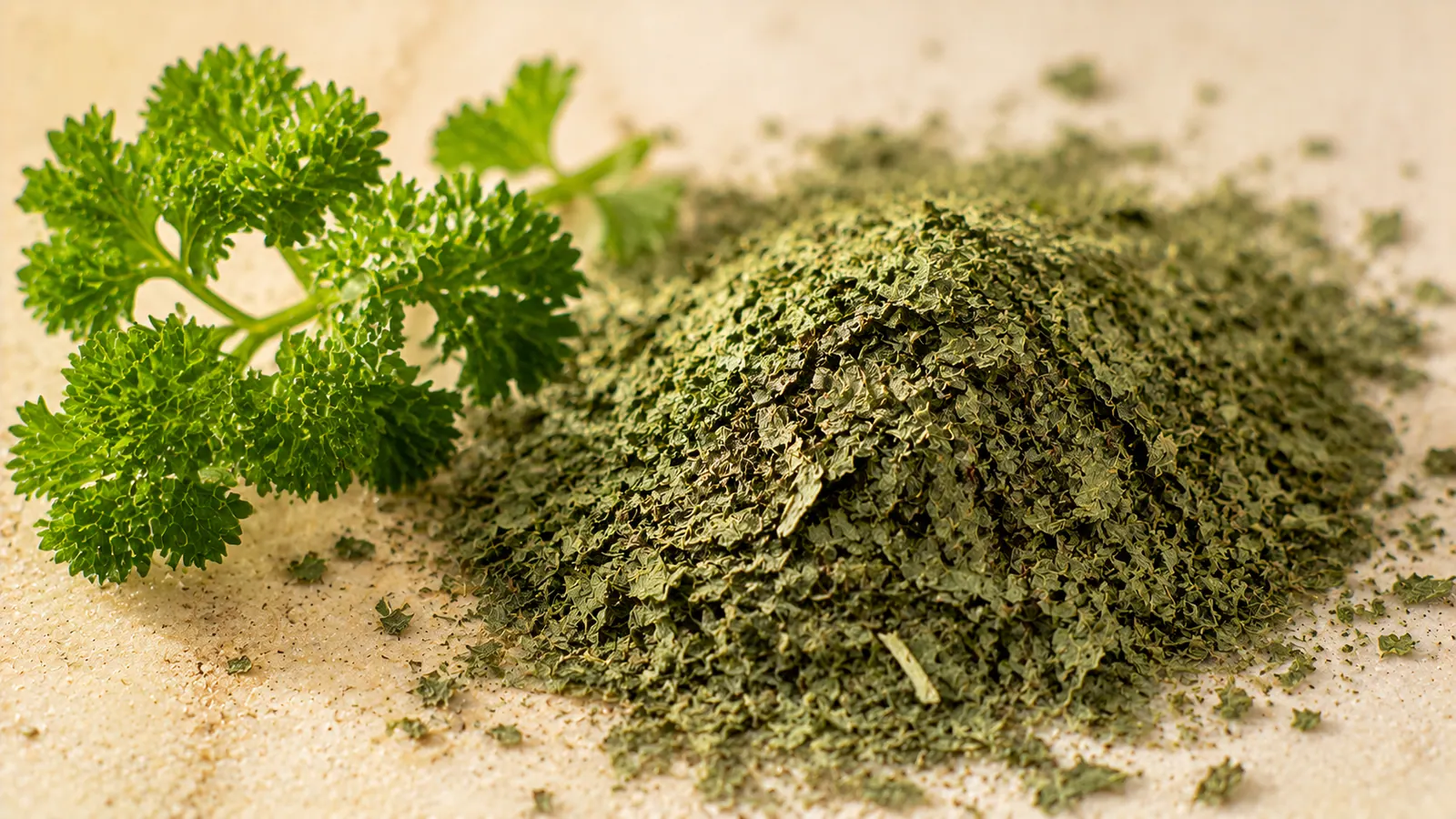
Parsley at a glance
- Botanical name
- Petroselinum crispum
- Family
- Apiaceae
- Part used
- Leaf
- ITC-HS
- 0910 99 99
- Spices Board schedule
- #22
What is Parsley and how is it exported from India?
Parsley is the leaf of Petroselinum crispum, exported dried for seasoning blends. It is a minor scheduled herb in India’s spice basket.
Overview
Parsley is the leaf of Petroselinum crispum, an Apiaceae herb grown and dried for the dehydrated-herb and seasoning trade rather than for fresh culinary sale in the export channel. Two leaf forms exist commercially, curly-leaf and flat-leaf (Italian) parsley, both dried and often rubbed or cut to a defined flake size. In India parsley is a minor scheduled herb, cultivated to order for seasoning-blend manufacturers, dehydrated-vegetable packers and food-service supply rather than as a large field crop.
The value in dried parsley is colour retention and clean, green appearance as much as aroma. Good dehydration preserves a bright green leaf; poor drying browns it and drops the grade. The flavour is mild, fresh and grassy, so parsley works as a visual and aromatic garnish in soups, seasonings and vegetable blends rather than as a dominant note. Buyers specify cut size (flakes, rubbed, or powder), colour, and freedom from stem and foreign matter.
Because parsley reports under the residual HS 0910 99 basket, it carries no separable bilateral trade data, and Indian supply competes in a global dehydrated-herb market against established origins. The Indian offer is best framed on contract growing, controlled drying, sieving to a defined flake, and low microbial load rather than on any distinctive terroir.
For a buyer the practical sourcing questions are colour grade, cut specification, microbiological status and consistency of the dried flake, plus whether steam-treated or otherwise decontaminated material is required for ready-to-eat applications.
Forms & export grades
Dried parsley flakes in defined cut sizes, the principal traded form for seasoning manufacturers.
Rubbed dried leaf for herb blends and garnish use.
Parsley powder for spice-house custom blends and coatings.
Varieties & types
- Curly-leaf parsley
- The tightly curled leaf form, popular as a dried flake and garnish for its distinctive appearance and colour hold.
- Flat-leaf / Italian parsley (P. crispum var. neapolitanum)
- A flat, stronger-flavoured leaf preferred in some culinary blends and dried for a more robust herb note.
Growing regions
Parsley is grown to order in temperate and irrigated pockets, typically as a cool-season crop where mild weather favours leaf development and clean drying. It is not tied to a single well-known Indian origin; supply is contract-based near dehydration and seasoning-manufacturing capacity rather than concentrated in a named growing belt.
Uses & applications
- Dried parsley flakes for soup, sauce, seasoning and dressing manufacturing
- Dehydrated-herb blends and dry seasoning mixes for the food-manufacturing trade
- Garnish and visual green flecking in snack seasonings, ready meals and instant foods
- Food-service and QSR dry-herb supply where a consistent flake and colour are specified
- Vegetable and herb seasoning for meat, poultry and fish coatings and marinades
- Rubbed and powdered parsley for spice-house custom blends
- Retail-pack dried herb for the diaspora and general grocery trade
- Parsley seed and, in niche cases, parsley oil for the flavour and fragrance trade
Sourcing & export considerations
- Available as dried flakes (defined cut/mesh sizes), rubbed leaf and powder; occasionally as seed for the flavour trade
- Graded chiefly on green colour retention, cut/flake uniformity, stem and foreign-matter content, and aroma
- Controlled dehydration is the quality-critical step; cleaning, de-stemming and sieving to a target flake size are coordinated with vetted processors, not run in-house by the desk
- Microbiological status matters for ready-to-eat use; steam or equivalent decontamination and microbial testing (including Salmonella-absent) should be specified where the end use requires it
- Reports under residual HS 0910 99, so it lacks separable bilateral trade data; do not expect a parsley-specific trade split
- Packed in food-grade lined cartons or multi-wall bags with moisture barriers; dried leaf is light and bulky, so it cubes out (fills volume before weight) in a container
- Pesticide-residue testing is relevant for EU/food-grade buyers; supply a recent residue panel with food-use lots
- Specify leaf type (curly/flat), colour grade, cut size, microbial specification and decontamination method on the contract
ITC-HS classification
- 0910 99 99 — Spices — other, not elsewhere specified (residual basket line)
Frequently asked
What determines the grade of dried parsley?
Chiefly green colour retention, cut/flake uniformity, and freedom from stem and foreign matter, alongside aroma and microbiological status. Well-dried parsley stays bright green; poorly dried leaf browns and drops in grade.
Is steam-treated parsley available for ready-to-eat use?
Yes, decontaminated material is available for ready-to-eat applications. Sterilisation and testing are coordinated with vetted third-party processors; specify the decontamination method and the microbial specification (including Salmonella-absent) on the contract.
What this page does not tell you
- Volume
- Reports under HS 0910 99.
Related spices
Sources
- Spices Board of India — Export statistics· Tier 1, retrieved 2026-07-16
- Spices Board Act, 1986 — Schedule of spices· Tier 1, retrieved 2026-07-16