Lovage export from India
Levisticum officinale · Apiaceae · Leaf, stem
A celery-scented herb of the schedule with negligible Indian commercial trade.
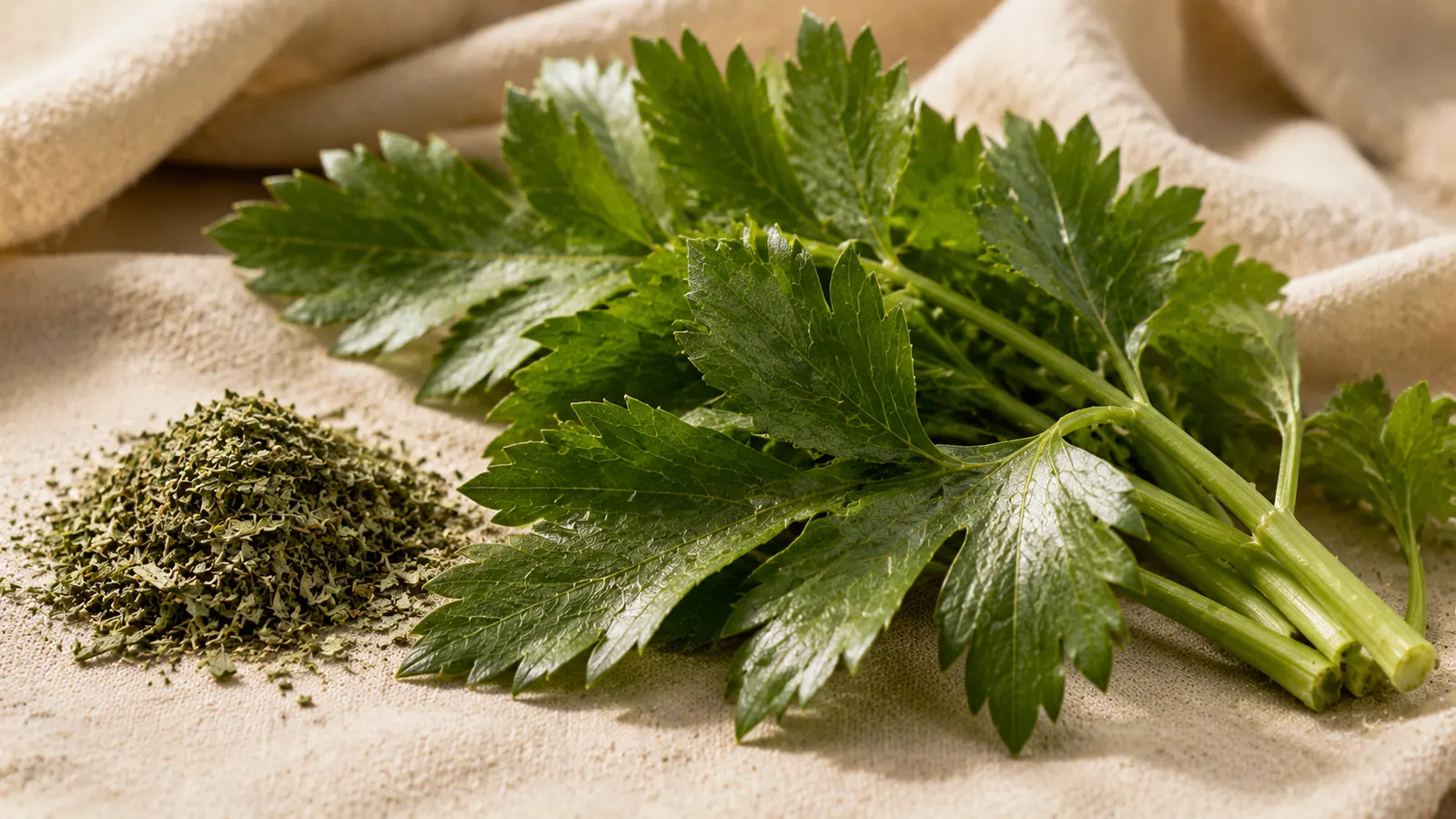
Lovage at a glance
- Botanical name
- Levisticum officinale
- Family
- Apiaceae
- Part used
- Leaf, stem
- ITC-HS
- 0910 99 99
- Spices Board schedule
- #39
What is Lovage and how is it exported from India?
Lovage (Levisticum officinale) is a tall Apiaceae herb with a celery-like flavour. It is scheduled in India but scarcely grown commercially.
Overview
Lovage is the aromatic herb Levisticum officinale, a tall, robust perennial of the Apiaceae, the same family as celery, parsley and coriander. Every part is aromatic, with a flavour strongly reminiscent of intense celery with yeasty, almost stock-cube savoury depth, which is why it is sometimes called the "Maggi herb". The leaves and young stems are the culinary herb, the seeds serve as an aromatic spice, and the root is distilled for a warm, spicy essential oil, giving lovage three distinct product streams from one plant.
Its dominant character comes from phthalides, the same class of aroma compound that gives celery its identity, so lovage reads as a concentrated celery note and is used sparingly. In the dried herb, quality is judged on green colour, aroma retention and clean, mould-free drying; the seed on aroma and cleanliness; the root oil on yield and profile. Because the flavour is so celery-forward, it slots naturally into savoury, stock and soup applications.
Within the Indian schedule lovage is a listed but scarcely commercial herb. It is a temperate plant with no established Indian production base, so domestic cultivation is negligible and there is no organised export crop. A sourcing desk should treat it as a specialty, largely-imported herb rather than an Indian-origin line, and be precise about which part (leaf, seed or root oil) a buyer actually wants.
Forms & export grades
Dried cut or rubbed leaf, the main culinary form.
Aromatic lovage seed used as a spice.
Root-distilled essential oil for flavour and fragrance.
Varieties & types
- Dried leaf herb
- The cut or rubbed leaf, the main culinary form, used sparingly for its strong celery note.
- Lovage seed
- The aromatic fruit used as a spice for baking, savouries and pickling.
- Root (oil source)
- The thick root, distilled for a warm, spicy essential oil for flavour and fragrance.
Growing regions
Lovage is a temperate perennial without an established commercial belt in India; any cultivation is limited to small trial or garden plantings in cooler hill zones rather than field-scale acreage. Leafy aromatic herbs are cut for drying around peak growth, and seed is taken as the umbels mature. With negligible domestic production, lovage in trade is generally imported, and India is not a genuine origin.
Uses & applications
- A concentrated celery-note herb for soups, broths, stocks and stews
- Savoury seasoning and stock/bouillon flavour bases in food manufacturing
- Fresh or dried leaf in salads, potato dishes and herb blends
- Lovage seed as an aromatic spice for breads, savouries and pickles
- Root-derived essential oil for flavour and fragrance houses
- Herbal tea and traditional digestive preparations
Sourcing & export considerations
- Distinct product streams: dried leaf herb, lovage seed and root-derived essential oil; confirm which the buyer needs
- Dried-herb quality turns on green colour, aroma retention, low stalk and clean drying; seed on aroma and cleanliness
- Cleaning and cut-and-sift sizing are coordinated with vetted third-party herb processors rather than owned lines
- Packaging: light- and moisture-barrier lined cartons or pouches; the phthalide aroma fades with air, heat and light
- Shelf life is aroma-driven rather than a fixed figure; dried leafy herb loses character faster than seed and holds best cool, dark and sealed
- Reports under residual HS 0910 99, so there is no separable bilateral lovage trade figure
- Specify on contract: plant part (leaf/seed/root oil), cut size, aroma/oil expectation, and origin, given India is not a real source
ITC-HS classification
- 0910 99 99 — Spices — other, not elsewhere specified (residual basket line)
Frequently asked
What does lovage taste like?
Like a concentrated, savoury celery, with a yeasty stock-cube depth that has earned it the nickname "Maggi herb". It comes from the same phthalide aroma compounds as celery and is used sparingly in soups, stocks and savoury dishes.
Does India produce lovage commercially?
No. Lovage is scheduled in India but is a temperate herb with negligible domestic cultivation. Supply in trade is generally imported, so we do not present it as a genuine Indian-origin line and confirm origin before contracting.
What this page does not tell you
- Volume
- Negligible Indian production.
Related spices
Sources
- Spices Board of India — Export statistics· Tier 1, retrieved 2026-07-16
- Spices Board Act, 1986 — Schedule of spices· Tier 1, retrieved 2026-07-16