Garlic export from India
Allium sativum · Alliaceae · Bulb
Exported fresh and dehydrated, with two Tamil-Kerala hill GIs prized for high pungency and allicin.
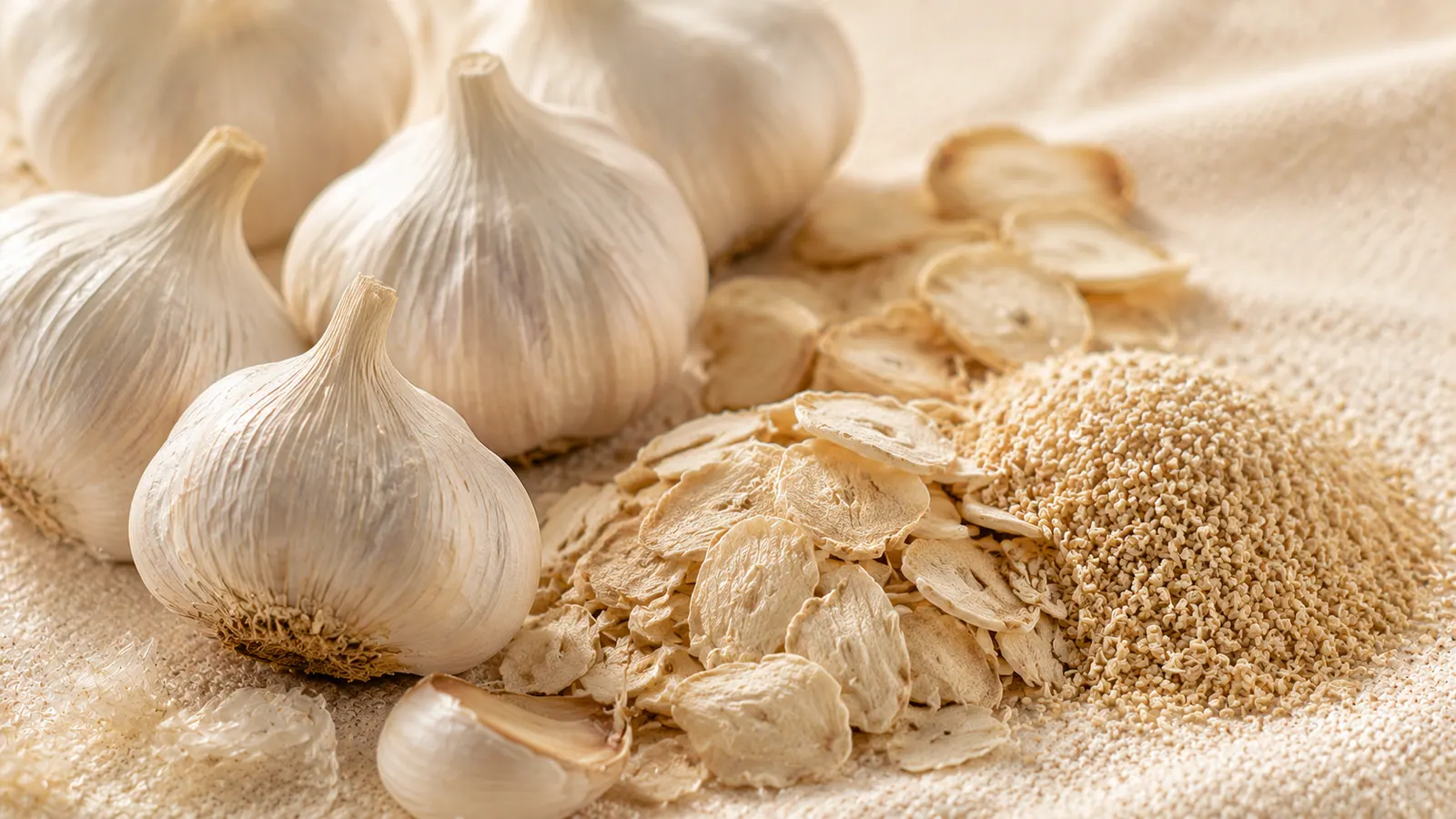
Garlic at a glance
- Botanical name
- Allium sativum
- Family
- Alliaceae
- Part used
- Bulb
- Also known as
- Lahsun
- Forms exported
- Dried, Dehydrated, Ground
- ITC-HS
- 0712 90 00
- Spices Board schedule
- #17
What is Garlic and how is it exported from India?
Garlic is the bulb of Allium sativum, exported fresh, as dehydrated flakes/granules and powder. India’s GI hill garlics (Kodaikanal, Kanthalloor-Vattavada) are small-clove, high-pungency types.
Overview
Garlic is the compound bulb of Allium sativum, and in the export trade it splits into two quite different businesses. One is fresh bulb, a bulk vegetable commodity moved in mesh and carton by the tonne. The other, and the one that behaves like a spice ingredient, is dehydrated garlic: cloves peeled, sliced and dried, then sold as kibbled/minced pieces, flakes, granules and powder to the food-manufacturing and seasoning trade. The flavour and pungency of both come from alliin, which converts on crushing to allicin and the sulphur compounds responsible for the sharp aroma, so pungency and allicin potential are what quality-conscious buyers actually chase.
For dehydrated garlic the technical specifications a manufacturer cares about are moisture, mesh/particle size, colour (a clean cream-white, not scorched or grey), added-anti-caking status, and the microbiological profile. Because it is a low-moisture ready-to-eat ingredient, dehydrated garlic is a recognised Salmonella and total-plate-count risk, so microbial testing and a validated reduction step are standard buyer requirements. India competes in this trade on cost and on the naturally high pungency of its material, though China is the dominant world dehydrated-garlic origin.
India also grows small-clove, high-pungency hill garlics that are recognised on the GI register, notably Kodaikanal Malai Poondu and the Kanthalloor-Vattavada garlic of the Western Ghats, prized for their strong flavour and high allicin (giRegistry). Because garlic largely reports as a vegetable rather than under the Chapter 9 spice headings, its trade figures are not comparable to the seed spices, and buyers should treat garlic sourcing as a produce-and-dehydrate supply chain with spice-grade quality control.
Forms & export grades
Peeled, sliced and dried garlic as kibbled/minced, flakes and granules for the food-manufacturing trade.
Garlic powder milled from dehydrated garlic, specified by mesh, moisture and colour.
Dried garlic flakes/slices for visible-inclusion seasoning and ready-meal use.
Garlic oleoresin and garlic oil for concentrated, standardised flavour dosing.
Varieties & types
- Kodaikanal Malai Poondu (GI)
- A small-clove Tamil hill garlic on the GI register, prized for intense pungency and high allicin (giRegistry).
- Kanthalloor-Vattavada garlic (GI)
- A Western-Ghats hill garlic (Kerala) on the GI register, a small-clove, high-pungency type (giRegistry).
- Common white/plains garlic
- The bulk fresh and dehydration-feedstock garlic, larger-bulbed and lower-cost than the hill GIs.
- Dehydrated grades
- Kibbled/minced, flakes, granules (roasted and unroasted) and powder, specified by mesh, moisture and colour.
Growing regions
Garlic is grown widely across India as a rabi (winter) crop, with Madhya Pradesh, Rajasthan, Gujarat and Uttar Pradesh among the large plains-producing states supplying the fresh and dehydration trade, and harvest concentrated in late winter to spring. Distinct small-clove, high-pungency garlics come from the southern hills, including the GI-registered Kodaikanal and Kanthalloor-Vattavada types. Fresh bulb stores for months under proper curing and ventilation, which spreads availability beyond the harvest window.
Uses & applications
- Dehydrated garlic flakes, granules and powder for savoury food manufacturing and seasoning blends
- Minced/kibbled dried garlic for ready-meals, sauces, marinades and spice mixes
- Garlic salt, garlic bread seasoning and QSR/HORECA seasoning supply
- Snack, cracker and instant-noodle seasoning where a strong garlic note is wanted at controlled moisture
- Fresh bulb for the retail and food-service vegetable trade (a separate, produce-side business)
- Garlic oil and garlic oleoresin for concentrated, standardised flavour dosing
- Allicin- and organosulphur-standardised extracts for the nutraceutical and supplement trade
- Pickle, chutney and condiment manufacturing
- GI hill garlics (Kodaikanal, Kanthalloor-Vattavada) for premium and functional positioning
Sourcing & export considerations
- Available as fresh bulb (produce trade) and as dehydrated garlic in kibbled/minced, flakes, granule and powder forms for the ingredient trade
- For dehydrated garlic, specify moisture, mesh/particle size, colour, roasted vs unroasted, and anti-caking/flow-agent status on the contract
- Dehydrated garlic is a ready-to-eat low-moisture ingredient with a real Salmonella and total-plate-count risk, so require microbial testing (Salmonella absent in 25 g) and a validated reduction step, arranged with vetted third-party facilities
- For fresh bulb, specify bulb size/count, curing, and phytosanitary certification, and expect produce-style handling and shelf life rather than dry-spice storage
- Dehydrated forms store well cool, dry and in barrier packaging; ground/granule forms are hygroscopic and cake if they take up moisture
- MOQ follows trade practice: sample lots around 50-100 kg for dehydrated grades, private-label from about 100 kg per variant, larger runs by tonnage; fresh bulb moves in far larger produce lots (cbi)
- Garlic largely reports as a vegetable under HS 0703 (fresh) and 0712 (dried), not under Chapter 9, so its trade figures are not comparable to the seed spices and should not be blended with them
- For GI hill garlics, verify the GI status and traceability on the register before making a GI claim (giRegistry)
- Nutraceutical buyers should specify the target assay (allicin potential or organosulphur content) and test method, since these define the extraction grade
ITC-HS classification
- 0712 90 00 — Dried vegetables — other, incl. dried garlic
Frequently asked
Why does dehydrated garlic need Salmonella testing?
It is a low-moisture, ready-to-eat ingredient, and dried garlic and onion are recognised Salmonella and high-plate-count risks. Require Salmonella-absent-in-25 g testing and a validated microbial-reduction step, coordinated with vetted third-party facilities, on every lot.
What makes Indian GI hill garlics different?
Kodaikanal Malai Poondu and Kanthalloor-Vattavada garlic are small-clove hill types on the GI register, valued for intense pungency and high allicin rather than bulb size (giRegistry). They suit premium and functional positioning over bulk dehydration.
Why are garlic trade figures not comparable to other spices?
Garlic reports mainly as a vegetable under HS 0703 (fresh) and 0712 (dried), not under the Chapter 9 spice headings. So its volumes sit in a different classification and should not be lumped with seed-spice export figures.
What this page does not tell you
- Spice-schedule vs vegetable trade
- Garlic largely reports as a vegetable (HS 0703/0712), not under Chapter 9; figures are not comparable to seed spices.
Related spices
Sources
- Spices Board of India — Export statistics· Tier 1, retrieved 2026-07-16
- Spices Board Act, 1986 — Schedule of spices· Tier 1, retrieved 2026-07-16
- Geographical Indications Registry, India — Registered GIs· Tier 1, retrieved 2026-07-16
- CBI — Entering the European market for spices and herbs· Tier 2, retrieved 2026-07-16