Dill export from India
Anethum graveolens · Apiaceae · Fruit
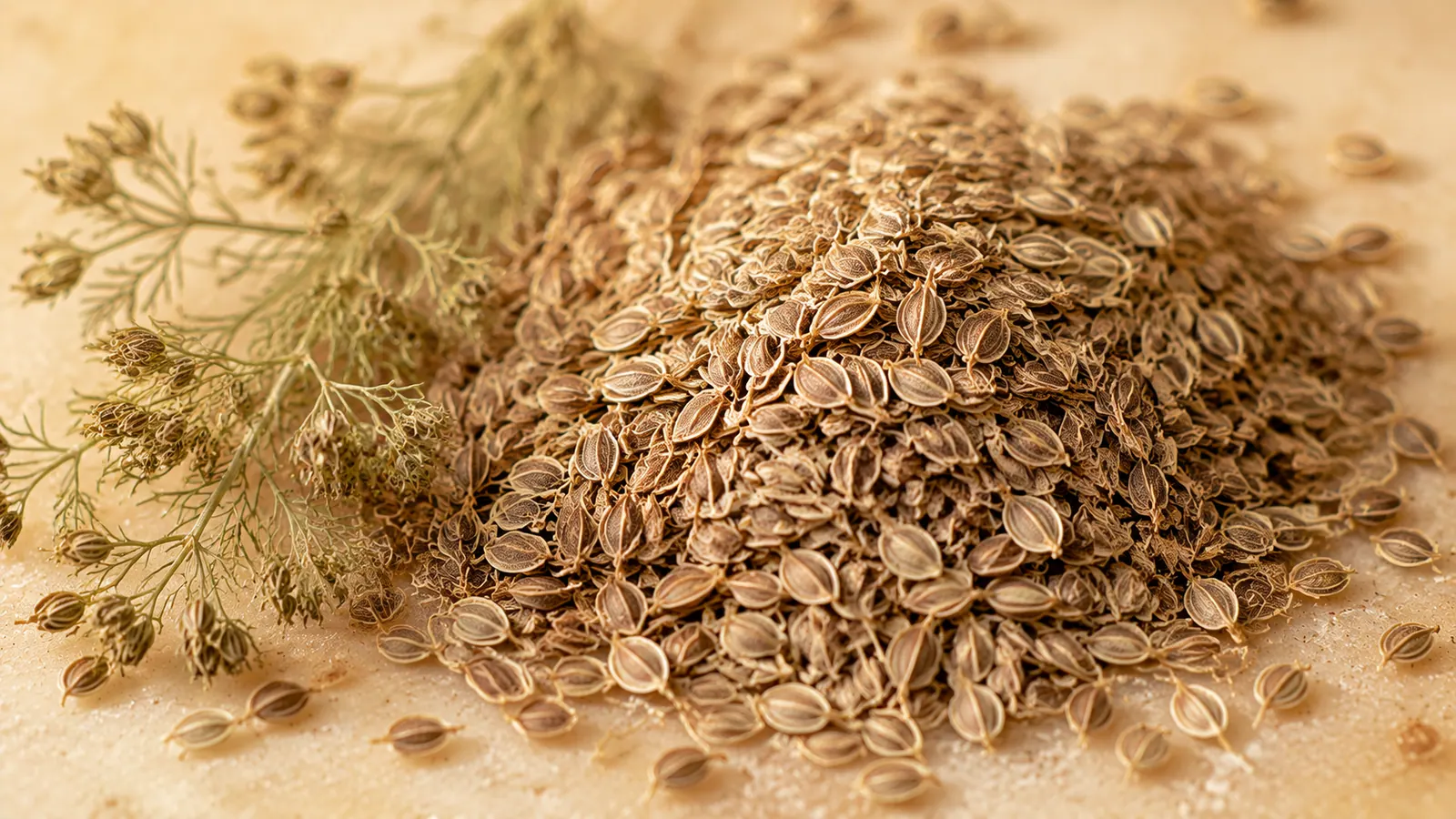
Indian dill seed (sowa), a distinct chemotype from European dill, supplied to the seasoning and extraction trade.
Dill at a glance
- Botanical name
- Anethum graveolens
- Family
- Apiaceae
- Part used
- Fruit
- Also known as
- Sowa, Soya (seed)
- ITC-HS
- 0910 99 25
- Spices Board schedule
- #14
What is Dill and how is it exported from India?
Dill is Anethum graveolens; the Indian type (often called Indian dill / sowa) has a carvone-rich profile and is exported as seed and for oil extraction.
Overview
Dill is Anethum graveolens, an umbellifer grown for both its feathery leaf (dill weed) and its flat, oval, winged seed, and the Indian material is a recognisably distinct chemotype. Where European dill leans on a soft, grassy character, Indian dill (commonly called sowa) is carvone-rich, giving a sharper, more caraway-adjacent aroma in the seed. This chemotype difference is a real sourcing point: a buyer used to European dill will find Indian dill seed more pungent, which suits some blends and extraction uses better than others.
The seed is graded on cleanliness, colour and, for the extraction trade, on carvone and dill-oil yield. It is light and small, so admixture removal is a genuine quality issue and sortex-cleaned lots command confidence. The leaf side of the crop is sold as dried dill weed for the herb trade, a separate finished product from the seed, and there is a distinct dill (and dill-seed) oil stream feeding flavour houses and the pickling industry.
India is a significant supplier of dill seed and dill-seed oil into the seasoning, pickling and extraction trade, and the crop moves largely as an industrial ingredient rather than a retail spice. It reports under a residual tariff line, so no clean stand-alone export series exists; buyers plan on qualitative supply and on assay, not on an invented volume.
Forms & export grades
Whole cleaned/sortex dill seed, the mainstream pickling and blend form.
Milled powder for blends, milled close to use to hold the carvone note.
Steam-distilled dill seed oil for pickling and flavour houses, sold on carvone strength.
Dried dill weed (leaf), an adjacent product for the herb and dressing trade.
Varieties & types
- Indian dill / sowa (carvone-rich)
- The distinct Indian chemotype: a sharper, carvone-forward seed valued by the pickling and extraction trade.
- European-type dill
- A softer, grassier chemotype; buyers used to it should note the Indian seed is more pungent.
- Dill weed (leaf)
- The dried feathery leaf, a separate finished product for the herb and dressing trade rather than the seed.
Growing regions
Dill is grown as a cool-season rabi crop across parts of north, central and western India within the wider seed-spice belt, sown after the monsoon and harvested in late winter to spring, so new-crop seed comes forward in the first half of the year. The carvone-rich Indian chemotype is a product of local germplasm and growing conditions. Post-harvest drying influences the dill-oil yield that extraction buyers pay for.
Uses & applications
- Pickling and brining spice for the cucumber, gherkin and vegetable-processing trade
- Dill-seed and dill-oil flavouring for pickles, sauces and savoury products
- A carvone-forward note in seasoning and spice-blend manufacturing
- South Asian tempering and blends (sowa) and lentil/vegetable dishes
- Dried dill weed (leaf) for the herb, dressing and dip trade as an adjacent product
- Dill seed oil and oleoresin extraction for flavour houses and the beverage trade
- Digestive and carminative (gripe-water-style) preparations in the traditional and nutraceutical trade
- Whole seed for the diaspora retail and HORECA spice trade
Sourcing & export considerations
- Available as whole cleaned/sortex seed, as ground powder, as dill seed oil and oleoresin, and (leaf side) as dried dill weed
- Cleaning by air-screen, gravity and colour sorting to strip stalk, chaff and weed seed from the light fruit; specify cleaned vs sortex grade
- Confirm you are buying the Indian carvone-rich chemotype or a European type, since the aroma and pungency differ and this affects blend and pickling performance
- Extraction buyers should specify a carvone or dill-oil floor and a fresh crop; the volatile note is what the seed is bought for
- Whole seed stores well in cool, dry, barrier packaging; ground dill loses aroma quickly and is best milled close to use
- Packed in food-grade lined bags, palletised for sea freight; MOQ by trade practice, sample lots around 50-100 kg, private-label from about 100 kg (cbi)
- For EU and US buyers, specify pesticide-residue and microbial testing; steam-based microbial reduction is coordinated with vetted third-party facilities
- Dill reports under residual HS 0910 99 (0910 99 25 in the Indian tariff), so no clean bilateral volume series exists for the seed alone
ITC-HS classification
- 0910 99 25 — Dill seed
Frequently asked
How is Indian dill (sowa) different from European dill?
Indian dill is a carvone-rich chemotype, so the seed is sharper and more caraway-adjacent than the softer, grassier European type. Buyers accustomed to European dill should sample the Indian seed against their brief before committing.
Is dill weed the same product as dill seed?
No. Dill weed is the dried feathery leaf, used in dressings, dips and fish dishes. Dill seed is the dried fruit, used in pickling and extraction. They are separate products sold and priced independently.
Why is Indian dill favoured for pickling and extraction?
Its higher carvone gives a stronger, more assertive aroma that carries through brines and survives processing, and it yields well on distillation for dill seed oil. That pungency suits industrial pickling and flavour use.
What this page does not tell you
- Volume
- Reports under HS 0910 99.
Related spices
Sources
- Spices Board of India — Export statistics· Tier 1, retrieved 2026-07-16
- Spices Board Act, 1986 — Schedule of spices· Tier 1, retrieved 2026-07-16
- CBI — Entering the European market for spices and herbs· Tier 2, retrieved 2026-07-16
- UN Comtrade — reporter India, Chapter 09· Tier 1, retrieved 2026-07-16