Curry Leaf export from India
Murraya koenigii · Rutaceae · Leaf
Exported fresh and dried to the diaspora and seasoning trade, and processed for its aromatic leaf oil.
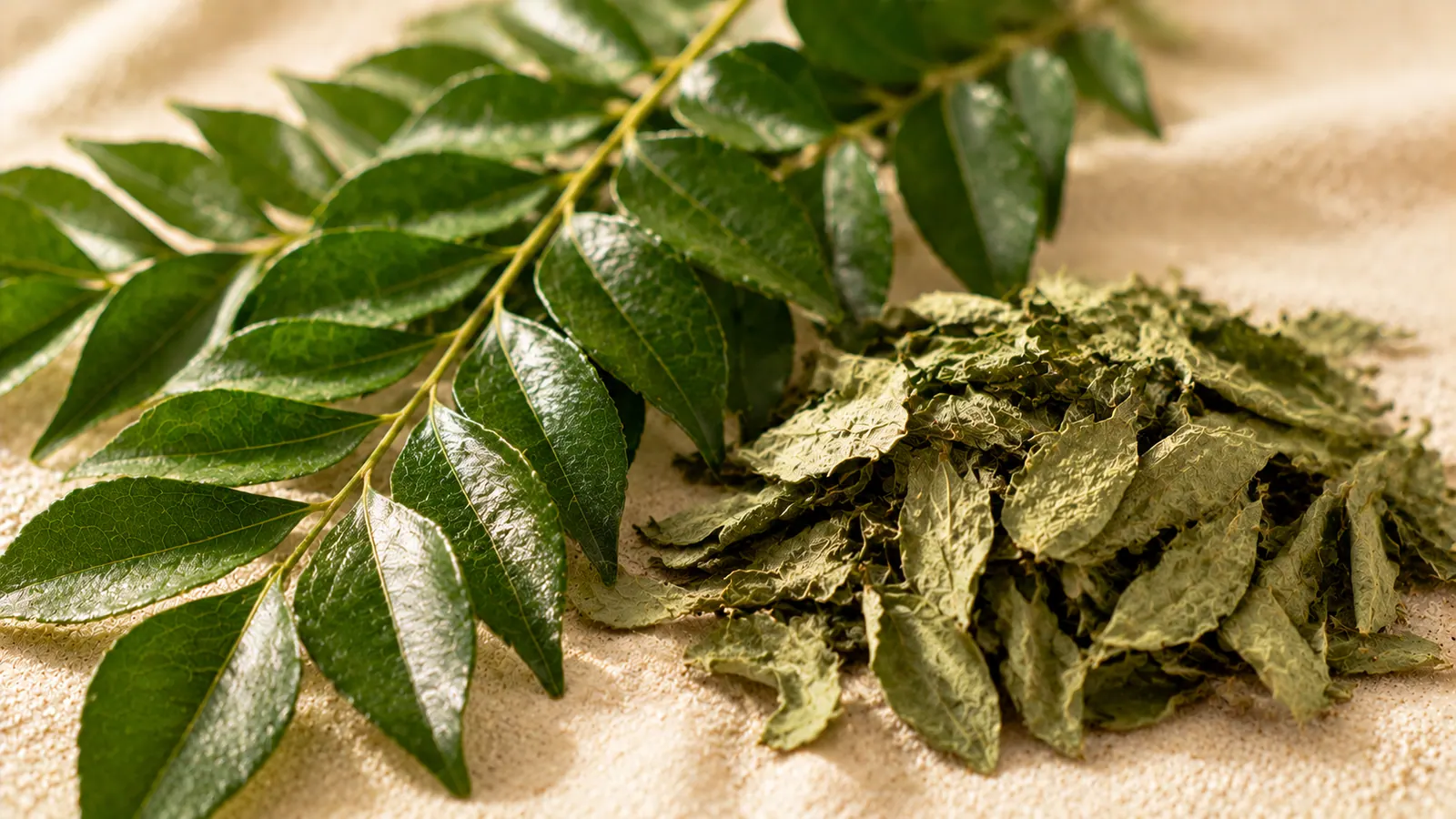
Curry Leaf at a glance
- Botanical name
- Murraya koenigii
- Family
- Rutaceae
- Part used
- Leaf
- Also known as
- Kadi patta, Kariveppilai
- ITC-HS
- 0910 99 99
- Spices Board schedule
- #18
What is Curry Leaf and how is it exported from India?
Curry leaf is the aromatic leaf of Murraya koenigii, used fresh and dried. India exports it to diaspora markets and extracts leaf oil for flavour use.
Overview
Curry leaf is the aromatic leaf of Murraya koenigii, a small Rutaceae tree of the citrus family, and despite the English name it has nothing to do with curry powder. The fresh leaf carries a distinctive warm, nutty, faintly citrus-and-anise aroma that is released when it is fried in hot oil at the start of a South Indian dish (the tadka), and that volatile aroma is the whole point of the ingredient, which is why the trade splits sharply between fresh leaf, where aroma is at its peak, and dried leaf, which is more stable but noticeably weaker.
For a B2B buyer the leaf presents in three streams. Fresh leaf on the stem moves fast to the diaspora retail and food-service trade and is essentially a perishable-produce business with cold-chain and phytosanitary requirements. Dried and freeze-dried leaf, and leaf powder, serve seasoning manufacturers and diaspora retail where shelf stability matters more than peak aroma. And curry-leaf oil and oleoresin feed flavour houses and the nutraceutical trade, the latter interested in the leaf as a source of carbazole alkaloids studied for functional benefits.
India is the natural home of the crop and the dominant supplier, but curry leaf is one of the more compliance-exposed items in the fresh-produce spice trade: fresh curry leaves from India have a documented history of pesticide-residue rejections at EU and US import, so residue control and traceability are the front-line quality issue, not an afterthought (rasff). Curry leaf reports under residual and fresh-produce tariff lines, so it carries no clean stand-alone export series.
Forms & export grades
Air-dried or freeze-dried leaf for seasoning and shelf-stable retail; freeze-dried holds more colour and aroma.
Curry-leaf powder milled from dried leaf for blends and instant foods.
Distilled curry-leaf oil for flavour houses as a concentrated aromatic.
Solvent-extracted oleoresin for standardised flavour and functional dosing.
Varieties & types
- Fresh leaf (on stem)
- The peak-aroma perishable form for diaspora retail and food service; a produce business with cold-chain needs.
- Dried / freeze-dried leaf
- Shelf-stable leaf for seasoning and retail; freeze-drying retains more colour and aroma than air-drying.
- Leaf powder
- Milled dried leaf for blend and instant-food manufacturing.
- Curry-leaf oil / oleoresin
- Distilled oil and solvent oleoresin for flavour houses and functional use.
Growing regions
Curry leaf grows across South India and is cultivated widely in Tamil Nadu, Karnataka, Andhra Pradesh, Telangana and Kerala, as well as in home gardens nationwide, and as a perennial it yields leaf through much of the year rather than in a single seasonal window. That year-round availability supports a steady fresh-export flow, though fresh leaf is highly perishable and quality falls quickly after harvest without cold-chain handling. Dried and extracted forms are made to carry the aroma beyond the perishability limit of the fresh leaf.
Uses & applications
- Fresh leaf on the stem for South Indian and Sri Lankan cooking, sold to diaspora retail and food service
- Tempering (tadka) aromatic for curries, dals, chutneys, rice dishes and snacks
- Dried and freeze-dried leaf for seasoning blends and shelf-stable retail packs
- Curry-leaf powder for spice-blend and instant-food manufacturing
- Curry-leaf oil and oleoresin for flavour houses as a concentrated, standardised note
- Carbazole-alkaloid-standardised extracts for the nutraceutical and supplement trade
- Herbal, hair-oil and personal-care preparations that use curry-leaf extract
- Snack and namkeen seasoning where a fried curry-leaf note is wanted
Sourcing & export considerations
- Available as fresh leaf on the stem, dried and freeze-dried leaf, leaf powder, and curry-leaf oil and oleoresin
- Fresh leaf is highly perishable and needs cold-chain handling, rapid transit and phytosanitary certification; specify pack format, cold-chain and shelf-life expectations
- Pesticide-residue control is the front-line issue: fresh Indian curry leaves have a documented history of residue rejections at EU/US import, so require a recent accredited residue panel and traceability to source (rasff)
- For EU-facing fresh leaf, treat residue compliance under the increased-controls framework seriously and keep the residue dossier with the shipment (eurlex1793)
- Dried and freeze-dried leaf and powder are far more stable; specify drying method, colour and moisture, since freeze-dried retains more aroma than air-dried
- Any microbial-reduction step on dried leaf/powder is coordinated with vetted third-party facilities, not performed in-house
- MOQ follows trade practice: sample lots around 50-100 kg for dried forms, private-label from about 100 kg; fresh leaf moves in smaller, faster perishable consignments (cbi)
- Curry leaf reports under residual HS 0910 99 and fresh-produce lines, so no clean bilateral volume series exists for it alone
- Extraction buyers should specify the target assay (carbazole alkaloid or oil yield) and test method up front
ITC-HS classification
- 0910 99 99 — Spices — other, not elsewhere specified (residual basket line)
Frequently asked
Does curry leaf have anything to do with curry powder?
No. Curry leaf is the aromatic leaf of the Murraya koenigii tree, used mainly in South Indian tempering. Curry powder is a blend of ground spices. The shared English word is misleading, and the two are unrelated products.
Why is pesticide residue the main concern with fresh curry leaf?
Fresh Indian curry leaves have a documented history of pesticide-residue rejections at EU and US import (rasff). Because the leaf is eaten and lightly processed, residue control and traceability to source are the front-line quality requirement on any fresh-leaf contract.
Fresh, dried, or freeze-dried curry leaf for my product?
Fresh gives peak aroma but is perishable and needs a cold chain. Air-dried is stable but weaker. Freeze-dried keeps more colour and aroma than air-dried at higher cost. Match the form to your shelf-life and aroma needs.
What this page does not tell you
- Volume
- Reports under HS 0910 99 / fresh-produce lines; not separable.
Related spices
Sources
- Spices Board of India — Export statistics· Tier 1, retrieved 2026-07-16
- Spices Board Act, 1986 — Schedule of spices· Tier 1, retrieved 2026-07-16
- RASFF Window — EU rapid alert for food and feed· Tier 1, retrieved 2026-07-16
- Reg. (EU) 2019/1793 — temporary increase of official controls· Tier 1, retrieved 2026-07-16
- CBI — Entering the European market for spices and herbs· Tier 2, retrieved 2026-07-16