Caper export from India
Capparis spinosa · Capparidaceae · Flower bud
A brined flower bud from arid zones — a minor scheduled spice in India.
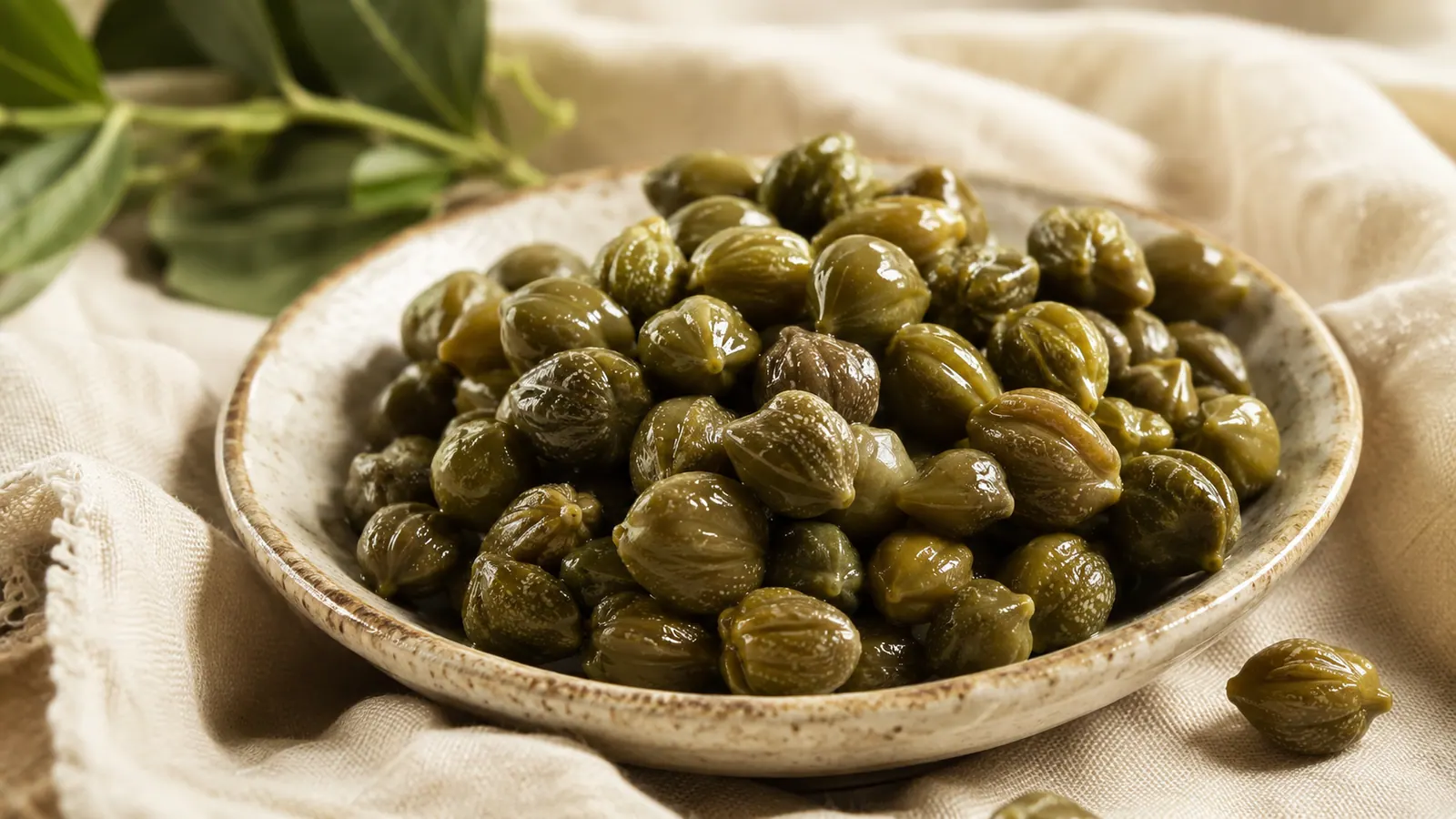
Caper at a glance
- Botanical name
- Capparis spinosa
- Family
- Capparidaceae
- Part used
- Flower bud
- ITC-HS
- 0910 99 99
- Spices Board schedule
- #32
What is Caper and how is it exported from India?
Capers are the pickled flower buds of Capparis spinosa. India’s production is small and localised to arid regions; most capers in trade are Mediterranean.
Overview
Capers are the unopened flower buds of Capparis spinosa, a sprawling, drought-hardy shrub of the Capparidaceae that grows out of rock crevices and poor arid soils. The bud is inedible raw and bitter; its familiar sharp, briny, faintly floral character is created entirely by curing, either in brine, in vinegar, or the traditional dry-salt cure that ferments the bud and develops the mustard-oil pungency from glucosinolates in the tissue. What the market pays for is therefore small, tight, evenly-sized buds and a clean cure, not the raw agricultural bud.
Size is the defining grade axis. The smallest buds command the premium and step down through a named size ladder to the large buds, and the same plant also yields the elongated caperberry, the immature fruit picked on its stalk and cured whole. Colour should be a uniform olive-green, buds firm and closed rather than blown open, with a clean saline brine and no soft or mushy pieces.
India is a marginal origin for a spice whose commercial centre of gravity is firmly Mediterranean. Wild and semi-wild Capparis grows across dry zones of the subcontinent and is harvested locally, but there is no large organised export crop, and most capers moving in international trade originate around the Mediterranean basin. For a sourcing desk the honest framing is a niche, specialty line rather than a volume commodity.
Forms & export grades
Whole cured buds packed in brine, vinegar or dry salt by size grade.
Caper-based pastes and tapenade bases for the deli and sauce trade.
Varieties & types
- Nonpareil (smallest grade)
- The tiniest, tightest buds; the premium size tier prized for delicate finishing use.
- Larger size grades
- Progressively bigger buds down the ladder (surfines, capucines, capotes and up), milder and cheaper per bud.
- Caperberry
- The immature fruit picked whole on its stalk and cured; served as a garnish rather than a seasoning.
Growing regions
Capparis is a wild, drought-adapted shrub found across arid and semi-arid tracts of India, including rocky Himalayan foothill and western dryland zones, where buds are gathered from wild or semi-managed stands rather than a plantation crop. Harvest follows the flowering flush, with buds picked before they open. Because there is no organised commercial acreage of scale, seasonality and volume are irregular and most traded capers are of Mediterranean origin.
Uses & applications
- Brined or salted capers as a finishing condiment for antipasti, salads and fish
- A defining ingredient in Mediterranean sauces such as tartare, remoulade, puttanesca and piccata
- Deli and delicatessen manufacturing for spreads, tapenades and cream-cheese blends
- Smoked-salmon, cured-fish and charcuterie plating in food service
- Caperberries served whole as a bar and antipasti garnish and as a pickle line
- Pizza and flatbread toppings in the QSR and frozen-food supply chain
- Dressing and vinaigrette manufacturing where a briny, piquant note is wanted
Sourcing & export considerations
- Traded almost entirely in cured form: in brine, in vinegar, or dry-salted; raw fresh buds are not a shipping format
- Graded primarily by bud size, with the smallest grades carrying the premium; uniformity and closed, firm buds matter as much as size
- Packaging: food-grade pails, drums or jars for brined product; lined sacks/pouches for salt-cured buds, kept cool
- Shelf life is governed by the cure and acidity/salinity of the pack rather than a fixed figure; kept submerged in brine and cool, cured capers hold well
- MOQ behaves as a specialty pickle line; expect sampling and modest trial lots ahead of any standing programme
- Reports under residual HS 0910 99, so no separable bilateral caper trade figure exists for India
- Specify on contract: cure type (brine/vinegar/salt), size grade, drained weight, brine strength/acidity, and caper vs caperberry
- Because the Indian crop is small and wild-gathered, verify true origin before making an India-grown claim rather than a re-export
ITC-HS classification
- 0910 99 99 — Spices — other, not elsewhere specified (residual basket line)
Frequently asked
Are capers grown at scale in India?
No. Capparis grows wild in Indian dry zones and is gathered locally, but there is no large organised caper crop. Most traded capers are Mediterranean, so we verify true origin before describing a lot as India-grown.
What is the difference between capers and caperberries?
Capers are the tiny unopened flower buds, graded by size with the smallest fetching the premium. Caperberries are the larger immature fruit picked whole on the stalk and cured, used as a garnish rather than a chopped seasoning.
Brine, vinegar or salt cure?
Salt-cured capers keep a firmer texture and more concentrated flavour and are rinsed before use; brined and vinegared capers are ready to use straight from the pack. Specify the cure, size grade and drained weight on the contract.
What this page does not tell you
- Volume
- Negligible Indian export.
Related spices
Sources
- Spices Board of India — Export statistics· Tier 1, retrieved 2026-07-16
- Spices Board Act, 1986 — Schedule of spices· Tier 1, retrieved 2026-07-16
- CBI — Entering the European market for spices and herbs· Tier 2, retrieved 2026-07-16