Allspice export from India
Pimenta dioica · Myrtaceae · Fruit, leaf
A New-World berry tasting of several spices at once — grown only marginally in India.
Allspice at a glance
- Botanical name
- Pimenta dioica
- Family
- Myrtaceae
- Part used
- Fruit, leaf
- Also known as
- Pimento, Kabab chini (adjacent)
- ITC-HS
- 0910 99 99
- Spices Board schedule
- #45
What is Allspice and how is it exported from India?
Allspice is the dried berry of Pimenta dioica, so named for its clove-cinnamon-nutmeg profile. India grows it marginally in the south; most trade is re-export.
Overview
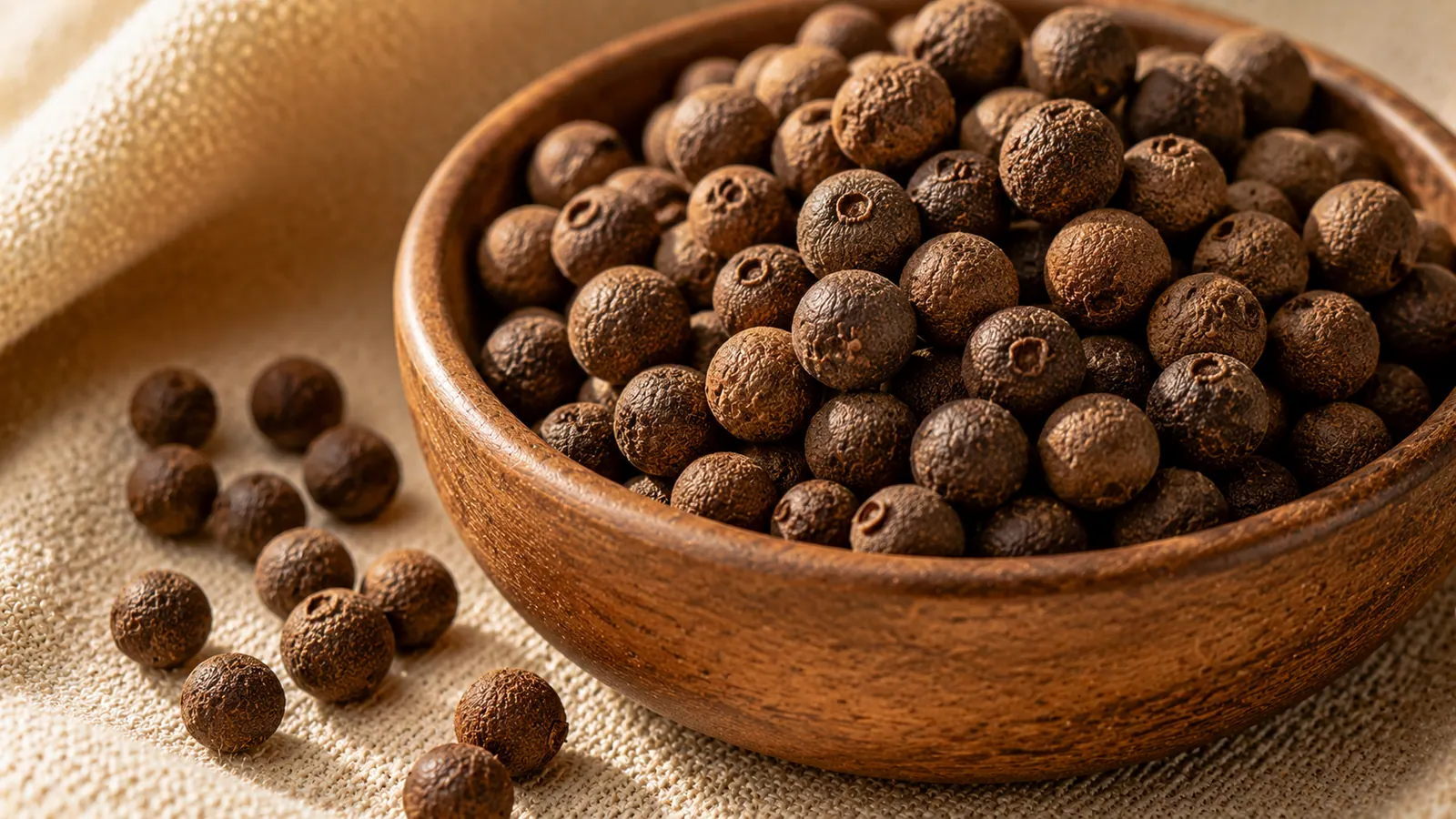
Allspice is the dried unripe berry of Pimenta dioica, an evergreen of the Myrtaceae native to the Caribbean and Central America. Its English name captures its defining feature: a single berry tastes of several spices at once, a warm compound of clove, cinnamon and nutmeg, driven largely by a high eugenol content shared with clove. The berry is picked green and mature but unripe, then sun-dried until it rattles, turning a dull reddish-brown; both berry and leaf are aromatic, and leaf oil is a recognised derivative alongside the more familiar berry.
Because allspice is a New-World spice, India is only a marginal grower, with small plantings in the humid south, and most allspice moving through Indian trade is re-exported or blended rather than India-origin. This shapes how a buyer should read any Indian offer: the value a sourcing desk adds on allspice is in cleaning, grading, blending and reliable supply rather than in a distinctive Indian origin story. Buyers who need a specific botanical origin should ask, because "supplied from India" and "grown in India" are not the same thing for this spice.
Sensory quality turns on the volatile-oil content that carries the clove-led aroma, on the berry being whole, clean and uniformly sized, and on freedom from stalk and foreign matter. Like other whole berries dried in the open, allspice needs sound curing and dry storage to hold aroma and avoid mould. In the trade it is used both whole and ground, and as an oleoresin/oil where a standardised flavour dose is wanted, which is common in manufactured seasonings.
Forms & export grades
Whole dried berries, the reference form, graded on size and aroma.
Milled allspice for direct seasoning use; specify freshness.
Extracted oleoresin/oil for standardised flavour dosing in manufacturing.
Varieties & types
- Whole allspice berry
- Dried unripe berries sold whole; graded on size uniformity, cleanliness and aroma.
- Ground allspice
- Milled berry for direct blend use, bought on freshness and aroma retention.
Growing regions
Allspice is not a traditional Indian field crop; small plantings exist in humid southern pockets, but volumes are marginal and much of the allspice in Indian trade is re-exported rather than locally grown. There is accordingly no meaningful Indian growing-season story to quote, and buyers wanting a specific origin should confirm whether a lot is India-grown or re-export.
Uses & applications
- Whole berries in pickling spice, brines, mulled drinks and slow-cooked meat dishes
- Ground allspice in bakery, cakes, puddings and dessert spice blends
- Caribbean and jerk-style seasoning blends where allspice is the defining note
- Charcuterie, sausage and processed-meat seasoning in the food-manufacturing supply chain
- Sauce, ketchup and condiment flavouring
- Allspice oleoresin and berry/leaf essential oil for standardised flavour and fragrance dosing
- Beverage and liqueur flavouring
Sourcing & export considerations
- Available whole and ground, plus oleoresin/oil for standardised flavour; whole berry is the reference form for graders.
- Much allspice supplied from India is re-export or blend stock rather than India-grown, so buyers wanting a specific botanical origin should confirm provenance on the contract.
- Graded on volatile-oil aroma, berry size uniformity, cleanliness and freedom from stalk and foreign matter; there is no single verified trade spec, so grade is described qualitatively.
- As a whole berry dried in the open it needs sound curing and dry storage; where sterilisation is required, steam treatment can be coordinated with vetted third parties.
- Reports under residual HS 0910 99, which means it lacks separable bilateral trade data; describe supply qualitatively rather than by tonnage.
- Packaging in food-grade lined bags/cartons with moisture protection; ground allspice needs faster turnover than whole berry.
- Order sizes and any MOQ are trade practice; on the contract specify whole vs ground vs oleoresin, aroma/cleanliness target and provenance (India-grown vs re-export).
ITC-HS classification
- 0910 99 99 — Spices — other, not elsewhere specified (residual basket line)
Frequently asked
Why is it called allspice?
A single dried berry of Pimenta dioica tastes of several spices at once, a warm blend of clove, cinnamon and nutmeg, driven by a high eugenol content shared with clove. It is one spice, not a mixture, despite the name.
Is allspice actually grown in India?
Only marginally. Allspice is a New-World spice, and most allspice moving through Indian trade is re-exported or blend stock rather than India-grown. Buyers who need a specific botanical origin should confirm provenance rather than assume Indian cultivation.
What this page does not tell you
- Origin
- Largely re-exported; little India-grown.
Related spices
Sources
- Spices Board of India — Export statistics· Tier 1, retrieved 2026-07-16
- Spices Board Act, 1986 — Schedule of spices· Tier 1, retrieved 2026-07-16
- Spices Board — ITC-HS classification of spices· Tier 1, retrieved 2026-07-16