Ajowan export from India
Trachyspermum ammi · Apiaceae · Fruit
The thymol-bearing carom seed — sharp, thyme-like, and a source of extracted thymol.
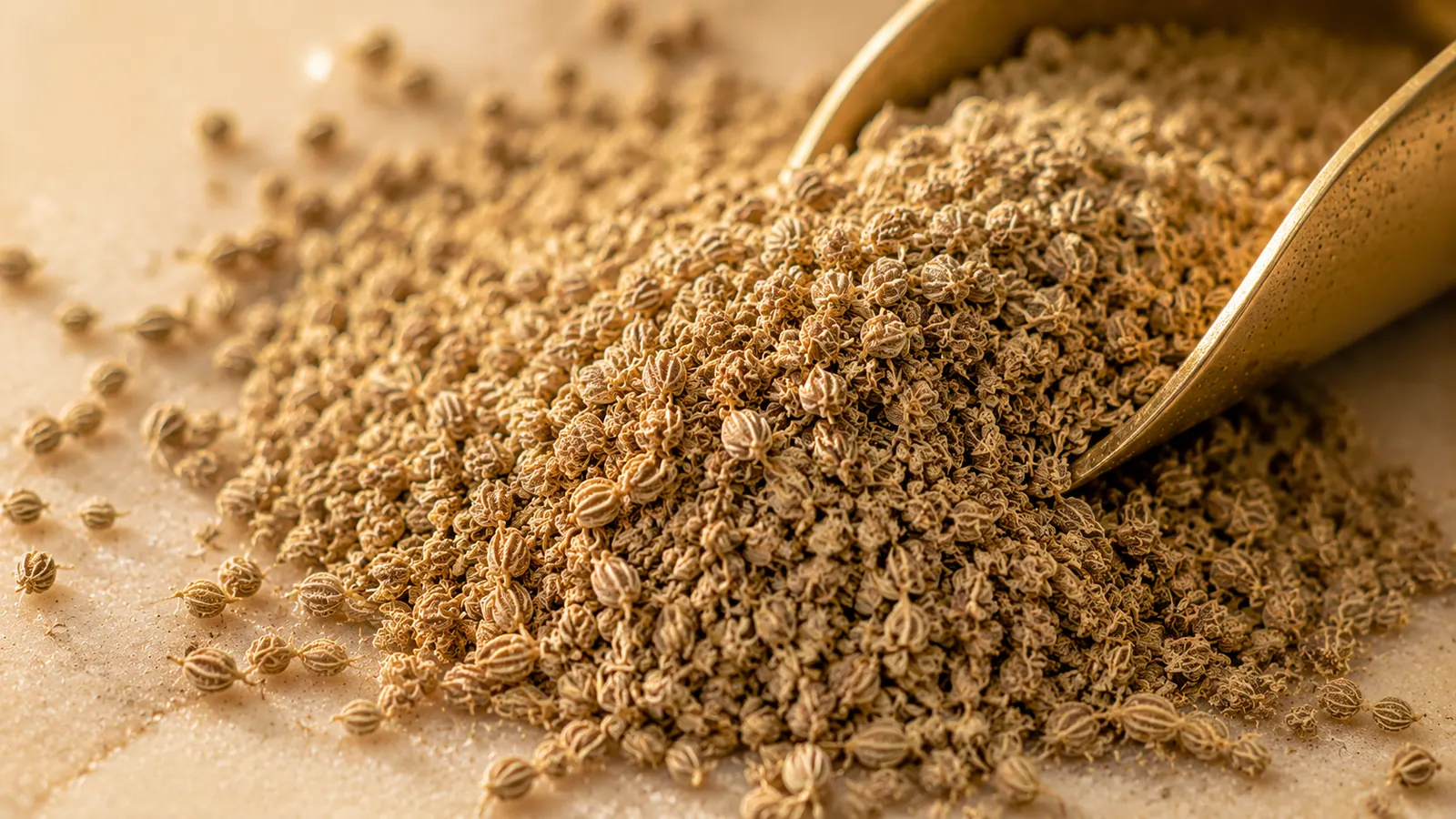
Ajowan at a glance
- Botanical name
- Trachyspermum ammi
- Family
- Apiaceae
- Part used
- Fruit
- Also known as
- Ajwain, Carom seed, Bishop’s weed
- ITC-HS
- 0910 99 13
- Spices Board schedule
- #12
What is Ajowan and how is it exported from India?
Ajowan (ajwain) is the fruit of Trachyspermum ammi, rich in thymol. It is used whole in Indian breads and savouries and processed for thymol extraction.
Overview
Ajowan, better known in India as ajwain or carom, is the fruit of Trachyspermum ammi, an umbellifer whose seed looks like a miniature caraway but tastes almost entirely of thyme. That thyme character comes from a high content of thymol in the volatile oil, and it is thymol, not the visual grade, that defines a good lot: the seed should be sharp, pungent and warming, with a strong medicinal-herbal punch that carries through cooking. Raw, it is aggressively bitter and is used in tiny quantities; heated in oil it blooms into a rounded thyme-savoury note.
The commercial seed is small, oval, ridged and greyish-green to khaki. Cleanliness is a real grading issue because the fruit is tiny and grows with sand, stalk and weed seed, so sortex and gravity separation quality separates export lots. For the extraction and pharmaceutical trade the seed is a feedstock for thymol and for ajowan (ajwain) oil, so those buyers specify on thymol and volatile-oil assay rather than on appearance.
India is the principal world origin and the dominant consumer, and ajowan sits at the crossroads of food and traditional medicine. On the culinary side it is a defining seed in breads, savoury fried snacks and tempering; on the ingredient side it feeds a thymol and essential-oil trade and a long tradition of digestive and carminative preparations. It reports under a residual tariff line, so there is no clean stand-alone export series for it.
Forms & export grades
Whole cleaned/sortex carom seed, the mainstream culinary and export form.
Milled powder for blends and bread masalas, milled close to use to hold thymol aroma.
Steam-distilled ajowan oil, thymol-rich, for flavour, fragrance and functional use.
Varieties & types
- Common Indian carom seed
- The mainstream export type, a small thymol-bearing fruit graded on cleanliness and pungency rather than a named cultivar.
- High-thymol extraction grade
- Lots bought by the thymol and essential-oil trade on assayed thymol and volatile-oil content.
Growing regions
Ajowan is grown as a cool-season rabi crop in the semi-arid west and centre of India, with Rajasthan and Gujarat the principal producing states and pockets across the seed-spice belt. It is sown after the monsoon and harvested in late winter to spring, so new-crop seed enters the market in the first half of the year. The thymol strength that ingredient buyers pay for varies with growing conditions and post-harvest drying.
Uses & applications
- A defining seed in Indian breads and flatbreads (paratha, puri, thepla) and in savoury fried snacks (namkeen, sev, mathri)
- Tempering (tadka) and pickling spice where a thyme-savoury note is wanted
- Ethnic-food and spice-blend manufacturing for the diaspora retail and HORECA trade
- Digestive, carminative and gripe preparations in the traditional-medicine and nutraceutical trade
- Thymol extraction as a feedstock for antiseptic, oral-care and pharmaceutical use
- Ajowan (ajwain) essential oil for flavour, fragrance and functional applications
- A thyme-substitute savoury note in some seasoning formulations
- Whole seed for the retail spice and mukhwas trade
Sourcing & export considerations
- Available as whole cleaned/sortex seed, as ground powder, and as thymol and ajowan oil through the extraction trade
- Cleaning by air-screen, gravity and colour sorting to strip sand, stalk and weed seed; the small fruit makes admixture removal a key grade point
- Ingredient buyers should specify a thymol or volatile-oil floor and a fresh crop, since the pungent top note is what the spice is bought for
- Whole seed is robust in cool, dry, barrier packaging; ground ajowan loses aroma faster and is best milled close to use
- Packed in food-grade lined bags, palletised for sea freight; a dense seed that loads to container weight
- MOQ is trade practice: sample lots around 50-100 kg, private-label from about 100 kg, larger blend and extraction contracts by tonnage (cbi)
- For EU and US buyers, specify pesticide-residue and Salmonella-absent testing; steam-based microbial reduction is coordinated with vetted third-party facilities
- Ajowan reports under residual HS 0910 99 (0910 99 13 in the Indian tariff), so no clean bilateral volume series exists for the seed alone
ITC-HS classification
- 0910 99 13 — Ajwain (Bishop’s weed)
Frequently asked
Why does ajowan taste like thyme?
Its volatile oil is high in thymol, the same aroma compound that dominates thyme. That is why carom seed reads as intensely thyme-like and savoury despite looking like a small caraway or celery seed.
Is ajowan the same as caraway or celery seed?
No. All three are small umbellifer fruits and look similar, but ajowan (Trachyspermum ammi) is thymol-dominant, caraway (Carum carvi) is carvone-dominant, and celery seed (Apium graveolens) carries a green celery note. Name the species on the contract.
What should an extraction buyer specify for ajowan?
Specify a thymol and total volatile-oil assay floor and a fresh crop, since the seed is bought as a thymol and essential-oil feedstock. Visual grade matters far less than the assayed active content for that channel.
What this page does not tell you
- Trade volume
- Reports under HS 0910 99; no separable ajowan figure exists.
Related spices
Sources
- Spices Board of India — Export statistics· Tier 1, retrieved 2026-07-16
- Spices Board Act, 1986 — Schedule of spices· Tier 1, retrieved 2026-07-16
- CBI — Entering the European market for spices and herbs· Tier 2, retrieved 2026-07-16
- UN Comtrade — reporter India, Chapter 09· Tier 1, retrieved 2026-07-16